Loading...
Hastings Banda vs V. V. Giri
V. V. Giri leads by 2.1 pts · 2 figures compared
…
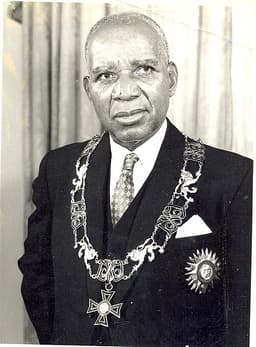
Hastings Banda
Politician · Modern
49.3Total

V. V. Giri
Politician · Modern
51.4Total
Basic Information
Born
1898
1894
Died
1997
1980
Era
Modern
Modern
Nationality
Malawi
India
Occupation
Politician
Politician
Civilization
Other
Indian
Score Comparison
Military (10%)
13.4
49.6
Political (20%)
48.0
45.1
Influence (20%)
54.9
52.5
Legacy (20%)
45.0
43.3
Leadership (15%)
74.0
65.0
Strategy (15%)
47.0
60.0
TOTAL
49.3
51.4
Hastings Banda — Complete Timeline
1958 AD
Returned to Malawi and led independence movementPolitical Action◆ Major
Banda returned to Nyasaland after decades abroad and assumed leadership of the Nyasaland African Congress. He led the push for independence from British colonial rule, becoming the central figure in the nationalist movement.
IndependenceNationalismDecolonization
Impact: nationalconstructive
1963 AD
Became first Prime Minister of independent MalawiPolitical Action
Following constitutional changes and elections, Banda became Prime Minister of self-governing Nyasaland. On July 6, 1964, Malawi achieved full independence from Britain, with Banda as its first Prime Minister.
IndependenceGovernment Formation
Impact: nationalconstructive
1966 AD
Declared Malawi a one-party statePolitical Action◆ Major
Banda declared Malawi a republic and himself President. He consolidated power by making the Malawi Congress Party the sole legal party, banning all opposition and establishing an authoritarian regime that lasted for three decades.
AuthoritarianismOne-Party StateRepression
Impact: nationaldestructive
1967 AD
Established diplomatic relations with apartheid South AfricaPolitical Action◆ Major
Banda became the first African leader to establish formal diplomatic relations with apartheid South Africa. This controversial decision provided Malawi with economic aid and trade benefits but drew sharp criticism from other African nations.
Foreign PolicyApartheidDiplomacy
Impact: regional
1994 AD
Lost power in multi-party electionsPolitical Action◆ Major
After decades of authoritarian rule, Banda was defeated in Malawi's first multi-party elections since independence. Bakili Muluzi of the United Democratic Front won the presidency, ending Banda's 31-year rule.
ElectionTransitionDemocracy
Impact: national
V. V. Giri — Complete Timeline
1956 AD
Appointed Governor of Uttar PradeshPolitical Action
V. V. Giri was appointed as the Governor of Uttar Pradesh, serving from 1956 to 1960. He later served as Governor of Kerala and Mysore, handling administrative responsibilities in various states.
GovernorUttar PradeshConstitutional
Impact: regionalconstructive
1967 AD
Appointed Vice President of IndiaPolitical Action◆ Major
V. V. Giri was elected as the Vice President of India, serving from 1967 to 1969. He also served as Chairman of the Rajya Sabha, presiding over the upper house.
Vice PresidentRajya SabhaConstitutional
Impact: nationalconstructive
1969 AD
Nationalization of banksReform◆ Major
President V. V. Giri supported the nationalization of 14 major commercial banks in India in 1969, a key socialist policy of the Indira Gandhi government. This aimed to increase credit access for agriculture and small industries.
Bank NationalizationEconomic ReformSocialism
Impact: nationalconstructive
Acting President of IndiaPolitical Action◆ Major
V. V. Giri served as Acting President of India following the death of President Zakir Husain in May 1969. He held the office until the election of a new president.
Acting PresidentConstitutionalTransition
Impact: national
Elected President of IndiaPolitical Action◆ Major
V. V. Giri was elected as the 4th President of India in a contested election, defeating the official Congress candidate. He served from 1969 to 1974, promoting socialist policies and labor rights.
PresidencyElectionSocialist
Impact: nationalconstructive
Expert Analysis
Origins
Hastings Kamuzu Banda was born around 1898 in Kasungu, Nyasaland (now Malawi). He left for South Africa at age 13 and later studied in the United States and Britain, earning a medical degree. His long absence shaped his outsider perspective. V. V. Giri, born in 1894 in Berhampur, India, studied law in Ireland and was active in the Indian independence movement. Giri's early involvement with labor unions and the Indian National Congress provided a grassroots foundation.
Rise to Power
Banda returned to Nyasaland in 1958 after decades abroad, assuming leadership of the Nyasaland African Congress. He led the push for independence, becoming Prime Minister in 1963 and President in 1966. His rise was swift, fueled by his image as a messianic leader. Giri rose through constitutional roles: Governor of Uttar Pradesh (1956-1960), Governor of Kerala and Mysore, then Vice President of India (1967). After President Zakir Husain's death in 1969, Giri served as Acting President and was elected President in a contested election, defeating the official Congress candidate.
Leadership & Governance
Banda's leadership was autocratic. He declared Malawi a one-party state in 1966, banned opposition, and controlled the judiciary and media. He established diplomatic relations with apartheid South Africa in 1967, trading moral condemnation for economic aid. This policy, while pragmatic, isolated Malawi from other African nations. Giri's leadership was democratic and constitutional. As President, he supported Prime Minister Indira Gandhi's socialist policies, notably the nationalization of 14 major banks in 1969. He used his position to uphold secularism and federalism, though his role was largely ceremonial. Banda's Leadership score of 74.0 reflects his firm control, while Giri's 65.0 reflects his constrained but principled influence.
Triumph & Tragedy
Banda's triumph was leading Malawi to independence and fostering economic growth through agricultural exports and infrastructure. However, his tragedy was his authoritarian turn: he repressed dissent, detained opponents, and his health policies (e.g., banning condom imports) contributed to a high HIV/AIDS rate. Giri's triumph was his role in bank nationalization, which expanded state control over finance and aided rural development. His tragedy was the erosion of his independence; he was seen as a supporter of Congress policies rather than a check on power. Giri scored 43.3 in Legacy, Banda 45.0.
Character & Destiny
Banda was aloof, secretive, and intolerant of dissent. His long absence from Malawi made him an outsider, and he ruled through a cult of personality. His destiny was to be overthrown by democracy in 1994. Giri was a conciliator and institutionalist. His character led him to work within the system, but his destiny was to be a transitional figure overshadowed by Indira Gandhi. Banda's strategic score of 47.0 and Giri's 60.0 reflect their different approaches to power.
Legacy
Banda's legacy is mixed: he is credited with nation-building but condemned for human rights abuses. Malawi's democratic transition after his rule is a testament to the rejection of his autocracy. Giri's legacy is tied to bank nationalization, which shaped India's socialist era. He is remembered as a dignified president who upheld constitutional norms. However, neither figure left a lasting institutional framework: Banda's personalist rule crumbled, and Giri's influence was limited by the ceremonial presidency.
Conclusion
V. V. Giri had a slightly higher overall impact, scoring 51.4 to Banda's 49.3. Giri's role in bank nationalization had concrete economic consequences for India's development, while Banda's authoritarianism, despite initial stability, ultimately hindered Malawi's long-term growth. Giri's democratic legacy aligns with enduring values, whereas Banda's autocratic model proved unsustainable. Thus, Giri's influence, though less dramatic, was more positive and lasting.
Rankings
🥇
V. V. GiriLeader
Mil: 49.6Pol: 45.1Inf: 52.5
51.4
🥈
Hastings Banda
Mil: 13.4Pol: 48.0Inf: 54.9
49.3
+2.1 behind
How This Comparison Works
Algorithm
Each figure is scored on 6 dimensions (0—100 scale) based on structured historical data: Military (10%), Political (20%), Influence (20%), Legacy (20%), Leadership (15%), Strategy (15%). The weighted total produces the final ranking.
Data Sources
Scores are computed from structured sub-indicators in the database. Scale factors adjust for era (Ancient ×0.85, Modern ×1.0) and civilization size (Eastern ×1.05, Other ×0.80) to account for differences in population and military scale.
Maximum 3 Figures
Comparisons are limited to 2—3 figures to ensure readability and statistical meaningfulness.
Error Margins
±5 points per dimension — Sub-scores are derived from historical records with inherent uncertainty. Two figures within 5 points on a dimension should be considered roughly equivalent in that area.
Total Score Accuracy
±3 points overall — The weighted combination of 6 dimensions produces a total score with approximately ±3 points of uncertainty. Differences of less than 3 points are not statistically significant— the figures are effectively tied.
Known Limitations
- Historical records are incomplete and uneven across civilizations
- Figures from oral-tradition societies may be underrepresented
- Occupation labels can misclassify multi-role figures
- Scores measure capability and impact, not moral character
- Quantitative scoring is a comparison tool, not absolute truth
Capability Radar
Military (10%) — Battles & Warfare
Battles
27
44
Win Rate
29
44
Expansion
31
49
Political (20%) — Governance & Reform
Reform
50
35
Diplomacy
40
45
Economy
30
30
Influence (20%) — Cultural & Global Reach
Cultural
40
25
Global
30
20
Legacy (20%) — Historical Impact
Historical
50
30
Longevity
30
20
Leadership (15%) — Power & Stability
Tenure
70
40
Stability
20
40
Strategy (15%) — Tactics & Innovation
Strategy
36
52
Tactics
36
57
Reform
42
57
Similar Comparisons
Comments & Discussion
No comments yet. Be the first to share your thoughts!