Loading...
Hayato Ikeda vs Lal Krishna Advani
Lal Krishna Advani leads by 2.1 pts · 2 figures compared
…
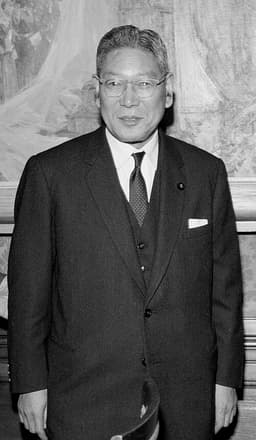
Hayato Ikeda
Politician · Modern
56.3Total

Lal Krishna Advani
Politician · Modern
58.4Total
Basic Information
Born
1899
1927
Died
1965
—
Era
Modern
Modern
Nationality
Japan
India
Occupation
Politician
Politician
Civilization
Eastern
Indian
Score Comparison
Military (10%)
12.5
38.8
Political (20%)
78.0
65.0
Influence (20%)
59.0
56.7
Legacy (20%)
52.0
55.0
Leadership (15%)
79.8
72.0
Strategy (15%)
35.9
60.0
TOTAL
56.3
58.4
Hayato Ikeda — Complete Timeline
1960 AD
Launch of the Income-Doubling PlanReform
Prime Minister Hayato Ikeda announced the 'Income-Doubling Plan' in December 1960, a ten-year economic program aiming to double the national income through rapid industrial growth, increased productivity, and expanded trade. The plan successfully guided Japan's high-growth era, achieving its target in seven years and transforming the country into an economic powerhouse.
Economic PolicyGrowthJapan
Impact: nationalconstructive
Liberalization of Trade and CapitalReform◆ Major
Ikeda's government pursued gradual liberalization of trade and capital flows, aligning Japan with international economic norms. This included joining the General Agreement on Tariffs and Trade (GATT) and the International Monetary Fund (IMF) Article VIII, which required removing restrictions on current account transactions, boosting foreign trade.
Trade PolicyLiberalizationEconomic Integration
Impact: nationalconstructive
Political Reconciliation with the OppositionPolitical Action
After the violent protests against the US-Japan Security Treaty in 1960, Ikeda adopted a 'low posture' approach, seeking dialogue with the opposition Socialist Party. He focused on economic growth and social welfare to reduce political polarization, successfully stabilizing Japanese politics during his tenure.
Political StrategyStabilityJapan
Impact: nationalconstructive
Lal Krishna Advani — Complete Timeline
1990 AD
Leadership of the Ram Rath YatraPolitical Action
Lal Krishna Advani led the Ram Rath Yatra, a political-religious procession from Somnath to Ayodhya, to mobilize support for building a Ram temple at the disputed Babri Masjid site. The yatra sparked communal tensions and was stopped by the Bihar government.
AyodhyaRam TempleCommunal Politics
Impact: nationaldestructive
1998 AD
Appointment as Minister of Home AffairsPolitical Action◆ Major
Lal Krishna Advani was appointed Union Minister of Home Affairs in the Vajpayee government, serving until 2004. He oversaw internal security, including the Kargil War (1999) and the 2001 Indian Parliament attack.
Home MinisterInternal SecurityKargil
Impact: national
2002 AD
Appointment as Deputy Prime Minister of IndiaPolitical Action◆ Major
Lal Krishna Advani was appointed Deputy Prime Minister of India in the Vajpayee government, serving until 2004. He also held the Home Ministry portfolio, overseeing internal security during a period of communal violence.
Deputy Prime MinisterHome MinisterSecurity
Impact: national
2004 AD
Appointment as Leader of the Opposition in Lok SabhaPolitical Action◆ Major
Lal Krishna Advani was appointed Leader of the Opposition in the Lok Sabha after the BJP's defeat in the 2004 general election. He served in this role until 2009, leading the opposition against the UPA government.
Leader of OppositionLok SabhaBJP
Impact: national
2009 AD
Resignation as BJP President After 2009 Election DefeatPolitical Action
Lal Krishna Advani resigned as President of the Bharatiya Janata Party after the party's defeat in the 2009 general election. He took responsibility for the electoral loss, though he remained a senior leader.
ResignationBJPElection Defeat
Impact: national
Expert Analysis
Origins
Hayato Ikeda was born on December 3, 1899, in Yoshina, Hiroshima Prefecture, Japan, into a sake-brewing family. He studied law at Kyoto Imperial University, graduating in 1925, and entered the Ministry of Finance. His early career was shaped by bureaucratic expertise rather than political lineage. Lal Krishna Advani was born on November 8, 1927, in Karachi, British India (now Pakistan), into a Sindhi Hindu family. He studied at D.G. National College in Hyderabad, Sindh, and was influenced by the Rashtriya Swayamsevak Sangh (RSS), joining its Karachi branch in 1941. The partition of India in 1947 forced his family to migrate to India, a formative trauma that shaped his Hindu nationalist worldview.
Rise to Power
Ikeda's rise came through the Ministry of Finance, where he served as a key economic planner under Prime Minister Shigeru Yoshida. He entered politics in 1949, winning a seat in the Diet, and held finance portfolios in the 1950s. His turning point came in July 1960 when he became Prime Minister after the resignation of Nobusuke Kishi, following violent protests against the US-Japan Security Treaty. Advani's rise began in the RSS and the Bharatiya Jana Sangh (BJS), a Hindu nationalist party. He was elected to the Rajya Sabha in 1970 and later served as the BJP's president. His major turning point was the Ram Rath Yatra in 1990, a chariot procession from Somnath to Ayodhya demanding a Ram temple at the disputed Babri Masjid site. This mobilized Hindu voters and propelled the BJP from a marginal party to the ruling coalition.
Leadership & Governance
Ikeda's leadership was defined by economic pragmatism. He launched the Income-Doubling Plan in December 1960, a ten-year program targeting 7.2% annual growth (actual growth averaged over 10%). He liberalized trade and capital gradually, aligning Japan with GATT and IMF norms. Politically, he adopted a 'low posture' after the 1960 protests, seeking dialogue with the opposition Socialist Party, reducing domestic conflict. His governance scored Political 78.0 and Leadership 79.8. Advani's leadership focused on cultural nationalism. As Home Minister (1998-2004), he oversaw internal security during the Kargil War and the 2002 Gujarat riots. He was a key strategist for the BJP, but his governance was controversial: critics blamed him for not preventing the 1992 Babri Masjid demolition (though he had resigned as BJP president before it). His Political score is 65.0 and Leadership 72.0. In comparison, Ikeda's governance was more systematic and less divisive.
Triumph & Tragedy
Ikeda's greatest success was the Income-Doubling Plan, which achieved 10.1% average GDP growth from 1960-1970, transforming Japan into the world's second-largest economy. His tragedy was that he did not live to see its full fruition; he resigned as PM in 1964 due to throat cancer and died in 1965. He also failed to address the US-Japan Security Treaty's unequal terms, which remained a source of tension. Advani's triumph was the Ram Rath Yatra, which made the BJP a national force; the party won 120 seats in 1991 (up from 85 in 1989). His tragedy was the 1992 Babri Masjid demolition, which led to nationwide riots and his own resignation as BJP president. He also failed to become Prime Minister despite being the BJP's face; his party chose Atal Bihari Vajpayee instead. Advani's Military score of 38.8 reflects his hawkish stance on Pakistan and nuclear tests, but his overall impact was more polarizing than Ikeda's.
Character & Destiny
Ikeda was a technocrat, cautious and detail-oriented. He avoided ideological confrontation, focusing on economic growth as a unifying goal. His 'low posture' style contrasted with his predecessor Kishi's confrontational approach. His character shaped a destiny of quiet transformation: he died before seeing his plan's success, but his legacy was cemented by Japan's economic miracle. Advani was a ideologue, driven by Hindu nationalism. He was disciplined, strategic, and willing to take risks (like the Yatra). His character led to a destiny of political upheaval: he built a major party but also faced the consequences of communal polarization. His Strategy score of 60.0 (vs Ikeda's 35.9) reflects his tactical acumen, but his rigidity limited his ability to become PM.
Legacy
Ikeda's legacy is Japan's economic growth model. The Income-Doubling Plan set a precedent for state-guided capitalism. He liberalized trade, paving the way for Japan's export boom. His political style of consensus-building influenced later PMs. Advani's legacy is the rise of Hindu nationalism as a mainstream force. The Ram temple issue led to the 1992 demolition and subsequent legal battles. He transformed the BJP from a marginal party to a ruling one, but also deepened religious divides. His legacy score of 55.0 (vs Ikeda's 52.0) is slightly higher, but the nature of his impact is more contested. Ikeda's legacy is universally praised; Advani's is debated.
Conclusion
Hayato Ikeda had a greater positive impact on his nation's development. His Income-Doubling Plan lifted millions out of poverty and created a stable, prosperous Japan. His Political score (78.0) and Leadership (79.8) exceed Advani's (65.0 and 72.0). While Advani's total score (58.4) is slightly higher than Ikeda's (56.3), the gap is driven by Military (38.8 vs 12.5) and Strategy (60.0 vs 35.9), areas less relevant to peacetime governance. Ikeda's economic policies had measurable, enduring effects; Advani's political mobilization, while influential, was divisive and did not produce comparable material improvement. Ikeda's legacy is a testament to constructive governance; Advani's is a symbol of ideological polarization. Thus, Ikeda's impact was more profound and beneficial.
Rankings
🥇
Lal Krishna AdvaniLeader
Mil: 38.8Pol: 65.0Inf: 56.7
58.4
🥈
Hayato Ikeda
Mil: 12.5Pol: 78.0Inf: 59.0
56.3
+2.1 behind
How This Comparison Works
Algorithm
Each figure is scored on 6 dimensions (0—100 scale) based on structured historical data: Military (10%), Political (20%), Influence (20%), Legacy (20%), Leadership (15%), Strategy (15%). The weighted total produces the final ranking.
Data Sources
Scores are computed from structured sub-indicators in the database. Scale factors adjust for era (Ancient ×0.85, Modern ×1.0) and civilization size (Eastern ×1.05, Other ×0.80) to account for differences in population and military scale.
Maximum 3 Figures
Comparisons are limited to 2—3 figures to ensure readability and statistical meaningfulness.
Error Margins
±5 points per dimension — Sub-scores are derived from historical records with inherent uncertainty. Two figures within 5 points on a dimension should be considered roughly equivalent in that area.
Total Score Accuracy
±3 points overall — The weighted combination of 6 dimensions produces a total score with approximately ±3 points of uncertainty. Differences of less than 3 points are not statistically significant— the figures are effectively tied.
Known Limitations
- Historical records are incomplete and uneven across civilizations
- Figures from oral-tradition societies may be underrepresented
- Occupation labels can misclassify multi-role figures
- Scores measure capability and impact, not moral character
- Quantitative scoring is a comparison tool, not absolute truth
Capability Radar
Military (10%) — Battles & Warfare
Battles
16
41
Win Rate
16
49
Expansion
21
51
Political (20%) — Governance & Reform
Reform
75
75
Diplomacy
70
70
Economy
85
60
Influence (20%) — Cultural & Global Reach
Cultural
30
70
Global
55
55
Legacy (20%) — Historical Impact
Historical
65
75
Longevity
55
65
Leadership (15%) — Power & Stability
Tenure
60
85
Stability
70
65
Strategy (15%) — Tactics & Innovation
Strategy
23
50
Tactics
26
58
Reform
28
59
Similar Comparisons
Comments & Discussion
No comments yet. Be the first to share your thoughts!