Loading...
This comparison has not been analyzed yet.
One-time AI generation (~1 minute). Scores and timeline are already available below.
Henry IV of HRE vs Stefan Uros IV Dusan
Henry IV of HRE leads by 2.4 pts · 2 figures compared
…

Henry IV of HRE
Emperor · Medieval
65.3Total
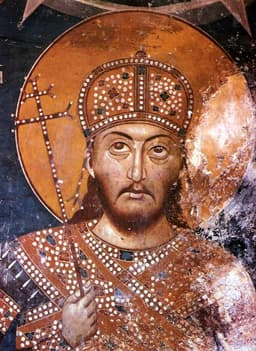
Stefan Uros IV Dusan
Emperor · Medieval
62.9Total
Basic Information
Born
1050
1308
Died
1106
1355
Era
Medieval
Medieval
Nationality
Holy Roman Empire
Serbia
Occupation
Emperor
Emperor
Civilization
Western
Western
Score Comparison
Military (10%)
50.0
76.0
Political (20%)
54.7
69.2
Influence (20%)
72.0
55.0
Legacy (20%)
72.0
55.0
Leadership (15%)
67.0
72.0
Strategy (15%)
60.0
65.9
TOTAL
65.3
62.9
Henry IV of HRE — Complete Timeline
1075 AD
Battle of LangensalzaWar◆ Major
Henry IV defeated Saxon rebels at Langensalza in Thuringia. The victory temporarily ended the Saxon Rebellion, but the conflict resumed later. The battle demonstrated Henry's military capability early in his reign.
Saxon RebellionBattle
Impact: regional
1076 AD
Excommunication by Pope Gregory VIIPolitical Action◆ Major
Pope Gregory VII excommunicated Henry IV after Henry attempted to depose the Pope. The excommunication freed Henry's subjects from their oaths of loyalty, leading to a rebellion by German princes. This forced Henry to seek reconciliation at Canossa.
Investiture ControversyPapacyRebellion
Impact: globaldestructive
1077 AD
Walk to CanossaPolitical Action
Henry IV traveled to Canossa Castle in northern Italy to seek absolution from Pope Gregory VII. He stood barefoot in the snow for three days before the Pope lifted his excommunication. This event symbolized the power struggle between secular and religious authority.
Investiture ControversyPapacyPenance
Impact: global
1084 AD
Siege of RomeWar◆ Major
Henry IV besieged Rome and captured the city. He was crowned Holy Roman Emperor by Antipope Clement III. Pope Gregory VII took refuge in the Castel Sant'Angelo and was rescued by Norman forces under Robert Guiscard, who sacked Rome.
Investiture ControversyRomeCrowning
Impact: regionaldestructive
Stefan Uros IV Dusan — Complete Timeline
1346 AD
Coronation as Emperor of Serbs and GreeksPolitical Action
Stefan Dušan was crowned Emperor (Tsar) of Serbs and Greeks in Skopje by the newly elevated Serbian Patriarch Joanikije II. This coronation asserted Serbian imperial ambitions over Byzantine territories. The act created the Serbian Empire, claiming succession to the Byzantine Empire and challenging Constantinople's authority.
Imperial coronationSerbian EmpireByzantine succession
Impact: regionalconstructive
Elevation of the Serbian Archbishopric to PatriarchatePolitical Action◆ Major
Dušan convened a church council in Skopje that elevated the Serbian Archbishopric to a Patriarchate, with Joanikije II as the first Patriarch. This act was done without Constantinople's approval, causing a schism. The Serbian Patriarchate provided ecclesiastical independence for the empire and legitimized Dušan's imperial coronation.
Patriarchate establishmentChurch independenceSchism
Impact: regionalconstructive
1348 AD
Conquest of Macedonia and EpirusWar◆ Major
Dušan's armies conquered most of Macedonia, including the cities of Serres, Drama, and Kavala, as well as Epirus and Thessaly. These conquests expanded the Serbian Empire to its greatest territorial extent, covering much of the Balkan Peninsula. The acquisitions gave Serbia access to the Aegean Sea and control over key trade routes.
Territorial expansionMacedoniaAegean access
Impact: regional
1349 AD
Promulgation of Dušan's Code (Zakonik)Reform◆ Major
Dušan issued the Zakonik, a comprehensive legal code consisting of 201 articles. The code regulated all aspects of society, including feudal relations, church rights, and criminal law. It was based on Byzantine law but adapted to Serbian conditions. The code remained in use until the Ottoman conquest and influenced later Balkan legal systems.
Legal codeByzantine influenceFeudal regulation
Impact: regionalconstructive
1355 AD
Death and collapse of the Serbian EmpireOther
Dušan died suddenly at age 47, possibly from poisoning or illness, near Constantinople while preparing a campaign against the Byzantine capital. His death left the Serbian Empire without a strong successor. His son Stefan Uroš V proved unable to control the nobility, leading to the empire's fragmentation into rival principalities within two decades.
Empire collapseSuccession crisisFragmentation
Impact: regionaltragic
This comparison has not been analyzed yet.
One-time AI generation (~1 minute). Scores and timeline are already available below.
Rankings
🥇
Henry IV of HRELeader
Mil: 50.0Pol: 54.7Inf: 72.0
65.3
🥈
Stefan Uros IV Dusan
Mil: 76.0Pol: 69.2Inf: 55.0
62.9
+2.4 behind
How This Comparison Works
Algorithm
Each figure is scored on 6 dimensions (0—100 scale) based on structured historical data: Military (10%), Political (20%), Influence (20%), Legacy (20%), Leadership (15%), Strategy (15%). The weighted total produces the final ranking.
Data Sources
Scores are computed from structured sub-indicators in the database. Scale factors adjust for era (Ancient ×0.85, Modern ×1.0) and civilization size (Eastern ×1.05, Other ×0.80) to account for differences in population and military scale.
Maximum 3 Figures
Comparisons are limited to 2—3 figures to ensure readability and statistical meaningfulness.
Error Margins
±5 points per dimension — Sub-scores are derived from historical records with inherent uncertainty. Two figures within 5 points on a dimension should be considered roughly equivalent in that area.
Total Score Accuracy
±3 points overall — The weighted combination of 6 dimensions produces a total score with approximately ±3 points of uncertainty. Differences of less than 3 points are not statistically significant— the figures are effectively tied.
Known Limitations
- Historical records are incomplete and uneven across civilizations
- Figures from oral-tradition societies may be underrepresented
- Occupation labels can misclassify multi-role figures
- Scores measure capability and impact, not moral character
- Quantitative scoring is a comparison tool, not absolute truth
Capability Radar
Military (10%) — Battles & Warfare
Battles
55
75
Win Rate
50
80
Expansion
35
85
Political (20%) — Governance & Reform
Reform
40
88
Diplomacy
70
70
Economy
30
75
Influence (20%) — Cultural & Global Reach
Cultural
60
70
Global
55
60
Legacy (20%) — Historical Impact
Historical
75
75
Longevity
65
65
Leadership (15%) — Power & Stability
Tenure
65
72
Stability
25
68
Strategy (15%) — Tactics & Innovation
Strategy
45
78
Tactics
40
70
Reform
30
65
Similar Comparisons
Comments & Discussion
No comments yet. Be the first to share your thoughts!