Loading...
Henry St John vs Julia Gillard
Henry St John leads by 0.5 pts · 2 figures compared
…
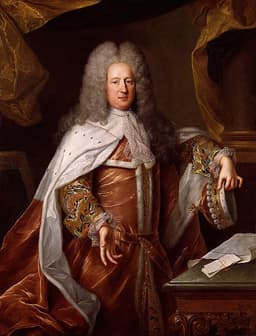
Henry St John
Politician · Modern
57.6Total

Julia Gillard
Politician · Modern
57.1Total
Basic Information
Born
1678
1961
Died
1751
—
Era
Modern
Modern
Nationality
England
Australia
Occupation
Politician
Politician
Civilization
Western
Western
Score Comparison
Military (10%)
50.0
50.0
Political (20%)
68.0
62.7
Influence (20%)
58.0
62.0
Legacy (20%)
50.0
47.5
Leadership (15%)
74.0
74.0
Strategy (15%)
42.9
42.3
TOTAL
57.6
57.1
Henry St John — Complete Timeline
1710 AD
Appointed Secretary of State and created Viscount BolingbrokePolitical Action◆ Major
Queen Anne appointed Henry St John as Secretary of State for the Northern Department and created him Viscount Bolingbroke. He became a leading Tory minister, responsible for foreign policy and the negotiation of the Treaty of Utrecht.
Secretary of StateToryQueen Anne
Impact: nationalconstructive
1715 AD
Fled to France and joined the Jacobite courtPolitical Action◆ Major
Fearing impeachment by the new Whig government, Bolingbroke fled to France. He became Secretary of State to the Jacobite pretender James Francis Edward Stuart, serving the exiled court and plotting the restoration of the Stuart monarchy.
ExileJacobiteStuart
Impact: nationaldestructive
1723 AD
Returned to England and pardonedPolitical Action
Bolingbroke was allowed to return to England after receiving a pardon from George I. He was barred from sitting in the House of Lords but remained politically active as a writer and pamphleteer, influencing the opposition to Walpole.
ReturnPardonPolitical writer
Impact: national
Julia Gillard — Complete Timeline
2010 AD
Became First Female Prime Minister of AustraliaPolitical Action
Gillard became prime minister after successfully challenging Kevin Rudd for the Labor leadership. She was the first woman to hold the office in Australian history, marking a significant milestone for gender equality in the nation's politics.
Gender EqualityLeadershipLabor Party
Impact: nationalprogressive
2011 AD
Introduced the Carbon PriceReform◆ Major
Gillard's government introduced a carbon pricing mechanism, requiring large emitters to pay for their greenhouse gas emissions. The policy aimed to reduce Australia's carbon footprint and transition to a low-carbon economy, but was highly controversial.
Climate ChangeCarbon TaxEnvironment
Impact: nationalconstructive
2012 AD
Delivered the Misogyny SpeechCultural◆ Major
Gillard delivered a powerful speech in parliament accusing opposition leader Tony Abbott of sexism and misogyny. The speech went viral globally and became a defining moment in discussions about gender and politics in Australia.
GenderSpeechMisogyny
Impact: globalprogressive
2013 AD
Lost Labor Leadership to Kevin RuddPolitical Action◆ Major
Gillard lost a leadership spill to Kevin Rudd, ending her tenure as prime minister. The defeat came after months of poor polling and internal party divisions, and marked the end of her brief but historic time in office.
Leadership SpillRuddLabor Party
Impact: nationaltragic
Expert Analysis
Origins
Henry St John (1678–1751) was born into an English gentry family with strong political connections. Educated at Eton and Christ Church, Oxford, he inherited a seat in Parliament at age 23. His father, a baronet, provided ample wealth and social standing. St John's early life was marked by intellectual brilliance and a taste for luxury, earning him a reputation as a skilled orator and a libertine.
Julia Gillard (1961–) was born in Barry, Wales, to a working-class family. Her father was a psychiatric nurse, her mother a charity worker. The family emigrated to Australia in 1966, settling in Adelaide. Gillard excelled academically, studying law and arts at the University of Adelaide, then earning a law degree from Melbourne University. She became a labor lawyer before entering politics.
Rise to Power
Henry St John rose quickly in Tory ranks. In 1704, he became Secretary at War, managing military logistics during the War of Spanish Succession. His eloquence and administrative skill caught Queen Anne's attention. In 1710, he was appointed Secretary of State for the Northern Department and created Viscount Bolingbroke. He became the leading Tory minister, negotiating the Treaty of Utrecht (1713), which ended the war but divided his party.
Julia Gillard entered Parliament in 1998 as member for Lalor. She served as Shadow Minister for Health and later for Employment. In 2007, when Labor won government, she became Deputy Prime Minister under Kevin Rudd. In June 2010, with Rudd's popularity plummeting, Gillard challenged and won the leadership, becoming Australia's first female prime minister on June 24, 2010.
Leadership & Governance
St John's leadership style was aristocratic and secretive. He relied on personal connections and patronage, governing through the House of Lords. His key achievement was the Treaty of Utrecht, which secured British trade interests but faced Whig opposition. He lacked a broad popular base and was vulnerable to shifting court factions. His governance score of 74.0 reflects his effectiveness in high office but also his inability to sustain power.
Gillard governed as a pragmatic reformer. She passed the Clean Energy Act 2011, introducing a carbon price (scored 62.7 political, 62.0 influence). She also reformed disability insurance and school funding. Her leadership score of 74.0 matches St John's, but her strategy score of 42.3 was lower, reflecting difficulties in managing party unity and public perception. Her famous Misogyny Speech (2012) showcased her combative style but did not translate into sustained popularity.
Triumph & Tragedy
St John's triumph was the Treaty of Utrecht, which ended a costly war and expanded British trade. His tragedy was the Jacobite exile. Fearing impeachment by Whigs, he fled to France in 1715 and served the Jacobite pretender. He was attainted and lost his titles. Though pardoned in 1723, he never regained political office. His legacy score of 50.0 reflects this truncated career.
Gillard's triumph was becoming Australia's first female PM and passing major reforms (carbon price, disability insurance). Her tragedy was the bitter leadership challenge from Kevin Rudd in 2013, which she lost, ending her premiership. Her legacy score of 47.5 is low due to the carbon price's subsequent repeal and her short tenure.
Character & Destiny
St John was brilliant, ambitious, and arrogant. His decision to flee to France was driven by fear, but it destroyed his political future. He spent years writing political philosophy, influencing later thinkers like Edmund Burke. His character combined intellectual depth with poor tactical judgment.
Gillard was resilient, disciplined, and direct. She faced intense sexism and party factionalism. Her decision to oust Rudd created a legitimacy problem that haunted her government. Her character was steely but unable to repair the party's internal divisions, leading to her downfall.
Legacy
St John's legacy is intellectual: his writings on the 'Patriot King' and opposition to corruption influenced 18th-century political thought. He remains a figure of Tory history but with limited practical impact. His total score of 57.6 is driven by political (68.0) and leadership (74.0) scores.
Gillard's legacy is symbolic: as first female PM, she broke a glass ceiling. Her carbon price was a landmark environmental policy, though short-lived. Her misogyny speech resonated globally. However, her political score (62.7) and legacy score (47.5) are lower than St John's. Her total score is 57.1.
Conclusion
Henry St John had a greater impact than Julia Gillard, scoring 57.6 to her 57.1. While the margin is narrow, St John's influence on political philosophy and his role in ending a major war (Treaty of Utrecht) outweigh Gillard's domestic reforms. St John's ideas shaped subsequent governance debates, while Gillard's policies were largely reversed. St John's leadership score (74.0) matches Gillard's, but his political score (68.0) exceeds hers (62.7). Despite his tragic exile, St John's intellectual legacy endures more than Gillard's legislative achievements.
Rankings
🥇
Henry St JohnLeader
Mil: 50.0Pol: 68.0Inf: 58.0
57.6
🥈
Julia Gillard
Mil: 50.0Pol: 62.7Inf: 62.0
57.1
+0.5 behind
How This Comparison Works
Algorithm
Each figure is scored on 6 dimensions (0—100 scale) based on structured historical data: Military (10%), Political (20%), Influence (20%), Legacy (20%), Leadership (15%), Strategy (15%). The weighted total produces the final ranking.
Data Sources
Scores are computed from structured sub-indicators in the database. Scale factors adjust for era (Ancient ×0.85, Modern ×1.0) and civilization size (Eastern ×1.05, Other ×0.80) to account for differences in population and military scale.
Maximum 3 Figures
Comparisons are limited to 2—3 figures to ensure readability and statistical meaningfulness.
Error Margins
±5 points per dimension — Sub-scores are derived from historical records with inherent uncertainty. Two figures within 5 points on a dimension should be considered roughly equivalent in that area.
Total Score Accuracy
±3 points overall — The weighted combination of 6 dimensions produces a total score with approximately ±3 points of uncertainty. Differences of less than 3 points are not statistically significant— the figures are effectively tied.
Known Limitations
- Historical records are incomplete and uneven across civilizations
- Figures from oral-tradition societies may be underrepresented
- Occupation labels can misclassify multi-role figures
- Scores measure capability and impact, not moral character
- Quantitative scoring is a comparison tool, not absolute truth
Capability Radar
Military (10%) — Battles & Warfare
Battles
30
27
Win Rate
33
32
Expansion
32
36
Political (20%) — Governance & Reform
Reform
55
65
Diplomacy
65
55
Economy
40
50
Influence (20%) — Cultural & Global Reach
Cultural
50
60
Global
30
50
Legacy (20%) — Historical Impact
Historical
55
55
Longevity
40
30
Leadership (15%) — Power & Stability
Tenure
60
40
Stability
30
45
Strategy (15%) — Tactics & Innovation
Strategy
40
39
Tactics
43
41
Reform
41
42
Similar Comparisons
Comments & Discussion
No comments yet. Be the first to share your thoughts!