Loading...
Henry VI vs Rupert of the Palatinate
Henry VI leads by 12.3 pts · 2 figures compared
…

Henry VI
Emperor · Medieval
52.1Total
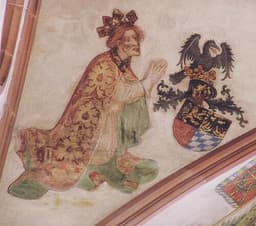
Rupert of the Palatinate
Emperor · Medieval
39.8Total
Basic Information
Born
1165
1352
Died
1197
1410
Era
Medieval
Medieval
Nationality
Holy Roman Empire
Holy Roman Empire
Occupation
Emperor
Emperor
Civilization
Western
Western
Score Comparison
Military (10%)
45.0
50.0
Political (20%)
48.0
26.4
Influence (20%)
54.1
47.9
Legacy (20%)
44.2
38.3
Leadership (15%)
65.7
38.1
Strategy (15%)
60.0
35.7
TOTAL
52.1
39.8
Henry VI — Complete Timeline
1190 AD
Election as King of GermanyPolitical Action◆ Major
Henry VI was elected King of Germany in 1190 following the death of his father Frederick Barbarossa. He succeeded without opposition, inheriting a powerful Hohenstaufen realm.
SuccessionHohenstaufen Dynasty
Impact: regional
1191 AD
Coronation as Holy Roman EmperorPolitical Action◆ Major
Pope Celestine III crowned Henry VI Holy Roman Emperor in Rome on April 15, 1191. The coronation was delayed due to tensions with the Papacy over Henry's claims in Sicily.
CoronationImperial Authority
Impact: regionalconstructive
1192 AD
Capture of Richard the LionheartPolitical Action◆ Major
Henry VI captured King Richard I of England in December 1192 near Vienna and held him for ransom. Richard was released in 1194 after payment of a huge ransom, which Henry used to fund his Sicilian campaign.
RansomRichard IDiplomacy
Impact: regional
1194 AD
Conquest of SicilyWar
Henry VI conquered the Kingdom of Sicily in 1194 after the death of King Tancred. He was crowned King of Sicily in Palermo on December 25, 1194, uniting the island with the Empire and creating a vast Mediterranean domain.
ConquestSicilyTerritorial Expansion
Impact: regional
1195 AD
Plan for a World EmpirePolitical Action
Henry VI proposed a plan to make the Empire hereditary and to launch a crusade to conquer the Byzantine Empire. The plan failed due to opposition from German princes and Henry's sudden death in 1197.
Imperial AmbitionCrusade
Impact: regional
Rupert of the Palatinate — Complete Timeline
1400 AD
Election as King of the RomansPolitical Action◆ Major
The four Rhenish electors deposed Wenceslaus IV and elected Rupert of the Palatinate as King of the Romans. Rupert's election was contested by Wenceslaus and his supporters, leading to a divided empire. Rupert was never crowned Holy Roman Emperor by the Pope.
ElectionImperial PoliticsSchism
Impact: regional
1401 AD
Italian CampaignWar◆ Major
Rupert led an expedition to Italy to secure his coronation as Holy Roman Emperor and to support Pope Boniface IX against his rivals. The campaign was a failure; Rupert's army was defeated by the forces of Gian Galeazzo Visconti of Milan near Brescia. Rupert retreated to Germany without achieving his goals.
Italian CampaignMilitary DefeatCoronation
Impact: regionaltragic
1405 AD
Conflict with the Archbishop of MainzPolitical Action
Rupert became embroiled in a conflict with Archbishop Johann II of Mainz over the election of a new bishop in the diocese of Paderborn. The dispute escalated into a military confrontation, with Rupert besieging the archbishop's castle. The conflict was eventually resolved through mediation, but it weakened Rupert's authority.
Ecclesiastical ConflictSiegeImperial Authority
destructive
Expert Analysis
Origins
Henry VI was born in 1165 in Nijmegen, the son of Emperor Frederick Barbarossa and Beatrice of Burgundy. He was raised in the Hohenstaufen court, receiving an education befitting a future emperor. His father's extensive military campaigns and political maneuvers shaped Henry's worldview. In contrast, Rupert of the Palatinate was born in 1352 in Amberg, the son of Elector Palatine Rupert II. He belonged to the Wittelsbach dynasty, which ruled the Electoral Palatinate. His upbringing was focused on regional governance and the intricacies of imperial politics, but he lacked the vast imperial resources of the Hohenstaufens.
Rise to Power
Henry VI became King of Germany in 1190 after his father Frederick Barbarossa died on the Third Crusade. He faced no opposition, inheriting a powerful realm. His coronation as Holy Roman Emperor occurred on April 15, 1191, though Pope Celestine III delayed it due to disputes over territorial claims. Henry's major turning point was the conquest of Sicily in 1194, which he claimed through his marriage to Constance, the Norman heiress. He defeated King Tancred and was crowned in Palermo on December 25, 1194. This union gave him control over southern Italy. Rupert's rise was more contested. In 1400, the four Rhenish electors deposed King Wenceslaus IV and elected Rupert as King of the Romans. His election was not universally recognized; Wenceslaus refused to abdicate. Rupert's political score of 26.4 reflects his weak mandate. He lacked the resources and consensus to consolidate power.
Leadership & Governance
Henry VI ruled with a focus on centralization and expansion. He attempted to make the Holy Roman Empire hereditary, but opposition from the princes forced him to abandon the plan. He also planned a crusade to conquer the Byzantine Empire, aiming for a world empire. His leadership score of 65.7 indicates effective command, though his political maneuvering was often heavy-handed. He imprisoned King Richard the Lionheart in 1192, extracting a huge ransom of 150,000 marks, which he used to fund his Italian ambitions. Rupert, by contrast, struggled with governance. His political score of 26.4 and leadership score of 38.1 show ineptitude. He engaged in a conflict with Archbishop Johann II of Mainz over a bishopric election, which drained his resources. His Italian campaign to secure coronation as emperor failed militarily, scoring 50.0 in military but lacking strategic follow-through (strategy 35.7). He was never crowned emperor.
Triumph & Tragedy
Henry VI's greatest triumph was the conquest of Sicily, which brought the Norman kingdom into the Hohenstaufen orbit. He also successfully captured Richard the Lionheart, demonstrating his ability to project power across Europe. His tragedy was the failure of his grand plan for a hereditary empire and a crusade against Byzantium. The opposition from German princes and the papacy thwarted his ambitions. He died in 1197 at age 32, possibly from malaria, leaving his infant son Frederick II as heir, leading to years of instability. Rupert's only notable achievement was his election as king, but it was contested. His Italian campaign was a disaster; he failed to reach Rome and was forced to return to Germany. He died in 1410, having never been crowned emperor, his reign marked by conflict and impotence.
Character & Destiny
Henry VI was ambitious and calculating, as shown by his strategic use of Richard's ransom. His character drove him to pursue grandiose plans, but his early death prevented their realization. Historians note his intelligence but also his ruthlessness. Rupert, by contrast, was less capable. His decision to challenge Wenceslaus and then embark on an ill-prepared Italian campaign reflects poor judgment. His character was marked by stubbornness and a lack of political acumen. The score gap of 12.3 points (Henry 52.1 vs Rupert 39.8) underscores the difference in their effectiveness.
Legacy
Henry VI's legacy lies in the consolidation of Hohenstaufen power and the eventual reign of his son Frederick II, who became one of the most influential medieval emperors. His capture of Richard the Lionheart set a precedent for royal ransom. Rupert's legacy is minimal; he is remembered as a failed king of the Romans during the troubled period of the Great Schism. The Palatinate continued under his family, but his reign had little lasting impact. Henry's influence score of 54.1 contrasts with Rupert's 47.9, though both are moderate.
Conclusion
Henry VI clearly had greater impact than Rupert of the Palatinate. His conquest of Sicily and capture of Richard the Lionheart were significant events that shaped European politics. Despite his early death and failed imperial plans, he laid the groundwork for the Hohenstaufen legacy. Rupert, with lower scores across most categories, failed to achieve his coronation and left no enduring mark. Henry's total score of 52.1 versus Rupert's 39.8 reflects this disparity. The historical record shows Henry as a formidable if flawed emperor, while Rupert is a footnote.
Rankings
🥇
Henry VILeader
Mil: 45.0Pol: 48.0Inf: 54.1
52.1
🥈
Rupert of the Palatinate
Mil: 50.0Pol: 26.4Inf: 47.9
39.8
+12.3 behind
How This Comparison Works
Algorithm
Each figure is scored on 6 dimensions (0—100 scale) based on structured historical data: Military (10%), Political (20%), Influence (20%), Legacy (20%), Leadership (15%), Strategy (15%). The weighted total produces the final ranking.
Data Sources
Scores are computed from structured sub-indicators in the database. Scale factors adjust for era (Ancient ×0.85, Modern ×1.0) and civilization size (Eastern ×1.05, Other ×0.80) to account for differences in population and military scale.
Maximum 3 Figures
Comparisons are limited to 2—3 figures to ensure readability and statistical meaningfulness.
Error Margins
±5 points per dimension — Sub-scores are derived from historical records with inherent uncertainty. Two figures within 5 points on a dimension should be considered roughly equivalent in that area.
Total Score Accuracy
±3 points overall — The weighted combination of 6 dimensions produces a total score with approximately ±3 points of uncertainty. Differences of less than 3 points are not statistically significant— the figures are effectively tied.
Known Limitations
- Historical records are incomplete and uneven across civilizations
- Figures from oral-tradition societies may be underrepresented
- Occupation labels can misclassify multi-role figures
- Scores measure capability and impact, not moral character
- Quantitative scoring is a comparison tool, not absolute truth
Capability Radar
Military (10%) — Battles & Warfare
Battles
45
20
Win Rate
40
25
Expansion
65
10
Political (20%) — Governance & Reform
Reform
40
15
Diplomacy
50
25
Economy
45
20
Influence (20%) — Cultural & Global Reach
Cultural
30
15
Global
35
10
Legacy (20%) — Historical Impact
Historical
40
20
Longevity
25
10
Leadership (15%) — Power & Stability
Tenure
55
30
Stability
30
15
Strategy (15%) — Tactics & Innovation
Strategy
50
15
Tactics
35
20
Reform
30
10
Similar Comparisons
Comments & Discussion
No comments yet. Be the first to share your thoughts!