Loading...
Henry VII of England vs Julius Caesar
Julius Caesar leads by 20.1 pts · 2 figures compared
…
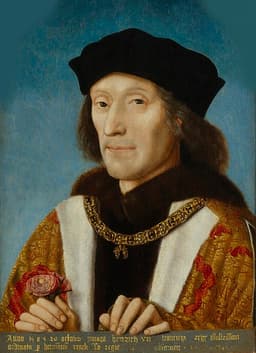
Henry VII of England
Emperor · Medieval
62.7Total

Julius Caesar
General · Ancient
82.8Total
Basic Information
Born
1457
-100
Died
1509
-44
Era
Medieval
Ancient
Nationality
England
Roman Republic
Occupation
Emperor
General
Civilization
Western
Western
Score Comparison
Military (10%)
55.0
88.0
Political (20%)
78.0
78.0
Influence (20%)
59.0
85.0
Legacy (20%)
52.0
82.0
Leadership (15%)
78.0
80.0
Strategy (15%)
60.0
85.0
TOTAL
62.7
82.8
Henry VII of England — Complete Timeline
1485 AD
Battle of Bosworth FieldWar
Henry Tudor defeated and killed Richard III at Bosworth Field, ending the Wars of the Roses. This victory allowed Henry to claim the throne as Henry VII, founding the Tudor dynasty.
BattleVictoryTudor Dynasty
Impact: nationalconstructive
1486 AD
Marriage to Elizabeth of YorkPolitical Action◆ Major
Henry VII married Elizabeth of York, uniting the Houses of Lancaster and York. This marriage symbolically ended the Wars of the Roses and strengthened the legitimacy of the Tudor claim to the throne.
MarriageUnificationTudor
Impact: nationalconstructive
1487 AD
Defeat of Lambert SimnelWar◆ Major
Henry VII defeated the Yorkist pretender Lambert Simnel at the Battle of Stoke Field. This victory crushed a major rebellion and secured Henry's throne against early challenges to his rule.
RebellionBattleYorkist
Impact: nationalconstructive
1489 AD
Treaty of Medina del CampoPolitical Action◆ Major
Henry VII signed a treaty with Spain, arranging the marriage of his son Arthur to Catherine of Aragon. This alliance strengthened England's position in Europe and laid the groundwork for future diplomatic ties.
DiplomacySpainAlliance
Impact: regionalconstructive
1499 AD
Execution of Perkin WarbeckPolitical Action
Henry VII executed Perkin Warbeck, a pretender who claimed to be Richard of Shrewsbury. Warbeck's capture and execution ended a major threat to Henry's reign and demonstrated his firm control over the kingdom.
PretenderExecutionSecurity
Impact: national
Julius Caesar — Complete Timeline
58 BC
Gallic WarsWar◆ Major
Caesar, as proconsul of Gaul, launched a series of campaigns that conquered all of Gaul (modern France, Belgium, and parts of Switzerland). He fought numerous battles, including against the Helvetii, the Belgae, and the Gallic chieftain Vercingetorix. The wars brought immense wealth and a loyal army to Caesar.
Gallic WarsConquestRoman Expansion
Impact: regional
49 BC
Crossing the RubiconPolitical Action◆ Major
Caesar led Legio XIII across the Rubicon River into Italy, defying the Roman Senate's order to disband his army. This act triggered a civil war against Pompey and the Optimates, ultimately leading to Caesar's dictatorship and the end of the Roman Republic.
Roman Civil WarEnd of RepublicPower Struggle
Impact: global
48 BC
Battle of PharsalusWar◆ Major
Caesar's outnumbered army defeated the larger forces of Pompey the Great at Pharsalus in Greece. Caesar's tactical use of a reserve line to counter Pompey's cavalry charge proved decisive. Pompey fled to Egypt, where he was assassinated, leaving Caesar as the undisputed master of the Roman world.
Roman Civil WarBattleDecisive Victory
Impact: regional
44 BC
Appointment as Dictator for LifePolitical Action◆ Major
The Roman Senate appointed Caesar dictator perpetuo (dictator for life), granting him unprecedented personal power. This move concentrated military, legislative, and judicial authority in one person, effectively ending the Roman Republic's traditional system of checks and balances and alarming many senators.
DictatorshipEnd of RepublicPower Consolidation
Impact: regionaldestructive
Assassination on the Ides of MarchPolitical Action◆ Major
A group of Roman senators, led by Marcus Junius Brutus and Gaius Cassius Longinus, stabbed Caesar to death at a meeting of the Senate in the Theatre of Pompey. The assassination was intended to restore the Republic, but instead triggered another civil war that led to the rise of the Roman Empire.
AssassinationRoman PoliticsEnd of Republic
Impact: globaldestructive
Expert Analysis
henry-vii-of-england-vs-julius-caesar
# The Throne and the Sword: Henry VII and Julius Caesar
On a cold February morning in 1485, a Welsh-born exile with a threadbare claim to the English crown landed on the coast of Pembrokeshire with a few thousand mercenaries. Across the centuries, on a January day in 49 BCE, a Roman general in his fifties stood at the banks of a small river in northern Italy, pondering a decision that would shatter a republic. Henry Tudor had everything to lose; Julius Caesar had everything to gain. One would found a dynasty that lasted a century; the other would end a republic that had lasted five. Both men walked the razor's edge between ambition and annihilation, yet they arrived on opposite sides of history's judgment.
Origins
Julius Caesar was born into the patrician Julian clan, a family with a name that echoed through Roman legend but had lost its political muscle. His uncle Marius had been a populist reformer; his father died when Caesar was sixteen. The Roman Republic of his youth was already rotting—senatorial corruption, street violence between factions, and slave armies commanded by warlords. Caesar grew up watching men like Sulla march on Rome with impunity. He learned early that in a dying republic, the law was only as strong as the swords behind it.
Henry Tudor was born in 1457 at Pembroke Castle, his father dead before his birth, his mother a teenager. The Wars of the Roses had torn England apart for two years already. Henry's Lancastrian blood was thin—his claim came through an illegitimate line—and for most of his youth he lived as a fugitive in Brittany and France. While Caesar was raised on the oratory of Cicero and the campaigns of Marius, Henry was raised on the cold reality that a king could be killed in battle and a dynasty erased in an afternoon. He learned not the art of conquest, but the art of survival.
Rise to Power
Caesar’s path was one of audacity and debt. He borrowed fortunes to stage games, bribed his way into the pontificate, and seduced the wives of his enemies. By 60 BCE, he had forged an alliance with Pompey and Crassus—the First Triumvirate—and secured command of Gaul. Over the next eight years, he conquered a territory larger than Italy itself, fought hundreds of battles, and built an army that worshipped him. When the Senate ordered him to disband his legions, he crossed the Rubicon in 49 BCE and marched on Rome. He was fifty-one years old.
Henry’s rise was the opposite: patient, legalistic, and desperate. He spent fourteen years in exile, watching the Yorkist kings Edward IV and Richard III destroy each other. In 1485, with French backing, he landed at Milford Haven. At Bosworth Field that August, Richard III charged directly at him, was pulled from his horse, and killed. Henry was crowned on the battlefield with Richard’s crown—found in a hawthorn bush—placed on his head. He was twenty-eight years old, and his claim was so weak that Parliament had to grant him the throne by right of conquest.
Leadership & Governance
Caesar governed like a storm. As dictator, he reformed the calendar, granted citizenship to provincials, initiated public works, and centralized power in his own hands. His military genius was unmatched—he wrote his own commentaries, he won battles against impossible odds, and he pardoned his enemies until they stabbed him. But his governance was a paradox: he wanted to heal the Republic while strangling it. He appointed senators who were loyal, not competent. He packed the Senate with his men, debased the currency to pay his debts, and treated the Republic as his personal estate.
Henry VII governed like a banker. He avoided war—his military score of 35 is the lowest of any effective English king—and instead built a treasury. He created the Court of Star Chamber to curb the nobility, fined his enemies into submission, and personally audited every account. His marriage to Elizabeth of York in 1486 united the warring houses, but he never trusted her family. He crushed pretenders—Lambert Simnel in 1487, Perkin Warbeck in 1499—not with armies but with spies, bribes, and executions. His Treaty of Medina del Campo with Spain in 1489 secured a Spanish bride for his son and locked England into European alliances. He was not loved; he was feared and obeyed.
Triumph & Tragedy
Caesar’s greatest triumph was Gaul—the conquest of a million people, the writing of a book that schoolboys still read, the creation of a legend that would outlast Rome itself. His greatest tragedy was the Ides of March. On March 15, 44 BCE, sixty senators surrounded him in the Pompeian Theatre and stabbed him twenty-three times. He fell at the feet of a statue of his old rival Pompey. He had pardoned most of his assassins. He had believed that power, once achieved, would protect him. It did not.
Henry’s greatest triumph was survival. He died in his bed on April 21, 1509, after twenty-four years of rule, leaving a full treasury, a peaceful realm, and a son to inherit. His greatest tragedy was the death of his heir Arthur in 1502—the prince for whom the Spanish alliance had been built. Henry’s wife Elizabeth died in childbirth the following year, and the king himself retreated into a cold, miserly grief. He never remarried. He never recovered.
Character & Destiny
Caesar was charismatic, reckless, and brilliant. He gambled everything—his life, his fortune, the Republic itself—on the belief that his luck would hold. He was generous to a fault, forgiving his enemies, promoting his friends, and believing that his personal magnetism could bind a fractured world. His destiny was to destroy the Republic he claimed to save. He could not have done otherwise; the Republic was already dead, and Caesar was the knife that made it official.
Henry VII was calculating, suspicious, and patient. He trusted no one—not his wife, not his mother, not his ministers. He read every report, counted every coin, and waited for his enemies to make mistakes. His destiny was to found a dynasty that would give England stability after a century of civil war. He could not have done otherwise; the Wars of the Roses had taught him that a king who sleeps is a king who dies.
Legacy
Caesar’s legacy is the Roman Empire. His adopted heir Octavian became Augustus, the first emperor. The title “Caesar” became synonymous with emperor—Kaiser, Tsar, Qaysar. His writings shaped Western military thought. His assassination made him a martyr and a warning. He is remembered as the man who crossed the Rubicon, who said “the die is cast,” who loved Cleopatra, who was betrayed by his friends. He is remembered as the most famous Roman who ever lived.
Henry VII’s legacy is the Tudor dynasty. His son Henry VIII would break with Rome, his granddaughter Elizabeth would defeat the Spanish Armada, and his great-grandson James would unite the crowns of England and Scotland. He is remembered as the first Tudor, the miser king, the man who ended the Wars of the Roses. But he is not famous—not in the way Caesar is famous. He is respected, not loved.
Conclusion
What drove these two men to such different fates? The answer lies not in their characters alone, but in the worlds they inherited. Caesar lived in a republic that had already eaten itself—a system where ambition was the only law, and where a man could rise to the top only by crushing those beneath him. Henry lived in a kingdom that had been torn apart by ambition—a system where survival meant restraint, and where a king who reached too far would be pulled down by those he had wronged. Caesar could not stop reaching. Henry could not stop holding. One died in a Senate chamber, stabbed by his equals. One died in his bed, surrounded by his gold. Both got exactly what they deserved.
Rankings
🥇
Julius CaesarLeader
Mil: 88.0Pol: 78.0Inf: 85.0
82.8
🥈
Henry VII of England
Mil: 55.0Pol: 78.0Inf: 59.0
62.7
+20.1 behind
How This Comparison Works
Algorithm
Each figure is scored on 6 dimensions (0—100 scale) based on structured historical data: Military (10%), Political (20%), Influence (20%), Legacy (20%), Leadership (15%), Strategy (15%). The weighted total produces the final ranking.
Data Sources
Scores are computed from structured sub-indicators in the database. Scale factors adjust for era (Ancient ×0.85, Modern ×1.0) and civilization size (Eastern ×1.05, Other ×0.80) to account for differences in population and military scale.
Maximum 3 Figures
Comparisons are limited to 2—3 figures to ensure readability and statistical meaningfulness.
Error Margins
±5 points per dimension — Sub-scores are derived from historical records with inherent uncertainty. Two figures within 5 points on a dimension should be considered roughly equivalent in that area.
Total Score Accuracy
±3 points overall — The weighted combination of 6 dimensions produces a total score with approximately ±3 points of uncertainty. Differences of less than 3 points are not statistically significant— the figures are effectively tied.
Known Limitations
- Historical records are incomplete and uneven across civilizations
- Figures from oral-tradition societies may be underrepresented
- Occupation labels can misclassify multi-role figures
- Scores measure capability and impact, not moral character
- Quantitative scoring is a comparison tool, not absolute truth
Capability Radar
Military (10%) — Battles & Warfare
Battles
30
95
Win Rate
35
92
Expansion
25
97
Political (20%) — Governance & Reform
Reform
80
90
Diplomacy
85
85
Economy
80
82
Influence (20%) — Cultural & Global Reach
Cultural
50
88
Global
45
94
Legacy (20%) — Historical Impact
Historical
70
95
Longevity
65
96
Leadership (15%) — Power & Stability
Tenure
75
75
Stability
85
60
Strategy (15%) — Tactics & Innovation
Strategy
45
94
Tactics
40
96
Reform
50
88
Similar Comparisons
Comments & Discussion
CrownAndRubicon6/17/2026
The real difference here is that Caesar gambled on his own coup while Henry Tudor gambled on someone else’s failure. Caesar crossed the Rubicon with a single loyal legion, betting Roman disillusionment with the Senate would hand him Italy without a fight—and he was right. Henry just waited for Richard III to alienate the nobility through fear, then stepped into the vacuum. Caesar made his moment. Henry stumbled into his.|en
数据拆穿者6/17/2026
说亨利七世“王朝持续百年”是典型辉格史观吹捧。都铎王朝其实只传了三代,118年,而凯撒养子屋大维建立的帝国持续了四百年。如果比“开创长命政权”,亨利七世连凯撒的零头都不够。治世长短是硬标准,别拿空壳谱系充数。选凯撒,他搞的体制能撑千年胚子。|zh
GhostOfSulla6/17/2026
The comparison is false because their threats were opposite. Caesar faced a Senate that had already broken every norm and murdered his allies; he had to cross the Rubicon to survive politically. Henry faced a usurper king with a stable title who just needed to be beaten in battle. Caesar's act was a defensive rebellion against a broken system; Henry's was a standard dynastic coup. Give me Caesar—at least he was fighting for reform, not just family crests.|en
乱世赌徒6/17/2026
论起身赌注,亨利七世根本比不上凯撒。凯撒49年跨卢比孔河时只有第十三军团四千人,对面庞培有十四个军团。他赌的是罗马民众厌弃元老院腐化,赌自己的声望能空手套白狼。亨利七世登陆博斯沃思时带的法国雇佣兵和叛军,实际只要买通斯坦利家族就能赢。凯撒是孤注一掷,亨利是花钱买保证。高下立判。|zh
BrutusAteMyHomework6/17/2026
Let's be blunt: Caesar was a military genius and a political visionary. Henry VII was a competent accountant with a crown. Caesar conquered Gaul, wrote war commentaries still studied today, reformed the calendar, and centralized power as dictator perpetuo. Henry's big achievements were tax collection and avoiding war. If you want a ruler who changes the world, pick Caesar. If you want a boring, stable taxman, sure—pick Henry. But history remembers conquerors, not bean-counters.|en