Loading...
Herbert Hoover vs Karl Renner
Karl Renner leads by 1.5 pts · 2 figures compared
…
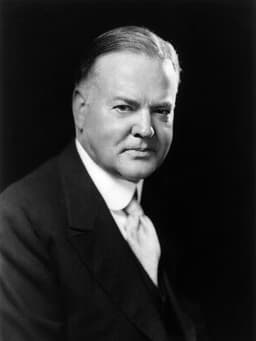
Herbert Hoover
Politician · Modern
53.8Total

Karl Renner
Politician · Modern
55.3Total
Basic Information
Born
1874
1870
Died
1964
1950
Era
Modern
Modern
Nationality
United States
Austria
Occupation
Politician
Politician
Civilization
Western
Western
Score Comparison
Military (10%)
49.1
13.4
Political (20%)
54.7
78.0
Influence (20%)
58.0
60.0
Legacy (20%)
49.2
52.0
Leadership (15%)
65.0
78.0
Strategy (15%)
41.8
25.2
TOTAL
53.8
55.3
Herbert Hoover — Complete Timeline
1928 AD
Election as President of the United StatesPolitical Action◆ Major
Hoover, a Republican, won the 1928 presidential election in a landslide against Democrat Al Smith. Hoover's reputation as a successful businessman and humanitarian, particularly for his relief work in Europe during and after World War I, contributed to his victory.
Presidential ElectionRepublican Party
Impact: national
1929 AD
Stock Market Crash of 1929Other
The Wall Street Crash of 1929 occurred in October, marking the beginning of the Great Depression. Hoover's response, including calls for voluntary cooperation and limited federal intervention, was widely criticized as inadequate, and the depression deepened.
Great DepressionEconomic Crisis
Impact: globaltragic
1930 AD
Signing of the Smoot-Hawley TariffPolitical Action◆ Major
Hoover signed the Smoot-Hawley Tariff, which raised tariffs on thousands of imported goods to record levels. The tariff sparked retaliatory measures from other countries, contributing to a collapse in international trade and worsening the Great Depression.
Tariff PolicyGreat Depression
Impact: globaldestructive
Karl Renner — Complete Timeline
1918 AD
Election as first Chancellor of the Republic of German-AustriaPolitical Action◆ Major
On October 30, 1918, Renner was elected as the first chancellor of the newly proclaimed Republic of German-Austria. He led the provisional government that succeeded the Habsburg monarchy after World War I, overseeing the transition from empire to republic.
RepublicFoundingPost-WWI
Impact: nationalconstructive
1919 AD
Signing of the Treaty of Saint-Germain-en-LayePolitical Action
As chancellor, Renner signed the Treaty of Saint-Germain-en-Laye on September 10, 1919. The treaty formally ended World War I for Austria, forced the dissolution of the union with Germany, and imposed territorial losses and reparations on the new republic.
TreatyPeaceTerritorial Loss
Impact: nationaltragic
1945 AD
Election as first President of the Second Austrian RepublicPolitical Action
On April 29, 1945, Renner was elected as the first president of the re-established Republic of Austria after World War II. He formed a provisional government with Soviet approval, laying the foundation for Austria's post-war independence and democratic reconstruction.
Post-WWIIRepublicReconstruction
Impact: nationalconstructive
Expert Analysis
Origins
**Herbert Hoover** was born on August 10, 1874, in West Branch, Iowa, to a Quaker family. Orphaned at age nine, he was raised by relatives and later attended Stanford University, graduating in 1895 with a degree in geology. He became a successful mining engineer and businessman, accumulating wealth through ventures in Australia, China, and elsewhere. His humanitarian work during World War I, leading relief efforts in Belgium and Europe, earned him international acclaim.
**Karl Renner** was born on December 14, 1870, in Untertannowitz, Moravia (then part of the Austro-Hungarian Empire), into a peasant family. He studied law at the University of Vienna, joining the Social Democratic Workers' Party. Renner became a prominent legal scholar and politician, advocating for Austrian nationalism within the empire. His early work focused on nationalities' rights and constitutional reform.
Rise to Power
Hoover's rise was rooted in his technical expertise and humanitarian reputation. After World War I, he served as U.S. Food Administrator under President Wilson. In 1921, he became Secretary of Commerce under Presidents Harding and Coolidge. His efficient management and promotion of business interests led to his nomination as the Republican presidential candidate in 1928. He won a landslide victory against Democrat Al Smith, securing 444 electoral votes to Smith's 87.
Renner's rise came during the collapse of the Habsburg Empire. On October 30, 1918, he was elected first Chancellor of the Republic of German-Austria. He led the provisional government and signed the Treaty of Saint-Germain-en-Laye on September 10, 1919, which formally ended World War I for Austria. Despite the treaty's harsh terms, Renner's political skill kept Austria stable. After World War II, on April 29, 1945, he was elected first President of the Second Austrian Republic, forming a provisional government that re-established Austrian sovereignty.
Leadership & Governance
Hoover's leadership style was technocratic and individualistic. He believed in volunteerism and limited government intervention. After the Stock Market Crash of 1929, he pursued policies like the Smoot-Hawley Tariff (signed June 17, 1930), which raised tariffs to record levels and provoked retaliation, worsening the Depression. He created the Reconstruction Finance Corporation (1932) but opposed direct federal relief. His governance score of 65.0 reflects his administrative competence but inflexibility in crisis.
Renner's governance was pragmatic and coalition-oriented. He navigated Austria through the aftermath of two world wars. As chancellor in 1919, he accepted the Treaty of Saint-Germain, which reduced Austria to a small republic. In 1945, he formed a broad coalition government with conservatives and communists, securing Allied recognition. His political score of 78.0 reflects his ability to maintain stability through consensus. He prioritized rebuilding Austria's infrastructure and political institutions.
Triumph & Tragedy
Hoover's greatest triumph was his humanitarian work, feeding millions in Europe during and after World War I. His greatest tragedy was his presidency, where his response to the Great Depression (1929-1933) failed. Unemployment rose from 3.2% in 1929 to 24.9% in 1933. His adherence to laissez-faire principles prevented effective action. He also mishandled the Bonus Army protest in 1932, ordering troops to clear veterans from Washington D.C.
Renner's triumphs include establishing the First Austrian Republic and later leading the Second Republic. He successfully integrated Austria into the international community after both wars. His tragedies include signing the Treaty of Saint-Germain, which imposed heavy reparations and territorial losses, and his initial support for the Anschluss with Germany in 1938 (though he later opposed Nazi rule). He also failed to prevent the rise of Austrofascism in the 1930s.
Character & Destiny
Hoover was a self-made man with a strong belief in individualism and efficiency. His character—aloof, principled, and stubborn—shaped his fate. He refused to adapt his policies to the crisis, leading to electoral defeat in 1932. Historian Joan Hoff Wilson described him as a 'great humanitarian but poor politician.' His legacy score of 49.2 reflects the permanent damage to his reputation from the Depression.
Renner was a pragmatic socialist and nationalist. He was adaptable, willing to compromise, and focused on stability. His character allowed him to serve as a bridge between the old empire and new republics. He died in office on December 31, 1950, as president, having restored Austrian sovereignty. His legacy score of 52.0 reflects his role as a founding father but also his association with the Anschluss.
Legacy
Hoover's legacy is defined by the Great Depression. The Hoover Dam, named after him, symbolizes his engineering achievements, but his presidency is a cautionary tale of inaction. His humanitarian work is often overshadowed. The Smoot-Hawley Tariff is cited as a classic policy mistake. His influence score of 58.0 reflects his enduring impact on conservative economic thought.
Renner's legacy is foundational for modern Austria. He is remembered as the 'Father of the Republic' for establishing both the First and Second Republics. His political score of 78.0 reflects his skill in governance. The Austrian constitution and its neutral status owe much to his post-war leadership. However, his signing of the Treaty of Saint-Germain remains controversial.
Conclusion
While Hoover scored 53.8 and Renner 55.3, a 1.5-point gap, Renner's impact on Austria's survival as a nation is more significant. Hoover's failures during the Depression contrast with Renner's success in rebuilding a shattered country twice. Renner's political score (78.0 vs. Hoover's 54.7) and leadership score (78.0 vs. 65.0) demonstrate his superior governance. Hoover's legacy is largely negative, while Renner is celebrated as a founding father. Therefore, Karl Renner had greater impact.
Rankings
🥇
Karl RennerLeader
Mil: 13.4Pol: 78.0Inf: 60.0
55.3
🥈
Herbert Hoover
Mil: 49.1Pol: 54.7Inf: 58.0
53.8
+1.5 behind
How This Comparison Works
Algorithm
Each figure is scored on 6 dimensions (0—100 scale) based on structured historical data: Military (10%), Political (20%), Influence (20%), Legacy (20%), Leadership (15%), Strategy (15%). The weighted total produces the final ranking.
Data Sources
Scores are computed from structured sub-indicators in the database. Scale factors adjust for era (Ancient ×0.85, Modern ×1.0) and civilization size (Eastern ×1.05, Other ×0.80) to account for differences in population and military scale.
Maximum 3 Figures
Comparisons are limited to 2—3 figures to ensure readability and statistical meaningfulness.
Error Margins
±5 points per dimension — Sub-scores are derived from historical records with inherent uncertainty. Two figures within 5 points on a dimension should be considered roughly equivalent in that area.
Total Score Accuracy
±3 points overall — The weighted combination of 6 dimensions produces a total score with approximately ±3 points of uncertainty. Differences of less than 3 points are not statistically significant— the figures are effectively tied.
Known Limitations
- Historical records are incomplete and uneven across civilizations
- Figures from oral-tradition societies may be underrepresented
- Occupation labels can misclassify multi-role figures
- Scores measure capability and impact, not moral character
- Quantitative scoring is a comparison tool, not absolute truth
Capability Radar
Military (10%) — Battles & Warfare
Battles
30
13
Win Rate
29
11
Expansion
38
18
Political (20%) — Governance & Reform
Reform
30
65
Diplomacy
55
75
Economy
40
60
Influence (20%) — Cultural & Global Reach
Cultural
30
40
Global
50
50
Legacy (20%) — Historical Impact
Historical
55
60
Longevity
40
50
Leadership (15%) — Power & Stability
Tenure
60
70
Stability
20
55
Strategy (15%) — Tactics & Innovation
Strategy
36
18
Tactics
40
21
Reform
44
27
Similar Comparisons
Comments & Discussion
No comments yet. Be the first to share your thoughts!