Loading...
Herbert Hoover vs Napoleon Bonaparte
Napoleon Bonaparte leads by 17.1 pts · 2 figures compared
…
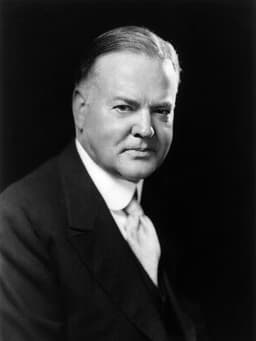
Herbert Hoover
Politician · Modern
53.8Total

Napoleon Bonaparte
General · Modern
70.9Total
Basic Information
Born
1874
1769
Died
1964
1821
Era
Modern
Modern
Nationality
United States
France
Occupation
Politician
General
Civilization
Western
Western
Score Comparison
Military (10%)
49.1
94.0
Political (20%)
54.7
72.0
Influence (20%)
58.0
40.0
Legacy (20%)
49.2
80.0
Leadership (15%)
65.0
78.0
Strategy (15%)
41.8
90.0
TOTAL
53.8
70.9
Herbert Hoover — Complete Timeline
1928 AD
Election as President of the United StatesPolitical Action◆ Major
Hoover, a Republican, won the 1928 presidential election in a landslide against Democrat Al Smith. Hoover's reputation as a successful businessman and humanitarian, particularly for his relief work in Europe during and after World War I, contributed to his victory.
Presidential ElectionRepublican Party
Impact: national
1929 AD
Stock Market Crash of 1929Other
The Wall Street Crash of 1929 occurred in October, marking the beginning of the Great Depression. Hoover's response, including calls for voluntary cooperation and limited federal intervention, was widely criticized as inadequate, and the depression deepened.
Great DepressionEconomic Crisis
Impact: globaltragic
1930 AD
Signing of the Smoot-Hawley TariffPolitical Action◆ Major
Hoover signed the Smoot-Hawley Tariff, which raised tariffs on thousands of imported goods to record levels. The tariff sparked retaliatory measures from other countries, contributing to a collapse in international trade and worsening the Great Depression.
Tariff PolicyGreat Depression
Impact: globaldestructive
Napoleon Bonaparte — Complete Timeline
1799 AD
Coup of 18 BrumaireOther◆ Major
Napoleon Bonaparte, with support from his brother Lucien and key political figures, overthrew the Directory in a bloodless coup. He established the Consulate with himself as First Consul, effectively becoming the ruler of France. This event ended the French Revolution's most unstable period.
French RevolutionCoupRise to Power
Impact: regional
1804 AD
Promulgation of the Napoleonic CodeOther◆ Major
Napoleon enacted the Civil Code of the French, known as the Napoleonic Code, a comprehensive set of laws that replaced the fragmented feudal legal systems. The code established legal equality, protected property rights, and secularized law. It became the basis for legal systems in many European and world countries.
Legal ReformNapoleonic CodeCivil Law
Impact: globalconstructive
1805 AD
Battle of AusterlitzWar◆ Major
Napoleon's Grande Arm
Napoleonic WarsBattleDecisive Victory
Impact: global
1812 AD
Invasion of RussiaWar◆ Major
Napoleon led the Grande Arm
Napoleonic WarsInvasionDisaster
Impact: globaldestructive
1815 AD
Battle of WaterlooWar◆ Major
Napoleon's French army was defeated by the combined forces of the Duke of Wellington's Anglo-Allied army and Gebhard Leberecht von Bl
Napoleonic WarsBattleFinal Defeat
Impact: globaldestructive
Expert Analysis
herbert-hoover-vs-napoleon-bonaparte
### The Emperor and the Engineer: Two Men, Two Catastrophes, and the Unforgiving Judgment of History
In the winter of 1812, Napoleon Bonaparte watched his Grand Army burn the ancient Kremlin, a desperate act of defiance against a retreating enemy. Less than six months later, he fled Paris in a sleigh, leaving behind the frozen corpses of half a million men. In the winter of 1929, Herbert Hoover, a man of unparalleled humanitarian achievement, stared at the ticker tape from the Wall Street crash and assured the American people that the economy was “fundamentally sound.” Within three years, he was a reviled figure, his name a curse word on the lips of the starving. One was a genius of war, the other a genius of organization. Both rose to the pinnacle of power from humble beginnings. Both were undone by forces they could not control—and by flaws they could not see. Why did one become a legend, and the other a cautionary tale?
### Origins: The Corsican and the Orphan
Napoleon Buonaparte was born in 1769 on the newly French island of Corsica, a place of fierce clan loyalties and simmering resentment against the mainland. His family was minor nobility, but poor. He spoke with a thick Italian accent, was mocked by his classmates at French military school, and carried a chip on his shoulder the size of a mountain. This outsider status forged an iron will. He read voraciously—history, geography, military tactics—and dreamed of glory. His world was one of revolution, chaos, and opportunity. The old order was crumbling, and a young artillery officer with talent and ambition could rewrite the map.
Herbert Hoover was born in 1874 in West Branch, Iowa, a Quaker village of plain wooden houses and hard work. By age nine, he was an orphan. He was sent to live with an uncle in Oregon, where he scrubbed floors and learned self-reliance. He clawed his way into Stanford University’s first class, graduating as a mining engineer. His world was one of order, efficiency, and problem-solving. If a mine was flooding, you pumped it out. If a famine was spreading, you organized food shipments. He believed in the power of systems, not armies. Both men were shaped by loss and exclusion, but Napoleon learned to conquer, while Hoover learned to build.
### Rise to Power: The Sword and the Ledger
Napoleon’s path was forged in gunpowder. In 1793, at age 24, he recaptured the port of Toulon from British forces with a brilliant artillery plan, earning instant promotion. By 1796, he was commanding the Army of Italy, where he turned a starving, ragged force into a conquering machine. He didn’t just win battles; he won the hearts of his soldiers by sharing their rations and leading from the front. His 1798 campaign in Egypt was a disaster of strategy but a triumph of self-promotion, and he returned to France a hero. In 1799, he staged a coup. He was not elected; he seized power. His rise was a whirlwind of ambition, luck, and the brute logic of war.
Hoover’s rise was a slow, steady climb of competence. He made a fortune as a mining engineer in Australia and China, then became the world’s most famous humanitarian. During World War I, he organized the relief of Belgium, feeding nine million people. When the U.S. entered the war, President Wilson appointed him Food Administrator, where he urged Americans to eat less wheat and meat—and they listened. He became “the Great Humanitarian.” In 1928, he was elected President in a landslide, the most popular man in America. His power came not from a coup, but from a reputation for solving problems. He believed that government was a machine, and he was its best engineer.
### Leadership & Governance: The Code and the Tariff
As Emperor, Napoleon was a hurricane of reform. He centralized the French state, established the Bank of France, and negotiated the Concordat with the Pope, ending a decade of religious war. His greatest achievement was the Napoleonic Code of 1804, a uniform system of law that abolished feudalism, protected property rights, and enshrined merit over birth. It was a masterpiece of clarity and reason, and it spread across Europe. But his governance was also a tyranny. He censored the press, suppressed dissent, and crowned himself Emperor. He was a reformer who believed only he could reform.
Hoover’s presidency was a tragedy of misplaced faith. He believed in “rugged individualism”—the idea that voluntary cooperation and local charity could solve anything. When the Great Depression hit in 1929, he refused to offer direct federal relief, fearing it would destroy American character. He signed the disastrous Smoot-Hawley Tariff in 1930, which triggered a global trade war. He created the Reconstruction Finance Corporation, but it was too little, too late. He was not lazy or cruel; he was trapped by his own ideology. He believed that the system, if left to self-correct, would heal itself. It did not. Napoleon’s reforms were imposed by force; Hoover’s inaction was imposed by principle. Both led to suffering.
### Triumph & Tragedy: Austerlitz and the Bonus Army
Napoleon’s greatest moment was the Battle of Austerlitz in 1805, where he crushed the combined armies of Russia and Austria. It was a masterpiece of deception and timing. He lured the allies into attacking his weakened right flank, then smashed their center. The sun broke through the fog, and his soldiers cheered. He was at the height of his power, master of Europe. His tragedy was the invasion of Russia in 1812. He marched 600,000 men into a vast, empty country. The Russians burned their own land and refused to fight. When winter came, the Grand Army disintegrated. He lost everything in a war he could not win.
Hoover’s greatest moment was his humanitarian work before his presidency. He saved millions from starvation, and his name was synonymous with generosity. His tragedy came in 1932, when 17,000 World War I veterans—the Bonus Army—marched on Washington demanding early payment of their bonuses. Hoover, fearing revolution, ordered the Army to clear them out. General Douglas MacArthur used tanks and bayonets, burning the veterans’ shantytown. The images of American soldiers attacking American veterans destroyed Hoover’s reputation forever. He had fed Belgium, but he could not feed his own people.
### Character & Destiny: The Eagle and the Engineer
Napoleon was a creature of fire. He was restless, impatient, and consumed by a need for glory. He once said, “Impossible is a word to be found only in the dictionary of fools.” He could not stop conquering, even when his empire was already overstretched. His character drove him to take risks that no sane man would take, and for a while, they paid off. But his hubris blinded him. He invaded Russia because he believed his will alone could overcome geography and climate.
Hoover was a creature of ice. He was logical, methodical, and convinced that the world could be managed with charts and committees. He once said, “The sole function of government is to bring about a condition of affairs favorable to the beneficial development of private enterprise.” He could not adapt. When the Depression broke the rules of his orderly world, he froze. He offered speeches, not bread. Napoleon’s flaw was overreach; Hoover’s was paralysis. Both were brilliant men who failed because their greatest strength became their greatest weakness.
### Legacy: The Shadow and the Footnote
Napoleon’s legacy is immense. He reshaped Europe’s borders, spread nationalism, and inspired legal systems from Italy to Louisiana. He is remembered as a military genius, a reformer, and a tyrant. His name still evokes awe. Hoover’s legacy is a footnote. He is remembered as the president who failed during the Depression. His humanitarian work is often forgotten. He died in 1964, a bitter old man, watching Franklin Roosevelt’s New Deal era overshadow his own. Napoleon’s score of 82.4 reflects a titan; Hoover’s 64.8 reflects a tragedy.
### Conclusion
Napoleon and Hoover never met, but they share a strange kinship. Both were outsiders who rose to the top through sheer ability. Both believed deeply in their own vision. And both were broken by events that exposed the limits of that vision. Napoleon’s fall was spectacular, a grand opera of fire and ice. Hoover’s fall was quiet, a slow erosion of hope. One is remembered for his glory, the other for his failure. But perhaps the real lesson is this: history forgives a conqueror who overreaches, but it never forgives a leader who, in a time of crisis, simply does not know how to lead. The engineer built a machine, but a machine cannot weep. The emperor built an empire, but an empire cannot feed the hungry. In the end, both were men who changed the world—and were destroyed by it.
Rankings
🥇
Napoleon BonaparteLeader
Mil: 94.0Pol: 72.0Inf: 40.0
70.9
🥈
Herbert Hoover
Mil: 49.1Pol: 54.7Inf: 58.0
53.8
+17.1 behind
How This Comparison Works
Algorithm
Each figure is scored on 6 dimensions (0—100 scale) based on structured historical data: Military (10%), Political (20%), Influence (20%), Legacy (20%), Leadership (15%), Strategy (15%). The weighted total produces the final ranking.
Data Sources
Scores are computed from structured sub-indicators in the database. Scale factors adjust for era (Ancient ×0.85, Modern ×1.0) and civilization size (Eastern ×1.05, Other ×0.80) to account for differences in population and military scale.
Maximum 3 Figures
Comparisons are limited to 2—3 figures to ensure readability and statistical meaningfulness.
Error Margins
±5 points per dimension — Sub-scores are derived from historical records with inherent uncertainty. Two figures within 5 points on a dimension should be considered roughly equivalent in that area.
Total Score Accuracy
±3 points overall — The weighted combination of 6 dimensions produces a total score with approximately ±3 points of uncertainty. Differences of less than 3 points are not statistically significant— the figures are effectively tied.
Known Limitations
- Historical records are incomplete and uneven across civilizations
- Figures from oral-tradition societies may be underrepresented
- Occupation labels can misclassify multi-role figures
- Scores measure capability and impact, not moral character
- Quantitative scoring is a comparison tool, not absolute truth
Capability Radar
Military (10%) — Battles & Warfare
Battles
30
95
Win Rate
29
90
Expansion
38
95
Political (20%) — Governance & Reform
Reform
30
95
Diplomacy
55
80
Economy
40
85
Influence (20%) — Cultural & Global Reach
Cultural
30
85
Global
50
90
Legacy (20%) — Historical Impact
Historical
55
95
Longevity
40
90
Leadership (15%) — Power & Stability
Tenure
60
85
Stability
20
70
Strategy (15%) — Tactics & Innovation
Strategy
36
95
Tactics
40
98
Reform
44
92
Similar Comparisons
Comments & Discussion
No comments yet. Be the first to share your thoughts!