Loading...
Honorius vs Julius Caesar
Julius Caesar leads by 46.5 pts · 2 figures compared
…
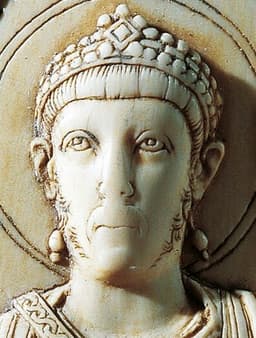
Honorius
Emperor · Ancient
36.3Total

Julius Caesar
General · Ancient
82.8Total
Basic Information
Born
384
-100
Died
423
-44
Era
Ancient
Ancient
Nationality
Western Roman Empire
Roman Republic
Occupation
Emperor
General
Civilization
Western
Western
Score Comparison
Military (10%)
10.2
88.0
Political (20%)
32.1
78.0
Influence (20%)
44.8
85.0
Legacy (20%)
38.3
82.0
Leadership (15%)
34.6
80.0
Strategy (15%)
45.0
85.0
TOTAL
36.3
82.8
Honorius — Complete Timeline
408 AD
Execution of StilichoPolitical Action◆ Major
Honorius ordered the execution of his magister militum Stilicho, who had effectively ruled the Western Empire. Stilicho was accused of treason and executed, leading to the massacre of barbarian soldiers' families and weakening Roman defenses.
Court IntrigueStilichoMilitary
Impact: nationaldestructive
410 AD
Sack of Rome by AlaricWar
The Visigoths under King Alaric sacked the city of Rome, the first time in 800 years that the city had fallen to a foreign enemy. Honorius, residing in Ravenna, failed to prevent the sack, which shocked the Roman world.
Barbarian InvasionsVisigothsFall of Rome
Impact: globaltragic
Loss of BritainPolitical Action◆ Major
Honorius wrote to the cities of Britain telling them to look to their own defense, effectively ending Roman rule in Britain. This withdrawal allowed Anglo-Saxon settlement and the formation of early medieval kingdoms.
BritainRoman WithdrawalAnglo-Saxons
Impact: regional
Julius Caesar — Complete Timeline
58 BC
Gallic WarsWar◆ Major
Caesar, as proconsul of Gaul, launched a series of campaigns that conquered all of Gaul (modern France, Belgium, and parts of Switzerland). He fought numerous battles, including against the Helvetii, the Belgae, and the Gallic chieftain Vercingetorix. The wars brought immense wealth and a loyal army to Caesar.
Gallic WarsConquestRoman Expansion
Impact: regional
49 BC
Crossing the RubiconPolitical Action◆ Major
Caesar led Legio XIII across the Rubicon River into Italy, defying the Roman Senate's order to disband his army. This act triggered a civil war against Pompey and the Optimates, ultimately leading to Caesar's dictatorship and the end of the Roman Republic.
Roman Civil WarEnd of RepublicPower Struggle
Impact: global
48 BC
Battle of PharsalusWar◆ Major
Caesar's outnumbered army defeated the larger forces of Pompey the Great at Pharsalus in Greece. Caesar's tactical use of a reserve line to counter Pompey's cavalry charge proved decisive. Pompey fled to Egypt, where he was assassinated, leaving Caesar as the undisputed master of the Roman world.
Roman Civil WarBattleDecisive Victory
Impact: regional
44 BC
Appointment as Dictator for LifePolitical Action◆ Major
The Roman Senate appointed Caesar dictator perpetuo (dictator for life), granting him unprecedented personal power. This move concentrated military, legislative, and judicial authority in one person, effectively ending the Roman Republic's traditional system of checks and balances and alarming many senators.
DictatorshipEnd of RepublicPower Consolidation
Impact: regionaldestructive
Assassination on the Ides of MarchPolitical Action◆ Major
A group of Roman senators, led by Marcus Junius Brutus and Gaius Cassius Longinus, stabbed Caesar to death at a meeting of the Senate in the Theatre of Pompey. The assassination was intended to restore the Republic, but instead triggered another civil war that led to the rise of the Roman Empire.
AssassinationRoman PoliticsEnd of Republic
Impact: globaldestructive
Expert Analysis
honorius-vs-julius-caesar
# The Ides of March and the Fall of Empires
On a cold January morning in 49 BCE, Julius Caesar stood at the banks of the Rubicon River, a small stream that marked the boundary between his province of Gaul and Italy proper. To cross with his army was to declare war on the Roman Republic itself. He hesitated, then reportedly said, "The die is cast," and led his legions across. Four centuries later, in the summer of 410 CE, the Visigoth king Alaric stood before the gates of Rome. The Western Emperor Honorius, safe in his fortified capital of Ravenna, reportedly sent word that the city's defenders should fight bravely. Alaric's men sacked the city for three days. Between these two moments lies the entire arc of Roman greatness and decay—and the story of two men who embodied its extremes.
Origins
Julius Caesar was born into the patrician Julian clan, a family of ancient lineage but diminished political fortune. His father died when Caesar was sixteen, plunging him into a Rome torn by civil wars between Marius and Sulla. Young Caesar refused Sulla's order to divorce his wife, Cornelia, and fled the city, learning early that survival required audacity. He was a man of the late Republic, an era of ambition unleashed, where a gifted aristocrat could rise through military glory, political cunning, and sheer force of personality.
Honorius, by contrast, was born in 384 CE into a world already crumbling. He was the younger son of Emperor Theodosius I, who divided the Roman Empire between his two boys upon his death in 395. Honorius inherited the West at age eleven. He was not a product of the Forum or the battlefield, but of the palace—a boy raised by eunuchs and courtiers in a court that had retreated to Ravenna's marshes for safety. The Republic was a distant memory; the Empire itself was a patient in decline.
Rise to Power
Caesar's path was one of relentless self-construction. He served in Asia Minor, was captured by pirates and famously told them he would crucify them (he did), and returned to climb the political ladder: quaestor, aedile, pontifex maximus, praetor. His real ascent began when he formed the First Triumvirate with Pompey and Crassus in 60 BCE, then secured the governorship of Gaul. The Gallic Wars (58–50 BCE) were his masterpiece—eight years of conquest that made him the richest and most powerful man in Rome, commanding a veteran army fiercely loyal to him alone.
Honorius became emperor by birthright, not merit. His father's will made him ruler of the West at age eleven. The real power lay with his magister militum, Stilicho, a half-Vandal general who held the empire together through marriage alliances and military campaigns. Honorius grew up in Stilicho's shadow, and for nearly a decade, the arrangement worked. But when Stilicho failed to crush Alaric in 406 and then proposed using the Visigoths against a usurper in Britain, Roman senators whispered betrayal. In 408, Honorius ordered Stilicho's execution—a decision that removed the West's most capable defender and left a power vacuum no one could fill.
Leadership & Governance
Caesar governed as he conquered—with energy, speed, and a vision that transcended the old Republic. As dictator, he reformed the calendar (the Julian calendar we still use), granted citizenship to provincials, redistributed land to veterans, and launched massive public works. His military style was personal: he marched with his men, ate their rations, and wrote his own commentaries. At Alesia in 52 BCE, he defeated Vercingetorix's coalition by building a ring of fortifications around the Gauls while simultaneously defending against a relief army—a feat of logistics and nerve that remains a textbook example of siege warfare.
Honorius governed from a distance. His court in Ravenna was safe but isolated. His military strategy was reactive: when Alaric besieged Rome in 408, Honorius refused to negotiate, forcing the Senate to pay a ransom. When Alaric returned in 410, the emperor sent no relief. The city's gates were opened by traitors from within. Honorius's greatest political achievement—if it can be called that—was the "Rescript of Honorius" in 410, which told the cities of Britain to look to their own defense. This effectively ended Roman rule in Britain after nearly four centuries.
Triumph & Tragedy
Caesar's greatest triumph was the conquest of Gaul, which doubled Rome's territory and made him a living legend. His greatest tragedy was his own success. The Senate, fearing his ambition, assassinated him on March 15, 44 BCE—the Ides of March. He fell at the foot of Pompey's statue, stabbed twenty-three times by men he had once called friends.
Honorius's tragedy was not a single event but a slow unraveling. The sack of Rome in 410 was a psychological blow that shattered the myth of Roman invincibility. Yet Honorius, upon hearing the news, was reportedly more distressed by the death of his favorite chicken, named Roma, than by the city's fall. The story may be apocryphal, but it captures the disconnect between emperor and empire.
Character & Destiny
Caesar was driven by an insatiable will to excel. He forgave enemies, promoted talent regardless of class, and courted popularity with a politician's instinct. But he also possessed a fatal arrogance—he believed his own myth, disbanded his bodyguard, and walked unarmed into the Senate on that March morning. His character was the engine of his rise and the cause of his fall.
Honorius was passive, indecisive, and sheltered. He trusted Stilicho, then killed him. He refused Alaric's reasonable offers of land and settlement, then watched Rome burn. His character was shaped by an upbringing that insulated him from reality. He was not evil; he was simply unequal to his age.
Legacy
Caesar's legacy is the Roman Empire itself. His name became synonymous with imperial rule—Kaiser, Tsar, Czar. His reforms outlived him, and his adopted heir, Octavian, became Augustus, the first true emperor. Caesar changed the course of Western history.
Honorius's legacy is the fall of the West. After his death in 423, the empire staggered on for another five decades, but the loss of Britain, the sack of Rome, and the collapse of central authority were wounds that never healed. He is remembered as the emperor who lost Rome.
Conclusion
One man built an empire; the other watched it burn. Caesar and Honorius represent the two poles of Roman civilization: the creative, ambitious energy that forged a world, and the enervated, passive decay that let it slip away. Between them lies not just four centuries of history, but the eternal lesson that leadership is not a birthright—it is a choice, made at the Rubicon, or avoided at Ravenna.
Rankings
🥇
Julius CaesarLeader
Mil: 88.0Pol: 78.0Inf: 85.0
82.8
🥈
Honorius
Mil: 10.2Pol: 32.1Inf: 44.8
36.3
+46.5 behind
How This Comparison Works
Algorithm
Each figure is scored on 6 dimensions (0—100 scale) based on structured historical data: Military (10%), Political (20%), Influence (20%), Legacy (20%), Leadership (15%), Strategy (15%). The weighted total produces the final ranking.
Data Sources
Scores are computed from structured sub-indicators in the database. Scale factors adjust for era (Ancient ×0.85, Modern ×1.0) and civilization size (Eastern ×1.05, Other ×0.80) to account for differences in population and military scale.
Maximum 3 Figures
Comparisons are limited to 2—3 figures to ensure readability and statistical meaningfulness.
Error Margins
±5 points per dimension — Sub-scores are derived from historical records with inherent uncertainty. Two figures within 5 points on a dimension should be considered roughly equivalent in that area.
Total Score Accuracy
±3 points overall — The weighted combination of 6 dimensions produces a total score with approximately ±3 points of uncertainty. Differences of less than 3 points are not statistically significant— the figures are effectively tied.
Known Limitations
- Historical records are incomplete and uneven across civilizations
- Figures from oral-tradition societies may be underrepresented
- Occupation labels can misclassify multi-role figures
- Scores measure capability and impact, not moral character
- Quantitative scoring is a comparison tool, not absolute truth
Capability Radar
Military (10%) — Battles & Warfare
Battles
5
95
Win Rate
5
92
Expansion
5
97
Political (20%) — Governance & Reform
Reform
10
90
Diplomacy
10
85
Economy
10
82
Influence (20%) — Cultural & Global Reach
Cultural
10
88
Global
15
94
Legacy (20%) — Historical Impact
Historical
20
95
Longevity
20
96
Leadership (15%) — Power & Stability
Tenure
30
75
Stability
10
60
Strategy (15%) — Tactics & Innovation
Strategy
5
94
Tactics
5
96
Reform
5
88
Similar Comparisons
Comments & Discussion
GladiatorGuru6/17/2026
Caesar crossed the Rubicon; Honorius couldn't cross a courtyard without tripping over a chicken. One rewrote history with blood and ambition, the other hid in Ravenna while his capital burned. Give me the man who gambled everything on a single river crossing over the emperor who thought Rome was a pet rooster any day.
历史痛击者6/17/2026
奥诺留斯连一只鸡都认错,却统治着人类史上最庞大的帝国;凯撒征服高卢、击败庞培,却死于他本应信任的元老院。这是命运的讽刺吗?不,这是失败的领导。当哥特人洗劫罗马时,奥诺留斯在拉文纳打游戏;而凯撒在战场上写的战报,至今仍是军事教材。谁更配称为帝王?
DataSkeptic426/17/2026
Let's cut through the hype. Caesar's "genius" came from inheriting a functioning system he could exploit—massive debts, loyal legions, civil war chaos. Honorius couldn't fix a collapsing empire with corrupt tax collectors and barbarian-fed armies. Compare apples to apples: give Caesar Honorius's failing economy and rapacious military, and he'd be sacked by 408 AD too. Leadership isn't magic; it's the era.
古典学派先生6/17/2026
凯撒不仅是独裁者,更是修辞大师。他的《高卢战记》至今仍是拉丁语学习的必修课,连西塞罗都赞叹其文风。而奥诺留斯?历史只留下他和“罗马”的鸡的笑话。从文化贡献看,凯撒改写了历史记录本身;奥诺留斯改写了编年史里的错误。一个创造文明,一个见证衰落。问我选谁?凯撒活着时,罗马还像罗马。