Loading...
This comparison has not been analyzed yet.
One-time AI generation (~1 minute). Scores and timeline are already available below.
Hugo Banzer vs Riad al-Asaad
Hugo Banzer leads by 13.9 pts · 2 figures compared
…
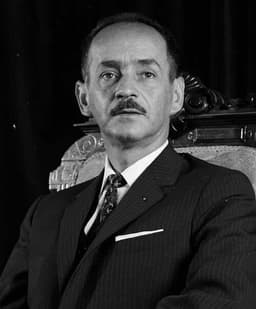
Hugo Banzer
General · Modern
54.3Total

Riad al-Asaad
General · Modern
40.4Total
Basic Information
Born
1926
1961
Died
—
—
Era
Modern
Modern
Nationality
Bolivia
Syria
Occupation
General
General
Civilization
Western
Middle Eastern
Score Comparison
Military (10%)
47.5
50.0
Political (20%)
68.0
25.0
Influence (20%)
52.5
51.0
Legacy (20%)
45.0
40.0
Leadership (15%)
71.0
35.4
Strategy (15%)
43.3
35.7
TOTAL
54.3
40.4
Hugo Banzer — Complete Timeline
1971 AD
Led Coup and Became DictatorPolitical Action◆ Major
General Hugo Banzer led a military coup that overthrew the leftist government of Juan Jos
CoupDictatorship
Impact: nationaldestructive
Repressive RegimePolitical Action◆ Major
Banzer's dictatorship (1971-1978) was marked by widespread human rights abuses, including torture, disappearances, and suppression of political dissent. Trade unions and leftist parties were banned, and thousands were imprisoned or exiled.
RepressionHuman Rights
Impact: nationaldestructive
1973 AD
Economic Growth Under DictatorshipReform
During Banzer's rule, Bolivia experienced economic growth driven by high commodity prices and foreign investment, particularly in oil and gas. However, this growth was uneven and benefited elites, while poverty and inequality persisted.
EconomyGrowth
Impact: national
1978 AD
Transition to DemocracyPolitical Action◆ Major
Banzer called for elections in 1978, but they were marred by fraud. He was eventually forced to step down after a coup, leading to a period of political instability. However, his later role in the democratic transition was significant.
DemocracyTransition
Impact: national
1997 AD
Elected President DemocraticallyPolitical Action◆ Major
Banzer was elected president of Bolivia in 1997 as a democrat, leading a coalition government. His term (1997-2001) focused on anti-corruption, education reform, and coca eradication, but was also marked by social unrest.
PresidencyDemocracy
Impact: nationalconstructive
1998 AD
Coca Eradication PolicyReform◆ Major
Banzer's government implemented a policy of forced coca eradication, targeting coca production in the Chapare region. This led to violent clashes with coca growers, who were supported by Evo Morales, and was controversial both domestically and internationally.
CocaDrug Policy
Impact: nationaldestructive
2001 AD
Resigned Due to IllnessPolitical Action
Banzer resigned the presidency in 2001 due to lung cancer. He was succeeded by his vice president, Jorge Quiroga. His resignation marked the end of his political career.
ResignationHealth
Impact: national
Riad al-Asaad — Complete Timeline
2011 AD
Announced formation of the Free Syrian ArmyPolitical Action◆ Major
On July 29, 2011, Riad al-Asaad, a former Syrian Air Force colonel, announced the formation of the Free Syrian Army (FSA) in a video statement. This marked the creation of an armed opposition force against the government of Bashar al-Assad, drawing defectors from the Syrian military and initiating organized armed resistance in the Syrian Civil War.
Syrian Civil WarArmed OppositionFSA
Impact: regional
2013 AD
Assassination attempt by car bombOther◆ Major
In March 2013, a car bomb targeted Riad al-Asaad in Deir ez-Zor, Syria. The explosion killed several of his bodyguards and severely wounded al-Asaad, leaving him with permanent injuries. The attack was attributed to Islamist extremist groups within the Syrian opposition, highlighting internal divisions among anti-government forces.
Assassination AttemptInternal ConflictInjury
Impact: nationaltragic
Relocated to Turkey and lost FSA leadershipPolitical Action
Following the assassination attempt, Riad al-Asaad moved to Turkey for medical treatment and safety. While in exile, his influence over the Free Syrian Army diminished as more powerful Islamist factions and rival commanders took operational control of FSA units inside Syria, reducing his role to a symbolic figurehead.
ExileLeadership DeclineFSA
Impact: national
This comparison has not been analyzed yet.
One-time AI generation (~1 minute). Scores and timeline are already available below.
Rankings
🥇
Hugo BanzerLeader
Mil: 47.5Pol: 68.0Inf: 52.5
54.3
🥈
Riad al-Asaad
Mil: 50.0Pol: 25.0Inf: 51.0
40.4
+13.9 behind
How This Comparison Works
Algorithm
Each figure is scored on 6 dimensions (0—100 scale) based on structured historical data: Military (10%), Political (20%), Influence (20%), Legacy (20%), Leadership (15%), Strategy (15%). The weighted total produces the final ranking.
Data Sources
Scores are computed from structured sub-indicators in the database. Scale factors adjust for era (Ancient ×0.85, Modern ×1.0) and civilization size (Eastern ×1.05, Other ×0.80) to account for differences in population and military scale.
Maximum 3 Figures
Comparisons are limited to 2—3 figures to ensure readability and statistical meaningfulness.
Error Margins
±5 points per dimension — Sub-scores are derived from historical records with inherent uncertainty. Two figures within 5 points on a dimension should be considered roughly equivalent in that area.
Total Score Accuracy
±3 points overall — The weighted combination of 6 dimensions produces a total score with approximately ±3 points of uncertainty. Differences of less than 3 points are not statistically significant— the figures are effectively tied.
Known Limitations
- Historical records are incomplete and uneven across civilizations
- Figures from oral-tradition societies may be underrepresented
- Occupation labels can misclassify multi-role figures
- Scores measure capability and impact, not moral character
- Quantitative scoring is a comparison tool, not absolute truth
Capability Radar
Military (10%) — Battles & Warfare
Battles
20
15
Win Rate
25
10
Expansion
15
10
Political (20%) — Governance & Reform
Reform
55
5
Diplomacy
50
15
Economy
45
5
Influence (20%) — Cultural & Global Reach
Cultural
20
10
Global
25
15
Legacy (20%) — Historical Impact
Historical
40
20
Longevity
30
10
Leadership (15%) — Power & Stability
Tenure
60
10
Stability
30
5
Strategy (15%) — Tactics & Innovation
Strategy
35
15
Tactics
30
20
Reform
40
10
Similar Comparisons
Comments & Discussion
No comments yet. Be the first to share your thoughts!