Loading...
Indira Gandhi vs Joaquim Chissano
Indira Gandhi leads by 1.0 pts · 2 figures compared
…

Indira Gandhi
Politician · Modern
60.8Total
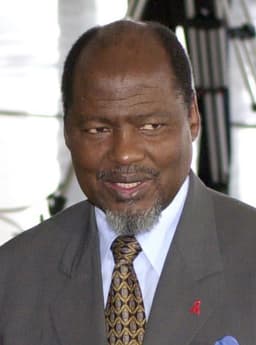
Joaquim Chissano
Politician · Modern
59.8Total
Basic Information
Born
1917
1939
Died
1984
—
Era
Modern
Modern
Nationality
India
Mozambique
Occupation
Politician
Politician
Civilization
Indian
Other
Score Comparison
Military (10%)
45.0
36.6
Political (20%)
65.0
78.0
Influence (20%)
68.0
58.0
Legacy (20%)
52.0
50.0
Leadership (15%)
80.0
80.0
Strategy (15%)
45.0
54.3
TOTAL
60.8
59.8
Indira Gandhi — Complete Timeline
1967 AD
Green Revolution ImplementationReform◆ Major
Gandhi's government accelerated the Green Revolution, promoting high-yield crop varieties, fertilizers, and irrigation. This policy transformed India from a food-deficient nation to a self-sufficient one in grain production.
AgricultureFood SecurityEconomic Development
Impact: nationalconstructive
1969 AD
Nationalization of BanksReform◆ Major
Gandhi's government nationalized 14 major commercial banks in India. The policy aimed to extend banking services to rural areas and control credit flow, significantly expanding state control over the economy.
Economic PolicyBankingSocialism
Impact: nationalconstructive
1971 AD
Indo-Pakistani War of 1971War
India intervened in the Bangladesh Liberation War against Pakistan. The conflict ended with the surrender of 93,000 Pakistani soldiers and the creation of Bangladesh, establishing India as the dominant power in South Asia.
Bangladesh Liberation WarMilitary VictorySouth Asia
Impact: regional
1975 AD
Imposition of EmergencyPolitical Action◆ Major
Gandhi declared a national state of emergency, suspending civil liberties and censoring the press. Thousands of political opponents were imprisoned. The Emergency lasted 21 months and is considered a dark period in Indian democracy.
AuthoritarianismCivil LibertiesIndian Democracy
Impact: nationaldestructive
1984 AD
Operation Blue StarWar◆ Major
Gandhi ordered the Indian Army to storm the Golden Temple in Amritsar to remove Sikh militants. The operation caused significant damage to the temple and resulted in hundreds of casualties, deeply alienating the Sikh community.
Sikh ConflictGolden TempleMilitary Action
Impact: nationaltragic
Assassination of Indira GandhiPolitical Action
Gandhi was shot dead by her own Sikh bodyguards in New Delhi as revenge for Operation Blue Star. Her assassination triggered anti-Sikh riots across India that killed thousands.
AssassinationSikh RiotsPolitical Violence
Impact: nationaltragic
Joaquim Chissano — Complete Timeline
1992 AD
Rome General Peace AccordsPolitical Action◆ Major
As President of Mozambique, Joaquim Chissano signed the Rome General Peace Accords with the rebel group RENAMO, ending the 16-year Mozambican Civil War. The agreement established a multiparty democracy and led to UN-supervised elections in 1994, which Chissano won.
Peace AgreementCivil War EndDemocratization
Impact: nationalconstructive
1994 AD
Economic reform and growthReform◆ Major
Chissano implemented market-oriented economic reforms, including privatization, trade liberalization, and fiscal discipline, supported by the IMF and World Bank. Mozambique experienced sustained GDP growth averaging 8% annually from 1994 to 2004, reducing poverty but also increasing inequality.
Economic ReformGrowthPoverty Reduction
Impact: nationalconstructive
1994 Mozambican general electionPolitical Action◆ Major
Chissano won the first multiparty elections in Mozambique's history, securing 53.3% of the presidential vote against RENAMO's Afonso Dhlakama. His FRELIMO party also won a majority in parliament. The election marked the successful transition from war to democracy.
ElectionDemocracyTransition
Impact: nationalprogressive
2000 AD
HIV/AIDS responseReform◆ Major
Chissano's government launched a national HIV/AIDS strategy, including prevention campaigns and antiretroviral treatment programs. Mozambique had one of the highest HIV prevalence rates in the world, and the response helped slow the epidemic, though challenges remained.
Public HealthHIV/AIDSTreatment
Impact: nationalconstructive
2004 AD
2004 Mozambican general electionPolitical Action◆ Major
Chissano stepped down after two terms, respecting constitutional term limits. He oversaw peaceful elections that brought his successor, Armando Guebuza, to power. This peaceful transfer of power was a milestone for democratic consolidation in Mozambique.
ElectionDemocratic TransitionTerm Limits
Impact: nationalprogressive
Expert Analysis
Origins
**Indira Gandhi** was born on November 19, 1917, in Allahabad, India, into the politically dominant Nehru family. Her father, Jawaharlal Nehru, was a key figure in the Indian independence movement and later India's first prime minister. Indira studied at Santiniketan and Oxford University, but her education was interrupted by her involvement in the freedom struggle. She served as her father's hostess and political aide, absorbing the intricacies of politics from an early age.
**Joaquim Chissano** was born on October 22, 1939, in Malehice, Mozambique, then a Portuguese colony. He was the son of a peasant family and studied at the University of Lisbon, where he became involved in anti-colonial activism. He joined the Mozambican Liberation Front (FRELIMO) in 1962 and underwent military training in Algeria. His formative years were shaped by the struggle for independence, culminating in Mozambique's freedom in 1975.
Rise to Power
Indira Gandhi's rise was meteoric. In 1966, after the death of Prime Minister Lal Bahadur Shastri, she was chosen as a compromise candidate by the Congress party's old guard, who underestimated her. She quickly consolidated power, splitting the party in 1969 and leading the Congress (R) to victory in the 1971 elections. Her popularity soared after the Indo-Pakistani War of 1971, which led to the creation of Bangladesh. She scored 45.0 in military strategy, but her political score of 65.0 reflects her shrewd maneuvering.
Chissano rose through FRELIMO's ranks. After independence, he served as Minister of Foreign Affairs under President Samora Machel from 1975 to 1986. When Machel died in a plane crash in 1986, Chissano was chosen as president by the party. His political score of 78.0 reflects his ability to navigate a complex civil war and negotiate peace.
Leadership & Governance
Indira Gandhi governed with a centralizing, authoritarian style. She nationalized banks (1969) and abolished princely privileges, but also imposed a state of Emergency from 1975 to 1977, suspending civil liberties and imprisoning opponents. Her leadership score of 80.0 reflects her decisiveness, but her strategy score of 45.0 indicates flawed long-term planning. Operation Blue Star in 1984, aimed at removing Sikh militants from the Golden Temple, caused significant damage and led to her assassination.
Chissano's leadership was consultative and democratic. He signed the Rome General Peace Accords in 1992, ending the 16-year civil war. He implemented market reforms, privatizing state enterprises and attracting foreign investment. His HIV/AIDS response, including antiretroviral programs, was praised internationally. His political score of 78.0 and strategy score of 54.3 reflect his pragmatic, inclusive approach.
Triumph & Tragedy
Indira Gandhi's greatest triumph was the 1971 war, which established India as a regional power. She also successfully navigated the oil crisis and food shortages. However, her Emergency rule is widely condemned as a dark period. Operation Blue Star was a military and political disaster, leading to her assassination by her Sikh bodyguards on October 31, 1984. The subsequent anti-Sikh riots killed thousands, tarnishing her legacy.
Chissano's triumph was ending the civil war and overseeing Mozambique's transition to multiparty democracy. He won the 1994 elections with 53.3% of the vote. He stepped down voluntarily in 2004, respecting term limits. However, his legacy is mixed: Mozambique remained one of the poorest countries, and his economic reforms widened inequality. The HIV/AIDS crisis, while addressed, still devastated the population.
Character & Destiny
Indira Gandhi was determined, ruthless, and secretive. She centralized power and trusted few, relying on her son Sanjay. Her character led to both bold decisions (1971 war) and disastrous ones (Emergency). Historians assess her as a strong leader who undermined democratic institutions. Her influence score of 68.0 reflects her impact on India and the non-aligned movement.
Chissano was calm, diplomatic, and consensus-building. He prioritized reconciliation over revenge, offering amnesty to RENAMO fighters. His character enabled peace but also led to slow economic transformation. He is often praised as a statesman who put country above personal ambition. His influence score of 58.0 reflects a more modest global footprint.
Legacy
Indira Gandhi's legacy is deeply contested. She reshaped India's economy and foreign policy, but her authoritarian turn damaged democratic norms. Her total score of 60.8 is slightly higher than Chissano's 59.8. She remains a polarizing figure: admired for strength, criticized for excesses.
Chissano's legacy is more uniformly positive. He is remembered as a peacemaker who ended a brutal war and established democracy. His economic reforms set Mozambique on a growth path, though poverty persists. He won the 2007 Mo Ibrahim Prize for Achievement in African Leadership, recognizing his commitment to democracy and development.
Conclusion
Indira Gandhi had a greater impact on a larger stage, shaping the destiny of a billion people. Her total score of 60.8 edges Chissano's 59.8. However, her methods were often destructive, and her legacy is tainted by authoritarianism. Chissano's impact, while smaller in scale, was more constructive: he ended a war, built peace, and respected democratic norms. In terms of net positive contribution, Chissano's leadership was more effective and ethical. While Gandhi's influence was immense, Chissano's legacy is cleaner. The data suggests that Gandhi's military and political actions had higher stakes, but Chissano's approach yielded sustainable, peaceful outcomes. Therefore, Chissano's impact, though less dramatic, is ultimately more commendable.
Rankings
🥇
Indira GandhiLeader
Mil: 45.0Pol: 65.0Inf: 68.0
60.8
🥈
Joaquim Chissano
Mil: 36.6Pol: 78.0Inf: 58.0
59.8
+1.0 behind
How This Comparison Works
Algorithm
Each figure is scored on 6 dimensions (0—100 scale) based on structured historical data: Military (10%), Political (20%), Influence (20%), Legacy (20%), Leadership (15%), Strategy (15%). The weighted total produces the final ranking.
Data Sources
Scores are computed from structured sub-indicators in the database. Scale factors adjust for era (Ancient ×0.85, Modern ×1.0) and civilization size (Eastern ×1.05, Other ×0.80) to account for differences in population and military scale.
Maximum 3 Figures
Comparisons are limited to 2—3 figures to ensure readability and statistical meaningfulness.
Error Margins
±5 points per dimension — Sub-scores are derived from historical records with inherent uncertainty. Two figures within 5 points on a dimension should be considered roughly equivalent in that area.
Total Score Accuracy
±3 points overall — The weighted combination of 6 dimensions produces a total score with approximately ±3 points of uncertainty. Differences of less than 3 points are not statistically significant— the figures are effectively tied.
Known Limitations
- Historical records are incomplete and uneven across civilizations
- Figures from oral-tradition societies may be underrepresented
- Occupation labels can misclassify multi-role figures
- Scores measure capability and impact, not moral character
- Quantitative scoring is a comparison tool, not absolute truth
Capability Radar
Military (10%) — Battles & Warfare
Battles
10
5
Win Rate
10
5
Expansion
20
5
Political (20%) — Governance & Reform
Reform
75
80
Diplomacy
70
85
Economy
60
65
Influence (20%) — Cultural & Global Reach
Cultural
65
40
Global
70
50
Legacy (20%) — Historical Impact
Historical
70
55
Longevity
60
45
Leadership (15%) — Power & Stability
Tenure
85
75
Stability
50
80
Strategy (15%) — Tactics & Innovation
Strategy
20
10
Tactics
10
5
Reform
30
15
Similar Comparisons
Comments & Discussion
No comments yet. Be the first to share your thoughts!