Loading...
Joaquim Chissano vs Napoleon Bonaparte
Napoleon Bonaparte leads by 11.1 pts · 2 figures compared
…
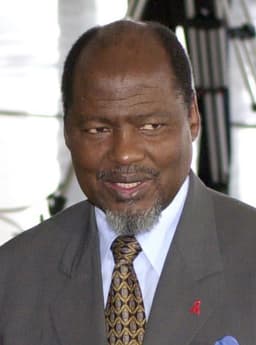
Joaquim Chissano
Politician · Modern
59.8Total

Napoleon Bonaparte
General · Modern
70.9Total
Basic Information
Born
1939
1769
Died
—
1821
Era
Modern
Modern
Nationality
Mozambique
France
Occupation
Politician
General
Civilization
Other
Western
Score Comparison
Military (10%)
36.6
94.0
Political (20%)
78.0
72.0
Influence (20%)
58.0
40.0
Legacy (20%)
50.0
80.0
Leadership (15%)
80.0
78.0
Strategy (15%)
54.3
90.0
TOTAL
59.8
70.9
Joaquim Chissano — Complete Timeline
1992 AD
Rome General Peace AccordsPolitical Action◆ Major
As President of Mozambique, Joaquim Chissano signed the Rome General Peace Accords with the rebel group RENAMO, ending the 16-year Mozambican Civil War. The agreement established a multiparty democracy and led to UN-supervised elections in 1994, which Chissano won.
Peace AgreementCivil War EndDemocratization
Impact: nationalconstructive
1994 AD
Economic reform and growthReform◆ Major
Chissano implemented market-oriented economic reforms, including privatization, trade liberalization, and fiscal discipline, supported by the IMF and World Bank. Mozambique experienced sustained GDP growth averaging 8% annually from 1994 to 2004, reducing poverty but also increasing inequality.
Economic ReformGrowthPoverty Reduction
Impact: nationalconstructive
1994 Mozambican general electionPolitical Action◆ Major
Chissano won the first multiparty elections in Mozambique's history, securing 53.3% of the presidential vote against RENAMO's Afonso Dhlakama. His FRELIMO party also won a majority in parliament. The election marked the successful transition from war to democracy.
ElectionDemocracyTransition
Impact: nationalprogressive
2000 AD
HIV/AIDS responseReform◆ Major
Chissano's government launched a national HIV/AIDS strategy, including prevention campaigns and antiretroviral treatment programs. Mozambique had one of the highest HIV prevalence rates in the world, and the response helped slow the epidemic, though challenges remained.
Public HealthHIV/AIDSTreatment
Impact: nationalconstructive
2004 AD
2004 Mozambican general electionPolitical Action◆ Major
Chissano stepped down after two terms, respecting constitutional term limits. He oversaw peaceful elections that brought his successor, Armando Guebuza, to power. This peaceful transfer of power was a milestone for democratic consolidation in Mozambique.
ElectionDemocratic TransitionTerm Limits
Impact: nationalprogressive
Napoleon Bonaparte — Complete Timeline
1799 AD
Coup of 18 BrumaireOther◆ Major
Napoleon Bonaparte, with support from his brother Lucien and key political figures, overthrew the Directory in a bloodless coup. He established the Consulate with himself as First Consul, effectively becoming the ruler of France. This event ended the French Revolution's most unstable period.
French RevolutionCoupRise to Power
Impact: regional
1804 AD
Promulgation of the Napoleonic CodeOther◆ Major
Napoleon enacted the Civil Code of the French, known as the Napoleonic Code, a comprehensive set of laws that replaced the fragmented feudal legal systems. The code established legal equality, protected property rights, and secularized law. It became the basis for legal systems in many European and world countries.
Legal ReformNapoleonic CodeCivil Law
Impact: globalconstructive
1805 AD
Battle of AusterlitzWar◆ Major
Napoleon's Grande Arm
Napoleonic WarsBattleDecisive Victory
Impact: global
1812 AD
Invasion of RussiaWar◆ Major
Napoleon led the Grande Arm
Napoleonic WarsInvasionDisaster
Impact: globaldestructive
1815 AD
Battle of WaterlooWar◆ Major
Napoleon's French army was defeated by the combined forces of the Duke of Wellington's Anglo-Allied army and Gebhard Leberecht von Bl
Napoleonic WarsBattleFinal Defeat
Impact: globaldestructive
Expert Analysis
joaquim-chissano-vs-napoleon-bonaparte
# The Conqueror and the Peacemaker
On a June morning in 1815, Napoleon Bonaparte stood on a muddy field near Waterloo, watching his Imperial Guard march into cannon fire for the last time. Nearly two centuries later, in October 1992, Joaquim Chissano sat in a Roman palace, signing a peace accord with the very rebels who had ravaged his country for sixteen years. One man built an empire of conquest that collapsed in a single day; the other built a fragile peace that outlasted his presidency. What separates the general who reshaped Europe through war from the politician who rebuilt a nation through compromise? The answer lies not merely in their choices, but in the worlds that shaped them.
Origins
Napoleon Bonaparte was born in 1769 on Corsica, an island that had just become French property. His family was minor nobility, poor enough to resent the mainland, ambitious enough to send him to French military academies. There, the short, intense boy with a thick Italian accent was mocked by aristocratic classmates. He learned early that brilliance could overcome birth—and that resentment could fuel greatness. The French Revolution erupted when he was twenty, shattering the old order and opening paths that birth had once barred. He emerged from that chaos with a conviction that will, intelligence, and cannon fire could remake the world.
Joaquim Chissano was born in 1939 in a rural village in Portuguese Mozambique, a colony where black Africans had no rights. His father was a peasant; his mother died when he was young. Education was his escape—he studied in Lisbon, then in France, where he met other young Africans plotting liberation. Unlike Napoleon, who inherited a revolution, Chissano inherited a colony. He joined FRELIMO, the Marxist liberation movement, learning guerrilla warfare in the bush. When independence came in 1975, he became Foreign Minister under Samora Machel, a fiery revolutionary. For a decade, he watched Mozambique descend into civil war, drought, and economic collapse. By the time Machel died in a 1986 plane crash, Chissano understood something Napoleon never did: that power gained through violence is rarely secured through more violence.
Rise to Power
Napoleon’s ascent was meteoric. At twenty-four, he drove the British out of Toulon. At twenty-six, he crushed a royalist uprising in Paris with a “whiff of grapeshot.” At twenty-seven, he conquered Italy, dictating peace terms to the Austrians. Each victory fed the next. By 1799, he was First Consul of France; by 1804, Emperor. His rise was a masterpiece of timing, talent, and ruthlessness—he seized opportunities that the Revolution’s chaos had created, and he never looked back.
Chissano’s rise was slower, quieter, and more tragic. He became president in 1986 not through conquest but through catastrophe: Machel’s plane crashed in South Africa under suspicious circumstances. Mozambique was bankrupt, its infrastructure destroyed by RENAMO rebels backed by white-ruled Rhodesia and South Africa. A million people had died. Chissano inherited a country that was, in his own words, “a patient in intensive care.” He did not storm history’s stage; he crept onto it, carrying a dying nation.
Leadership & Governance
Napoleon governed as he conquered: through will, order, and glory. His Napoleonic Code unified French law, establishing equality before the law and protecting property rights—a revolutionary legacy that spread across Europe. He built roads, schools, and a centralized bureaucracy. But his genius was military. At Austerlitz in 1805, he destroyed the armies of Russia and Austria, a battle still studied as a masterpiece of deception and timing. He understood that war was not just about soldiers but about morale, logistics, and the psychological destruction of the enemy. His political wisdom, however, was brittle. He appointed family members as kings, suppressed dissent, and believed his own legend. “Power is my mistress,” he once said. It was a confession of addiction.
Chissano governed through patience, negotiation, and strategic retreat. He abandoned Marxism not out of ideology but necessity, implementing market reforms in 1994 that privatized state industries and attracted foreign investment. He legalized opposition parties, freed political prisoners, and—most remarkably—negotiated with RENAMO’s leader, Afonso Dhlakama, a man who had ordered the murder of Chissano’s own supporters. The 1992 Rome Peace Accords were not a surrender but a recognition that peace required giving enemies a stake in the future. Chissano won Mozambique’s first multiparty elections in 1994 with 53.3% of the vote, then stepped down after two terms in 2004, respecting term limits that he could have abolished. His strategy was not Napoleonic brilliance but institutional humility.
Triumph & Tragedy
Napoleon’s greatest triumph was Austerlitz; his greatest tragedy was the 1812 invasion of Russia. He marched 600,000 men into the Russian winter; fewer than 100,000 returned. The disaster shattered his aura of invincibility, and within two years he was exiled to Elba. He returned for a final, desperate gamble in 1815—the Hundred Days—but Waterloo ended it. He died in 1821 on Saint Helena, a British prisoner, dictating memoirs that would cement his legend.
Chissano’s greatest triumph was the peace itself. Mozambique, once a byword for famine and war, became a story of recovery. By 2000, economic growth averaged 8% annually. His HIV/AIDS response, launched in 2000, expanded antiretroviral treatment and prevention campaigns, though the epidemic remained devastating. His tragedy was quieter: the peace was imperfect. Poverty persisted, corruption festered, and RENAMO never fully disarmed. In 2013, years after Chissano left office, fighting resumed briefly. Peace, unlike conquest, requires constant maintenance.
Character & Destiny
Napoleon’s character was a furnace of ambition, intelligence, and insecurity. He needed enemies to define himself, battles to prove his worth. “I live only for posterity,” he said, and so he did—at the cost of those who lived beside him. His destiny was to rise higher than any man of his age, then fall further, a cautionary tale about the limits of will.
Chissano’s character was shaped by survival. He had seen friends die in the liberation struggle, seen his mentor’s plane fall from the sky, seen his country starve. He learned that power was not a prize but a responsibility. “A leader is like a shepherd,” he once said. “He stays behind the flock, letting the most nimble go out ahead, whereupon the others follow, not realizing that all along they are being directed from behind.” His destiny was not glory but service—and a quiet legacy that outlasted his presidency.
Legacy
Napoleon’s legacy is monumental: the Napoleonic Code, modern warfare, the redrawing of Europe, the spread of nationalism. He is remembered as both liberator and tyrant, genius and megalomaniac. His name evokes cannon fire and marble arches, ambition and ruin.
Chissano’s legacy is less visible but equally profound. He proved that a leader could end a civil war by sharing power, not crushing enemies. He showed that economic reform could lift a country from collapse. In 2007, he was awarded the Mo Ibrahim Prize for Achievement in African Leadership—a recognition of his peaceful transition of power. He is remembered not for battles but for bridges.
Conclusion
Napoleon and Chissano lived in different worlds, but their stories share a haunting symmetry. Both inherited chaos; both sought order. Napoleon believed order came from above, imposed by a single will. Chissano believed order came from below, built through consent. One conquered Europe and lost everything; one saved a nation and walked away. The difference was not talent—both were brilliant. It was not opportunity—both faced extraordinary circumstances. The difference was what they chose to value: glory or peace, the self or the nation. In the end, Napoleon’s tomb in Paris is a monument to one man’s ambition; Chissano’s legacy is a country that still exists, still struggles, still hopes. That, perhaps, is the deeper victory.
Rankings
🥇
Napoleon BonaparteLeader
Mil: 94.0Pol: 72.0Inf: 40.0
70.9
🥈
Joaquim Chissano
Mil: 36.6Pol: 78.0Inf: 58.0
59.8
+11.1 behind
How This Comparison Works
Algorithm
Each figure is scored on 6 dimensions (0—100 scale) based on structured historical data: Military (10%), Political (20%), Influence (20%), Legacy (20%), Leadership (15%), Strategy (15%). The weighted total produces the final ranking.
Data Sources
Scores are computed from structured sub-indicators in the database. Scale factors adjust for era (Ancient ×0.85, Modern ×1.0) and civilization size (Eastern ×1.05, Other ×0.80) to account for differences in population and military scale.
Maximum 3 Figures
Comparisons are limited to 2—3 figures to ensure readability and statistical meaningfulness.
Error Margins
±5 points per dimension — Sub-scores are derived from historical records with inherent uncertainty. Two figures within 5 points on a dimension should be considered roughly equivalent in that area.
Total Score Accuracy
±3 points overall — The weighted combination of 6 dimensions produces a total score with approximately ±3 points of uncertainty. Differences of less than 3 points are not statistically significant— the figures are effectively tied.
Known Limitations
- Historical records are incomplete and uneven across civilizations
- Figures from oral-tradition societies may be underrepresented
- Occupation labels can misclassify multi-role figures
- Scores measure capability and impact, not moral character
- Quantitative scoring is a comparison tool, not absolute truth
Capability Radar
Military (10%) — Battles & Warfare
Battles
5
95
Win Rate
5
90
Expansion
5
95
Political (20%) — Governance & Reform
Reform
80
95
Diplomacy
85
80
Economy
65
85
Influence (20%) — Cultural & Global Reach
Cultural
40
85
Global
50
90
Legacy (20%) — Historical Impact
Historical
55
95
Longevity
45
90
Leadership (15%) — Power & Stability
Tenure
75
85
Stability
80
70
Strategy (15%) — Tactics & Innovation
Strategy
10
95
Tactics
5
98
Reform
15
92
Similar Comparisons
Comments & Discussion
MajorOfMarengo6/17/2026
Napoleon lost at Waterloo because he was outgeneraled—full stop. Wellington chose the field, Blücher arrived on time, and Napoleon's subordinates failed him. But here's the thing: without Waterloo, Chissano wouldn't have had a Mozambique to rebuild. European wars carved Africa into colonies; Chissano had to unstitch that mess with handshake diplomacy. Comparing a field marshal to a nation-builder misses the point. One breaks things down, the other puts them back together.
战史望远镜6/17/2026
论军事天赋,拿破仑甩查萨诺十条街。但恰恰是这种天才害了他——他把治国当成了打仗,用政令和刺刀推行改革,结果帝国像积木一样塌了。而查萨诺这位前游击队员,深知暴力解决不了莫桑比克的族裔裂痕,硬是带着砍刀和圣经跟雷纳莫和谈。一个死于自己最擅长的东西,一个活在自己最恐惧的东西里。讽刺啊。
ClassicsSkeptic6/17/2026
We're comparing a revolutionary emperor who controlled half of Europe with a president who managed a dirt-poor, war-torn colony. It's apples and cannonballs. Napoleon's Civil Code still governs half the world's legal systems; Chissano's main legacy is not starting more wars. That's like comparing Alexander the Great to a competent village mayor. Chissano deserves credit for peace, sure, but let's not pretend their impacts are remotely comparable in scale or reach.
和平裁缝6/17/2026
说拿破仑伟大的人,大多没经历过他的战争。他每场胜利都踩着几十万具尸体,最后把法国人口打光了一代人。查萨诺呢?他签《罗马和平总协议》时,莫桑比克已经死了上百万人,他选择放下枪而不是继续报仇。这比拿破仑在滑铁卢玩最后一搏难多了。真正的勇者不是敢开炮,而是敢把俘虏请上谈判桌。这才是领袖的试金石。
DataDrill6/17/2026
Numbers don't lie, but they sure can mislead. Napoleon's battles involved armies of 200,000; Chissano's entire country had fewer paved roads than Napoleon had horses. Yet here's the stat that matters: Chissano's peace held for 30+ years, while Napoleon's empire dissolved within three after Waterloo. One metric—longevity of positive outcome—flips the whole comparison. Conquest impresses in history books; lasting recovery is what people actually live with every day.
枫叶之眼6/17/2026
一个欧洲来的评论:拿破仑把法国送上顶峰又摔回谷底,查萨诺把莫桑比克从深渊拖到勉强站稳。但站在2024年回头看,拿破仑的遗产是民族主义战争和永不停歇的霸权焦虑,而查萨诺留下的是一个没有