Loading...
Injong of Goryeo vs Julius Caesar
Julius Caesar leads by 37.4 pts · 2 figures compared
…
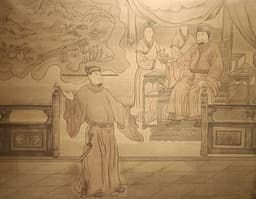
Injong of Goryeo
Emperor · Medieval
45.4Total

Julius Caesar
General · Ancient
82.8Total
Basic Information
Born
1109
-100
Died
1146
-44
Era
Medieval
Ancient
Nationality
Korea
Roman Republic
Occupation
Emperor
General
Civilization
Eastern
Western
Score Comparison
Military (10%)
25.9
88.0
Political (20%)
37.9
78.0
Influence (20%)
50.2
85.0
Legacy (20%)
45.0
82.0
Leadership (15%)
62.2
80.0
Strategy (15%)
39.6
85.0
TOTAL
45.4
82.8
Injong of Goryeo — Complete Timeline
1135 AD
Myocheong rebellionWar◆ Major
The Buddhist monk Myocheong led a rebellion in Pyongyang, advocating for moving the capital and attacking the Jurchen Jin dynasty. King Injong initially supported the plan but later opposed it, leading to a three-year revolt that was crushed by the general Kim Bu-sik.
RebellionCapital MoveGoryeo
Impact: nationaldestructive
1136 AD
Suppression of the Myocheong rebellion by Kim Bu-sikWar◆ Major
General Kim Bu-sik, acting on Injong's orders, besieged and captured Pyongyang, ending the Myocheong rebellion. The victory strengthened the authority of the civil bureaucracy over military and religious factions, but also deepened regional tensions.
Civil WarMilitary CampaignGoryeo
Impact: national
1140 AD
Adoption of the 'Goryeo dogyeong' (Goryeo Code)Reform
Injong oversaw the compilation of a new legal code based on Tang and Song Chinese models. The code standardized administrative procedures and criminal law, but its implementation was uneven due to aristocratic resistance.
Legal ReformCodeGoryeo
Impact: nationalconstructive
Julius Caesar — Complete Timeline
58 BC
Gallic WarsWar◆ Major
Caesar, as proconsul of Gaul, launched a series of campaigns that conquered all of Gaul (modern France, Belgium, and parts of Switzerland). He fought numerous battles, including against the Helvetii, the Belgae, and the Gallic chieftain Vercingetorix. The wars brought immense wealth and a loyal army to Caesar.
Gallic WarsConquestRoman Expansion
Impact: regional
49 BC
Crossing the RubiconPolitical Action◆ Major
Caesar led Legio XIII across the Rubicon River into Italy, defying the Roman Senate's order to disband his army. This act triggered a civil war against Pompey and the Optimates, ultimately leading to Caesar's dictatorship and the end of the Roman Republic.
Roman Civil WarEnd of RepublicPower Struggle
Impact: global
48 BC
Battle of PharsalusWar◆ Major
Caesar's outnumbered army defeated the larger forces of Pompey the Great at Pharsalus in Greece. Caesar's tactical use of a reserve line to counter Pompey's cavalry charge proved decisive. Pompey fled to Egypt, where he was assassinated, leaving Caesar as the undisputed master of the Roman world.
Roman Civil WarBattleDecisive Victory
Impact: regional
44 BC
Appointment as Dictator for LifePolitical Action◆ Major
The Roman Senate appointed Caesar dictator perpetuo (dictator for life), granting him unprecedented personal power. This move concentrated military, legislative, and judicial authority in one person, effectively ending the Roman Republic's traditional system of checks and balances and alarming many senators.
DictatorshipEnd of RepublicPower Consolidation
Impact: regionaldestructive
Assassination on the Ides of MarchPolitical Action◆ Major
A group of Roman senators, led by Marcus Junius Brutus and Gaius Cassius Longinus, stabbed Caesar to death at a meeting of the Senate in the Theatre of Pompey. The assassination was intended to restore the Republic, but instead triggered another civil war that led to the rise of the Roman Empire.
AssassinationRoman PoliticsEnd of Republic
Impact: globaldestructive
Expert Analysis
injong-of-goryeo-vs-julius-caesar
# The Emperor and the General: Two Paths to Power
On a cold January morning in 49 BCE, Julius Caesar stood at the banks of the Rubicon River in northern Italy, contemplating an act that would shatter centuries of Roman tradition. To cross with his legions was to declare war on the Republic itself. Across the world, nearly twelve centuries later, another ruler faced his own moment of decision: King Injong of Goryeo, a young monarch in his mid-twenties, watched as a charismatic Buddhist monk named Myocheong gathered armies in Pyongyang, demanding the capital be moved north and war declared against the Jurchen tribes. Both men stood at crossroads where power, ambition, and fate converged. Yet their responses—and their historical legacies—could not have been more different.
Origins
Julius Caesar was born into a patrician family that had seen better days. The Rome of 100 BCE was a cauldron of civil strife, where ambitious generals like Marius and Sulla had already demonstrated that military loyalty could override constitutional order. Caesar's father died when he was sixteen, leaving him to navigate Rome's treacherous politics as a young man with debts, ambition, and a name that still carried weight. He learned early that survival meant forging alliances, courting the masses, and never hesitating when opportunity presented itself.
Injong of Goryeo, born Yi Cheol in 1109, inherited a very different world. The Goryeo dynasty had ruled the Korean peninsula for nearly two centuries, its power rooted in a sophisticated Confucian bureaucracy and a Buddhist establishment that permeated court life. Injong was raised in the palace, surrounded by scholars and ministers who drilled him in classical Chinese texts. His father, King Yejong, had died young, leaving the throne to a boy of thirteen. The court was dominated by powerful aristocratic families, and the young king learned early that his authority was more ceremonial than absolute.
Rise to Power
Caesar's path to prominence was forged in blood and politics. As a young officer, he won the *corona civica*—the civic crown—for saving a citizen's life in battle. He climbed the *cursus honorum*, the ladder of Roman offices, but his real breakthrough came when he secured the governorship of Gaul in 58 BCE. Over the next eight years, Caesar demonstrated military genius on a staggering scale, conquering what is now France, Belgium, and parts of Germany and Britain. He fought over thirty battles against hundreds of thousands of enemies, and his *Commentaries on the Gallic War* remain a masterpiece of self-promotion and strategic narrative.
Injong's rise was quieter. He became king at thirteen, but real power rested with his maternal grandfather, Yi Ja-gyeom, and later with other court factions. The young king spent years watching ministers scheme and rebel. In 1126, a coup attempt by Yi Ja-gyeom himself forced Injong to flee the palace. He returned only after loyalists crushed the uprising. By the time Myocheong began preaching his radical vision in the 1130s, Injong had learned a painful lesson: a king's word meant little without the swords of loyal generals behind it.
Leadership & Governance
Caesar governed through sheer force of personality and strategic brilliance. As dictator, he reformed the calendar, granted citizenship to provincials, launched massive public works, and centralized power in ways that made the old Republic obsolete. His military leadership was unparalleled—he won battles against impossible odds, from the siege of Alesia to the civil war victory at Pharsalus. Yet his political wisdom was more pragmatic than principled: he pardoned former enemies, but he also accumulated powers that alarmed even his allies.
Injong governed through delegation and compromise. The defining moment of his reign came in 1135–1136, when Myocheong's rebellion erupted in Pyongyang. The monk had won support among northern elites who resented the southern-dominated court. Injong initially wavered, perhaps tempted by Myocheong's promises of glory against the Jurchen. But he ultimately entrusted General Kim Bu-sik—a Confucian scholar-official with no military background—to crush the rebellion. Kim Bu-sik besieged Pyongyang and executed Myocheong, restoring order. Injong then turned to reform, overseeing the compilation of the *Goryeo dogyeong*, or Goryeo Code, in 1140, which standardized administration based on Tang and Song Chinese models.
Triumph & Tragedy
Caesar's greatest triumph was his conquest of Gaul, which doubled Rome's territory and made him the wealthiest man in the Republic. His most devastating failure was his assassination on the Ides of March, 44 BCE, when sixty senators stabbed him to death in the Senate chamber. He had centralized power so completely that his removal triggered another civil war, not a restoration of the Republic.
Injong's triumph was survival itself. By suppressing Myocheong, he preserved the Goryeo dynasty and its Confucian bureaucratic system. The *Goryeo dogyeong* became a foundation of Korean governance for generations. Yet his tragedy was the quiet erosion of royal power. He never truly ruled; he managed. The aristocratic families who had dominated his youth continued to dominate his reign. He died in 1146 at age thirty-seven, leaving a kingdom stable but stagnant.
Character & Destiny
Caesar was audacious, charismatic, and ruthless. He believed in his own star—literally, as he claimed descent from Venus. His personality drove him to take risks that would have destroyed lesser men, and his decisions shaped history because he refused to accept limits. When he crossed the Rubicon, he famously declared, *"Alea iacta est"*—the die is cast. He understood that history belongs to those who act.
Injong was cautious, learned, and perhaps overwhelmed. He ruled during an era when Confucian ideology demanded that a king be virtuous, not bold. His personality inclined him toward consultation, not command. When Myocheong offered a vision of aggressive expansion, Injong hesitated. When Kim Bu-sik offered stability, he accepted. His decisions shaped history not through grand gestures but through the quiet accumulation of institutional reforms.
Legacy
Caesar's legacy transformed the Western world. His name became synonymous with imperial power—*Kaiser* and *Tsar* derive from it. His military campaigns set standards for strategy, his writings shaped Latin literature, and his death marked the end of the Roman Republic. He is remembered as both a tyrant and a visionary, a man whose ambition destroyed one world and created another.
Injong's legacy is more modest but no less significant for Korea. The *Goryeo dogyeong* standardized governance for centuries. The suppression of Myocheong's rebellion preserved the Confucian bureaucratic state that would define Korean civilization. Yet Injong himself is often overshadowed by his general, Kim Bu-sik, who went on to compile the *Samguk sagi*, the oldest surviving history of Korea. Injong is remembered as a king who kept his throne but never truly wielded power.
Conclusion
Standing at the Rubicon, Caesar chose to burn the bridges behind him. Injong, facing Myocheong's rebellion, chose to hold the line. One man's ambition shattered a centuries-old republic and built an empire; the other man's caution preserved a dynasty that would endure for another three hundred years. Both choices were rational, given their worlds. Caesar lived in a Rome where glory was won through conquest, where the Senate rewarded audacity. Injong lived in a Goryeo where stability was prized above all, where a king's highest virtue was to maintain harmony.
History celebrates the Caesars who cross rivers and break worlds. But it also depends on the Injongs who hold the line, compile the codes, and keep the machinery of civilization running. The question is not who was greater—it is who we need more. And the answer, perhaps, changes with the age.
Rankings
🥇
Julius CaesarLeader
Mil: 88.0Pol: 78.0Inf: 85.0
82.8
🥈
Injong of Goryeo
Mil: 25.9Pol: 37.9Inf: 50.2
45.4
+37.4 behind
How This Comparison Works
Algorithm
Each figure is scored on 6 dimensions (0—100 scale) based on structured historical data: Military (10%), Political (20%), Influence (20%), Legacy (20%), Leadership (15%), Strategy (15%). The weighted total produces the final ranking.
Data Sources
Scores are computed from structured sub-indicators in the database. Scale factors adjust for era (Ancient ×0.85, Modern ×1.0) and civilization size (Eastern ×1.05, Other ×0.80) to account for differences in population and military scale.
Maximum 3 Figures
Comparisons are limited to 2—3 figures to ensure readability and statistical meaningfulness.
Error Margins
±5 points per dimension — Sub-scores are derived from historical records with inherent uncertainty. Two figures within 5 points on a dimension should be considered roughly equivalent in that area.
Total Score Accuracy
±3 points overall — The weighted combination of 6 dimensions produces a total score with approximately ±3 points of uncertainty. Differences of less than 3 points are not statistically significant— the figures are effectively tied.
Known Limitations
- Historical records are incomplete and uneven across civilizations
- Figures from oral-tradition societies may be underrepresented
- Occupation labels can misclassify multi-role figures
- Scores measure capability and impact, not moral character
- Quantitative scoring is a comparison tool, not absolute truth
Capability Radar
Military (10%) — Battles & Warfare
Battles
20
95
Win Rate
15
92
Expansion
5
97
Political (20%) — Governance & Reform
Reform
30
90
Diplomacy
40
85
Economy
30
82
Influence (20%) — Cultural & Global Reach
Cultural
30
88
Global
10
94
Legacy (20%) — Historical Impact
Historical
40
95
Longevity
30
96
Leadership (15%) — Power & Stability
Tenure
60
75
Stability
20
60
Strategy (15%) — Tactics & Innovation
Strategy
10
94
Tactics
10
96
Reform
5
88
Similar Comparisons
Comments & Discussion
RUBICON_WARRIOR6/17/2026
Caesar's crossing of the Rubicon wasn't a calculated decision—it was a desperate gambit by a man who knew exile or death awaited if he disarmed. Injong had real choices: negotiate with Myocheong, compromise, or wait him out. Instead, the young king ordered executions and crushed the revolt, proving himself a shrewd survivalist. Caesar was a gambler; Injong was a conservative tactician. Different eras, different calculation of risk. If I'm choosing a leader for my kingdom? Give me the Goryeo king
江东狸猫6/17/2026
把仁宗和凯撒放在一起比,本身就是史学上的类型错乱。凯撒是罗马共和国晚期浮出水面的一条大鳄,靠着军功、民望、和贵族派系的反复拉扯才攒出的那点政治资本。而高丽仁宗呢?一个在寺党与门阀夹缝中勉强坐稳龙椅的傀儡君主,一辈子最好的“政绩”就是秋后算账、杀了个和尚。你让凯撒来面对妙清之乱?他根本不会等谋反爆发,早就在僧院门口立起十字架了。仁宗算不上“保守型智者”,他只是真的没那个资本去冒险罢了。
FORM_OVER_STRENGTH6/17/2026
So we're comparing a guy who basically invented turning civil war into a legitimate career path with a king whose best move was executing a charismatic monk? Sure, Caesar was a rulebreaker who destabilized a republic. But Injong's reaction—purging dissent and backing the capital elite—wasn't wisdom; it was the same feudal clampdown that kept Goryeo inward-looking and weak. History remembers Caesar because his ambition created a new world. Injecting Injong's "cautious decisiveness" into that stor
扫地僧高丽分僧6/17/2026
妙清那套“迁都平壤、北伐女真”的路线,说白了就是想复刻一次高句丽的旧梦。他没有凯撒那样的军政天才,却想一口吃成大国。仁宗压制他不是没有道理:高丽建国两百年,体制已经内卷化,一个僧人能调动边镇军队搞“上京请愿”,本身就是体制裂缝的危险信号。凯撒那次是军政一体化的必然;妙清之乱是多头政治中权力流散的特例。两个事件表面相似,内核完全不同。历史学者要是只看表象就开始写比较文章,那我建议你们先回去读一遍赵翼的《廿二史札记》。
TWELVE_TABLETS_AND_SILK6/17/2026
The analytical framework here is too flattering to Injong. Yes, Myocheong's rebellion was crushed—but at what long-term cost? The Goryeo court doubled down on