Loading...
Istvan Szechenyi vs Paul Biya
Istvan Szechenyi leads by 9.8 pts · 2 figures compared
…
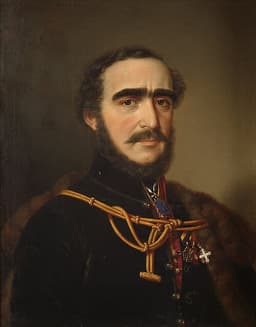
Istvan Szechenyi
Politician · Modern
58.2Total

Paul Biya
Politician · Modern
48.4Total
Basic Information
Born
1791
1933
Died
1860
—
Era
Modern
Modern
Nationality
Hungary
Cameroon
Occupation
Politician
Politician
Civilization
Western
Other
Score Comparison
Military (10%)
49.7
36.5
Political (20%)
72.0
37.9
Influence (20%)
56.7
51.0
Legacy (20%)
55.0
50.0
Leadership (15%)
68.0
66.0
Strategy (15%)
43.2
39.2
TOTAL
58.2
48.4
Istvan Szechenyi — Complete Timeline
1825 AD
Founding of the Hungarian Academy of SciencesCultural◆ Major
Istvan Szechenyi donated a year's income to found the Hungarian Academy of Sciences. The institution promoted scientific and cultural development in Hungary.
AcademyScienceCulture
Impact: nationalconstructive
1830 AD
Publication of 'Credit'Cultural◆ Major
Istvan Szechenyi published 'Credit', a book advocating for economic reforms in Hungary. The work argued for the abolition of serfdom and the modernization of agriculture.
PublicationReformEconomy
Impact: nationalconstructive
1849 AD
Chain Bridge ConstructionOther◆ Major
Istvan Szechenyi oversaw the construction of the Chain Bridge across the Danube in Budapest. The bridge connected Buda and Pest, symbolizing modernization and national unity.
InfrastructureBridgeModernization
Impact: nationalconstructive
1860 AD
SuicideOther◆ Major
Istvan Szechenyi died by suicide at the D
SuicideDeath
Impact: nationaltragic
Paul Biya — Complete Timeline
1975 AD
Became Prime Minister of CameroonPolitical Action◆ Major
Paul Biya was appointed Prime Minister of Cameroon by President Ahmadou Ahidjo. This position made him the second-highest official in the country and positioned him as Ahidjo's successor.
AppointmentCameroonGovernment
Impact: national
1982 AD
Succeeded Ahidjo as PresidentPolitical Action
President Ahmadou Ahidjo resigned unexpectedly, and Paul Biya, as Prime Minister, succeeded him as President of Cameroon. This transition was initially peaceful but led to a power struggle with Ahidjo.
SuccessionCameroonPower Struggle
Impact: national
1984 AD
Suppressed a Coup AttemptPolitical Action◆ Major
Biya's government foiled a coup attempt led by supporters of former President Ahidjo. The failed coup resulted in executions and purges within the military and government, consolidating Biya's control.
Coup AttemptCameroonRepression
Impact: nationaldestructive
1990 AD
Introduced Multi-Party PoliticsReform◆ Major
Under pressure from domestic and international actors, Biya's government legalized opposition parties, ending the one-party system. However, the transition was managed to ensure Biya's continued dominance.
Political ReformDemocracyCameroon
Impact: national
1992 AD
Won Controversial Re-electionsPolitical Action◆ Major
Biya won the 1992 presidential election, the first multi-party election since 1964. The election was marred by allegations of fraud and irregularities, leading to opposition protests and international criticism.
ElectionCameroonControversy
Impact: national
2016 AD
Anglophone Crisis EscalationWar◆ Major
Protests by English-speaking lawyers and teachers escalated into a separatist conflict in the Anglophone regions. Biya's government responded with a military crackdown, leading to a protracted insurgency and humanitarian crisis.
ConflictAnglophone CrisisCameroon
Impact: regionaldestructive
Expert Analysis
Origins
Istvan Szechenyi (1791-1860) was born into one of Hungary's wealthiest aristocratic families. His father, Ferenc Szechenyi, founded the Hungarian National Museum. After a military career during the Napoleonic Wars, Szechenyi traveled extensively across Europe, absorbing Enlightenment ideas. His exposure to industrialized England and France shaped his vision for modernizing Hungary.
Paul Biya (1933-) was born in Mvomeka'a, a small village in French Cameroon. He studied law and political science at the Sorbonne in Paris, then returned to Cameroon to join the civil service. His early career under President Ahmadou Ahidjo saw him rise through administrative ranks, becoming a technocrat rather than a revolutionary.
Rise to Power
Szechenyi's rise was not through political office but through influence. In 1825, he donated a year's income (60,000 florins) to found the Hungarian Academy of Sciences, instantly making him a national figure. His 1830 book 'Credit' (Hitel) argued for abolishing serfdom and modernizing agriculture, sparking public debate. By the 1840s, he was the leading voice for gradual reform, though he opposed the more radical nationalism of Lajos Kossuth.
Biya's rise was institutional. He became Prime Minister in 1975 under Ahidjo, a position of high visibility but limited power. When Ahidjo unexpectedly resigned in 1982, Biya succeeded him as President. Initially seen as a transitional figure, Biya quickly consolidated power, surviving a coup attempt in 1984 backed by Ahidjo loyalists. That event solidified his authority.
Leadership & Governance
Szechenyi's leadership was intellectual and philanthropic. He championed infrastructure projects like the Chain Bridge (1849), which connected Buda and Pest, and the regulation of the Danube River. He advocated for economic liberalization, railway construction, and credit reform. However, his top-down approach alienated the lower nobility and peasants, limiting his political base. His political score of 72.0 reflects his influence rather than elected office.
Biya's leadership style is autocratic and survival-focused. He maintained power through a mix of patronage, ethnic balancing, and repression. In 1990, under pressure, he legalized opposition parties, but the transition was controlled. Elections in 1992, 1997, 2004, 2011, and 2018 were marred by fraud. His governance score of 66.0 is driven by longevity (over 40 years in power), but his political score of 37.9 reflects limited democratic reform.
Triumph & Tragedy
Szechenyi's greatest triumph was the Chain Bridge, a symbol of Hungarian modernization. His Academy of Sciences remains a prestigious institution. However, his gradualist approach failed as the 1848 Revolution erupted; he opposed the radicalism and was sidelined. His mental health deteriorated, and he died by suicide in 1860 at the Döbling asylum. His tragedy was being a reformer in an era that demanded revolution.
Biya's triumph is his longevity: he has been president since 1982, one of Africa's longest-serving leaders. He maintained stability in a region plagued by conflict. However, his legacy is tainted by corruption, human rights abuses, and the Anglophone crisis (2016-present), which has killed thousands. His failure to manage ethnic tensions has left Cameroon deeply divided. His military score of 36.5 reflects his inability to resolve the conflict.
Character & Destiny
Szechenyi was idealistic, generous, but prone to despair. He believed in progress through reason and capital, but his aristocratic background made him distrustful of mass movements. His suicide reflects the gap between his vision and reality.
Biya is cautious, secretive, and pragmatic. He has outmaneuvered rivals through patience and manipulation. His destiny is tied to the system he inherited and maintained, but his refusal to groom a successor leaves Cameroon uncertain.
Legacy
Szechenyi's legacy is foundational for modern Hungary. The Academy of Sciences, Chain Bridge, and his writings inspired subsequent reforms. He is revered as 'the greatest Hungarian' for his selfless dedication. His influence score of 56.7 reflects his enduring symbolic power.
Biya's legacy is mixed. He transformed Cameroon from a one-party state to a multiparty one, but without genuine democracy. His legacy score of 50.0 is average; he will be remembered as a longevity record-holder but also as a leader who squandered opportunities. The Anglophone crisis may define his final years.
Conclusion
Istvan Szechenyi, with a total score of 58.2, had greater impact than Paul Biya's 48.4. Szechenyi's reforms shaped Hungarian national identity and development, while Biya's rule preserved a flawed system. Szechenyi's ideas outlasted his death; Biya's grip on power may not survive his departure. The score gap of 9.8 points reflects Szechenyi's superior political vision (72.0 vs 37.9) and leadership (68.0 vs 66.0). While Biya's longevity is notable, Szechenyi's transformative influence on a nation's trajectory is more profound.
Rankings
🥇
Istvan SzechenyiLeader
Mil: 49.7Pol: 72.0Inf: 56.7
58.2
🥈
Paul Biya
Mil: 36.5Pol: 37.9Inf: 51.0
48.4
+9.8 behind
How This Comparison Works
Algorithm
Each figure is scored on 6 dimensions (0—100 scale) based on structured historical data: Military (10%), Political (20%), Influence (20%), Legacy (20%), Leadership (15%), Strategy (15%). The weighted total produces the final ranking.
Data Sources
Scores are computed from structured sub-indicators in the database. Scale factors adjust for era (Ancient ×0.85, Modern ×1.0) and civilization size (Eastern ×1.05, Other ×0.80) to account for differences in population and military scale.
Maximum 3 Figures
Comparisons are limited to 2—3 figures to ensure readability and statistical meaningfulness.
Error Margins
±5 points per dimension — Sub-scores are derived from historical records with inherent uncertainty. Two figures within 5 points on a dimension should be considered roughly equivalent in that area.
Total Score Accuracy
±3 points overall — The weighted combination of 6 dimensions produces a total score with approximately ±3 points of uncertainty. Differences of less than 3 points are not statistically significant— the figures are effectively tied.
Known Limitations
- Historical records are incomplete and uneven across civilizations
- Figures from oral-tradition societies may be underrepresented
- Occupation labels can misclassify multi-role figures
- Scores measure capability and impact, not moral character
- Quantitative scoring is a comparison tool, not absolute truth
Capability Radar
Military (10%) — Battles & Warfare
Battles
31
26
Win Rate
32
28
Expansion
33
28
Political (20%) — Governance & Reform
Reform
85
20
Diplomacy
60
40
Economy
80
25
Influence (20%) — Cultural & Global Reach
Cultural
70
15
Global
55
30
Legacy (20%) — Historical Impact
Historical
75
30
Longevity
65
70
Leadership (15%) — Power & Stability
Tenure
55
85
Stability
50
30
Strategy (15%) — Tactics & Innovation
Strategy
41
34
Tactics
40
35
Reform
45
36
Similar Comparisons
Comments & Discussion
No comments yet. Be the first to share your thoughts!