Loading...
This comparison has not been analyzed yet.
One-time AI generation (~1 minute). Scores and timeline are already available below.
Ivan Bagramyan vs Norman Schwarzkopf
Ivan Bagramyan leads by 1.1 pts · 2 figures compared
…

Ivan Bagramyan
General · Modern
60.0Total
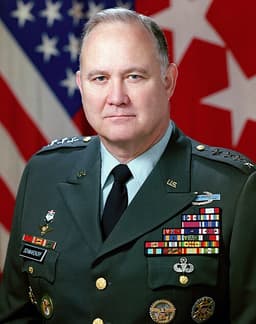
Norman Schwarzkopf
General · Modern
58.9Total
Basic Information
Born
1897
1934
Died
1982
—
Era
Modern
Modern
Nationality
USSR
United States
Occupation
General
General
Civilization
Western
Western
Score Comparison
Military (10%)
74.7
78.0
Political (20%)
62.7
45.0
Influence (20%)
57.2
55.0
Legacy (20%)
52.0
58.0
Leadership (15%)
62.0
62.0
Strategy (15%)
65.4
68.1
TOTAL
60.0
58.9
Ivan Bagramyan — Complete Timeline
1941 AD
Battle of MoscowWar◆ Major
Bagramyan served as chief of staff of the Southwestern Front during the Battle of Moscow. He helped plan the Soviet counteroffensive that pushed German forces back from the capital.
World War IIMoscowCounteroffensive
Impact: global
1944 AD
Operation BagrationWar◆ Major
Bagramyan commanded the 1st Baltic Front in Operation Bagration. His forces broke through German defenses in Belarus, encircling Vitebsk and advancing to the Baltic coast, cutting off Army Group North.
World War IIBelarusBaltic
Impact: regional
1945 AD
East Prussian OffensiveWar
Bagramyan commanded the 1st Baltic Front (later renamed Samland Group) in the East Prussian Offensive. His forces captured K
World War IIEast PrussiaKönigsberg
Impact: regional
1955 AD
Appointment as Deputy Minister of DefensePolitical Action
Bagramyan was appointed Deputy Minister of Defense of the USSR. He held this position until 1958, overseeing training and logistics for the Soviet armed forces.
Cold WarDefense MinistryLeadership
Impact: national
Norman Schwarzkopf — Complete Timeline
1990 AD
Appointed Commander of Coalition Forces for Operation Desert ShieldOther◆ Major
In August 1990, Schwarzkopf was appointed Commander-in-Chief of U.S. Central Command and overall commander of coalition forces in the Persian Gulf. He oversaw the buildup of over 500,000 troops in Saudi Arabia to deter Iraqi aggression after the invasion of Kuwait.
Gulf WarMilitary BuildupCoalition Command
Impact: global
1991 AD
Executed Operation Desert Storm Ground CampaignWar◆ Major
Schwarzkopf planned and executed the 100-hour ground offensive that began on February 24, 1991. Using a left-hook maneuver through the Iraqi desert, coalition forces outflanked Iraqi defenses, liberating Kuwait and destroying much of the Iraqi Republican Guard with minimal coalition casualties.
Gulf WarMilitary VictoryOperational Planning
Impact: global
Negotiated Ceasefire at SafwanOther◆ Major
On March 3, 1991, Schwarzkopf met with Iraqi military commanders at Safwan airfield to negotiate the terms of the ceasefire ending the Gulf War. He secured Iraqi agreement to return prisoners, provide minefield maps, and cease military operations, though he allowed Iraqi helicopters to fly, later criticized as enabling suppression of uprisings.
Gulf WarCeasefirePost-War Settlement
Impact: regional
1992 AD
Published Autobiography 'It Doesn't Take a Hero'Other
Schwarzkopf published his autobiography 'It Doesn't Take a Hero' in September 1992. The book detailed his military career from Vietnam through the Gulf War, becoming a bestseller and providing his personal account of the decision-making process during Operation Desert Storm.
AutobiographyMilitary MemoirPublic Figure
Impact: national
This comparison has not been analyzed yet.
One-time AI generation (~1 minute). Scores and timeline are already available below.
Rankings
🥇
Ivan BagramyanLeader
Mil: 74.7Pol: 62.7Inf: 57.2
60.0
🥈
Norman Schwarzkopf
Mil: 78.0Pol: 45.0Inf: 55.0
58.9
+1.1 behind
How This Comparison Works
Algorithm
Each figure is scored on 6 dimensions (0—100 scale) based on structured historical data: Military (10%), Political (20%), Influence (20%), Legacy (20%), Leadership (15%), Strategy (15%). The weighted total produces the final ranking.
Data Sources
Scores are computed from structured sub-indicators in the database. Scale factors adjust for era (Ancient ×0.85, Modern ×1.0) and civilization size (Eastern ×1.05, Other ×0.80) to account for differences in population and military scale.
Maximum 3 Figures
Comparisons are limited to 2—3 figures to ensure readability and statistical meaningfulness.
Error Margins
±5 points per dimension — Sub-scores are derived from historical records with inherent uncertainty. Two figures within 5 points on a dimension should be considered roughly equivalent in that area.
Total Score Accuracy
±3 points overall — The weighted combination of 6 dimensions produces a total score with approximately ±3 points of uncertainty. Differences of less than 3 points are not statistically significant— the figures are effectively tied.
Known Limitations
- Historical records are incomplete and uneven across civilizations
- Figures from oral-tradition societies may be underrepresented
- Occupation labels can misclassify multi-role figures
- Scores measure capability and impact, not moral character
- Quantitative scoring is a comparison tool, not absolute truth
Capability Radar
Military (10%) — Battles & Warfare
Battles
75
85
Win Rate
70
95
Expansion
65
70
Political (20%) — Governance & Reform
Reform
50
40
Diplomacy
60
75
Economy
45
50
Influence (20%) — Cultural & Global Reach
Cultural
40
55
Global
35
65
Legacy (20%) — Historical Impact
Historical
55
65
Longevity
45
50
Leadership (15%) — Power & Stability
Tenure
55
55
Stability
55
70
Strategy (15%) — Tactics & Innovation
Strategy
78
85
Tactics
72
80
Reform
60
60
Similar Comparisons
Comments & Discussion
No comments yet. Be the first to share your thoughts!