Loading...
This comparison has not been analyzed yet.
One-time AI generation (~1 minute). Scores and timeline are already available below.
Jaber al-Ahmad al-Sabah vs Yadavindra Singh
Yadavindra Singh leads by 3.8 pts · 2 figures compared
…
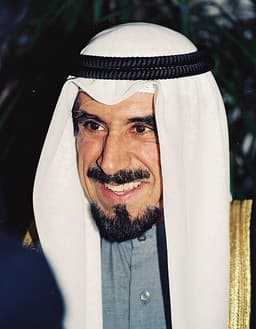
Jaber al-Ahmad al-Sabah
Emperor · Modern
45.4Total

Yadavindra Singh
Emperor · Modern
49.2Total
Basic Information
Born
1926
1913
Died
—
1974
Era
Modern
Modern
Nationality
Kuwait
India
Occupation
Emperor
Emperor
Civilization
Middle Eastern
Indian
Score Comparison
Military (10%)
12.2
20.0
Political (20%)
68.0
54.7
Influence (20%)
56.4
53.3
Legacy (20%)
44.2
41.7
Leadership (15%)
40.0
65.0
Strategy (15%)
28.2
54.6
TOTAL
45.4
49.2
Jaber al-Ahmad al-Sabah — Complete Timeline
1990 AD
Iraqi Invasion of KuwaitWar◆ Major
Iraqi forces invaded and occupied Kuwait under Saddam Hussein. Jaber al-Ahmad al-Sabah fled to Saudi Arabia and established a government-in-exile. The invasion led to the Gulf War and a seven-month occupation of Kuwait.
Gulf WarIraqi InvasionKuwaiti Occupation
Impact: globaltragic
1991 AD
Liberation of KuwaitWar◆ Major
A US-led coalition launched Operation Desert Storm, liberating Kuwait from Iraqi occupation. Jaber al-Ahmad al-Sabah returned to Kuwait as emir. The liberation restored Kuwaiti sovereignty but left the country with extensive damage and environmental destruction.
Gulf WarKuwaiti LiberationCoalition
Impact: globalconstructive
Reconstruction of Kuwait After Gulf WarReform◆ Major
Jaber al-Ahmad al-Sabah oversaw the massive reconstruction of Kuwait's infrastructure, oil fields, and economy after the Gulf War. The rebuilding cost billions of dollars and restored Kuwait's status as a major oil exporter. He also restored the National Assembly.
ReconstructionPost-War RecoveryKuwaiti Economy
Impact: nationalconstructive
Yadavindra Singh — Complete Timeline
1938 AD
Accession as Maharaja of PatialaPolitical Action◆ Major
Yadavindra Singh succeeded his father Bhupinder Singh as Maharaja of the princely state of Patiala. He inherited a wealthy and influential Sikh state in British India, with a strong military tradition.
SuccessionPrincely StatePatiala
Impact: regional
1947 AD
Signed Instrument of Accession to IndiaPolitical Action
Yadavindra Singh signed the Instrument of Accession, integrating Patiala into the Dominion of India. This decision, made during the partition of India, ensured Patiala became part of the Indian Union rather than Pakistan.
AccessionPartitionIndian Union
Impact: nationalconstructive
1948 AD
Formation of PEPSU (Patiala and East Punjab States Union)Political Action◆ Major
Yadavindra Singh played a key role in merging Patiala with other Sikh princely states to form the Patiala and East Punjab States Union (PEPSU). He served as its Rajpramukh (ceremonial head) until 1956.
MergerPEPSUSikh States
Impact: regionalconstructive
1965 AD
Appointment as Ambassador to ItalyPolitical Action
Yadavindra Singh was appointed India's ambassador to Italy, serving until 1966. This diplomatic role marked his transition from princely ruler to a representative of the Indian government abroad.
DiplomacyAmbassadorItaly
Impact: national
1971 AD
Appointment as Ambassador to the NetherlandsPolitical Action
Yadavindra Singh was appointed India's ambassador to the Netherlands, serving until 1974. This was his second diplomatic posting, continuing his service to the Indian government after the abolition of princely titles.
DiplomacyAmbassadorNetherlands
Impact: national
This comparison has not been analyzed yet.
One-time AI generation (~1 minute). Scores and timeline are already available below.
Rankings
🥇
Yadavindra SinghLeader
Mil: 20.0Pol: 54.7Inf: 53.3
49.2
🥈
Jaber al-Ahmad al-Sabah
Mil: 12.2Pol: 68.0Inf: 56.4
45.4
+3.8 behind
How This Comparison Works
Algorithm
Each figure is scored on 6 dimensions (0—100 scale) based on structured historical data: Military (10%), Political (20%), Influence (20%), Legacy (20%), Leadership (15%), Strategy (15%). The weighted total produces the final ranking.
Data Sources
Scores are computed from structured sub-indicators in the database. Scale factors adjust for era (Ancient ×0.85, Modern ×1.0) and civilization size (Eastern ×1.05, Other ×0.80) to account for differences in population and military scale.
Maximum 3 Figures
Comparisons are limited to 2—3 figures to ensure readability and statistical meaningfulness.
Error Margins
±5 points per dimension — Sub-scores are derived from historical records with inherent uncertainty. Two figures within 5 points on a dimension should be considered roughly equivalent in that area.
Total Score Accuracy
±3 points overall — The weighted combination of 6 dimensions produces a total score with approximately ±3 points of uncertainty. Differences of less than 3 points are not statistically significant— the figures are effectively tied.
Known Limitations
- Historical records are incomplete and uneven across civilizations
- Figures from oral-tradition societies may be underrepresented
- Occupation labels can misclassify multi-role figures
- Scores measure capability and impact, not moral character
- Quantitative scoring is a comparison tool, not absolute truth
Capability Radar
Military (10%) — Battles & Warfare
Battles
3
5
Win Rate
10
5
Expansion
13
5
Political (20%) — Governance & Reform
Reform
40
30
Diplomacy
55
50
Economy
50
30
Influence (20%) — Cultural & Global Reach
Cultural
30
30
Global
50
20
Legacy (20%) — Historical Impact
Historical
45
30
Longevity
30
20
Leadership (15%) — Power & Stability
Tenure
60
40
Stability
35
40
Strategy (15%) — Tactics & Innovation
Strategy
12
5
Tactics
18
5
Reform
23
10
Similar Comparisons
Comments & Discussion
No comments yet. Be the first to share your thoughts!