Loading...
Jakaya Kikwete vs Sekou Toure
Sekou Toure leads by 3.6 pts · 2 figures compared
…
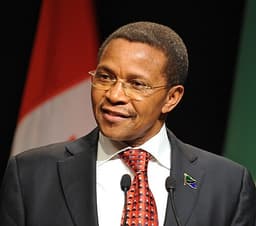
Jakaya Kikwete
Politician · Modern
50.6Total

Sekou Toure
Politician · Modern
54.2Total
Basic Information
Born
1950
1922
Died
—
—
Era
Modern
Modern
Nationality
Tanzania
Guinea
Occupation
Politician
Politician
Civilization
Other
Other
Score Comparison
Military (10%)
40.0
41.6
Political (20%)
53.8
43.7
Influence (20%)
54.1
59.0
Legacy (20%)
41.7
49.2
Leadership (15%)
72.0
74.0
Strategy (15%)
38.3
53.8
TOTAL
50.6
54.2
Jakaya Kikwete — Complete Timeline
2005 AD
Became President of TanzaniaPolitical Action◆ Major
Jakaya Kikwete was elected President of Tanzania, succeeding Benjamin Mkapa. He won with over 80% of the vote, continuing the dominance of the Chama Cha Mapinduzi (CCM) party. His presidency focused on economic growth, infrastructure, and social services.
PresidencyElectionCCM
Impact: nationalconstructive
2009 AD
Launched Kilimo Kwanza (Agriculture First) InitiativeReform◆ Major
Kikwete launched the Kilimo Kwanza initiative to modernize agriculture, increase productivity, and ensure food security. The program aimed to transform Tanzania into a regional food exporter by providing subsidies, irrigation, and access to credit for farmers.
AgricultureKilimo KwanzaFood Security
Impact: nationalconstructive
2010 AD
Oversaw Economic Growth and Gas DiscoveriesOther◆ Major
Under Kikwete, Tanzania experienced sustained economic growth averaging 6-7% annually, driven by mining, tourism, and construction. Major natural gas discoveries off the coast of Mtwara raised hopes for energy exports, but development was slow due to regulatory and investment challenges.
Economic GrowthNatural GasEnergy
Impact: nationalconstructive
2015 AD
Faced Zanzibar Political CrisisPolitical Action
Kikwete's government faced a political crisis in Zanzibar after disputed elections in 2015, which were annulled by the Zanzibar Electoral Commission. The opposition Civic United Front (CUF) boycotted the rerun, leading to a one-party government in Zanzibar and increased tensions.
ZanzibarElection DisputePolitical Crisis
Impact: regionaldestructive
Stepped Down After Two TermsPolitical Action◆ Major
Kikwete stepped down after completing his two-term limit, handing power to his successor, John Magufuli. His peaceful transfer of power reinforced Tanzania's reputation for political stability in a region often marked by coups and extended presidencies.
Term LimitsSuccessionDemocracy
Impact: nationalconstructive
Sekou Toure — Complete Timeline
1958 AD
Led Guinea to IndependencePolitical Action
Toure led Guinea to vote 'No' in the French constitutional referendum, choosing immediate independence over membership in the French Community. This made Guinea the first French African colony to gain independence, inspiring other movements.
IndependenceGuineaDecolonization
Impact: regionalconstructive
Became First President of GuineaPolitical Action◆ Major
Toure was elected as Guinea's first president after independence. He established a one-party state under the Democratic Party of Guinea and pursued a socialist, pan-Africanist agenda.
PresidencyGuineaOne-Party State
Impact: national
1960 AD
Implemented Socialist Economic PoliciesReform◆ Major
Toure nationalized key industries, collectivized agriculture, and established state-controlled enterprises. These policies aimed at economic self-sufficiency but led to inefficiency, shortages, and economic decline.
SocialismNationalizationEconomic Policy
Impact: national
1961 AD
Suppressed Political OppositionPolitical Action◆ Major
Toure's regime cracked down on dissent, imprisoning and executing political opponents. The 'Plot of the Teachers' in 1961 led to mass arrests. His rule became increasingly repressive, with thousands fleeing into exile.
RepressionPolitical PrisonersGuinea
Impact: nationaldestructive
1984 AD
Died in OfficeOther◆ Major
Toure died of a heart attack in Cleveland, Ohio, while undergoing surgery. His death ended 26 years of authoritarian rule. Shortly after, a military coup led by Lansana Cont
DeathGuineaEnd of Era
Impact: national
Expert Analysis
Origins
Jakaya Kikwete was born in 1950 in Msoga, Tanzania, to a Muslim family. He studied economics at the University of Dar es Salaam and later joined the civil service. His father was a teacher, and Kikwete's early career included work in the Ministry of Finance and the Tanzanian embassy in Nigeria. He entered politics through the ruling party Chama Cha Mapinduzi (CCM).
Sekou Toure was born in 1922 in Faranah, Guinea, to a peasant family of the Malinke ethnic group. He was educated at a French missionary school but expelled for leading a protest. He became a trade unionist and co-founded the Democratic Party of Guinea (PDG), inspired by Marxist ideology. His early activism against French colonial rule shaped his radical nationalism.
Rise to Power
Kikwete's rise was gradual within CCM. He served as Minister of Finance (1997-1999), Minister of Foreign Affairs (1999-2005), and was elected President in 2005 with 80.3% of the vote, succeeding Benjamin Mkapa. His campaign focused on continuity and economic reform.
Toure shot to prominence by leading Guinea to reject the French Community in 1958. He became the country's first president on October 2, 1958, after Guinea voted for immediate independence. He consolidated power by banning opposition parties and establishing a one-party state under the PDG.
Leadership & Governance
Kikwete's leadership was consultative and reformist. He launched the Kilimo Kwanza initiative in 2009 to modernize agriculture, but implementation was uneven. He oversaw economic growth averaging 6-7% annually, driven by mining and natural gas discoveries. However, his government struggled with corruption and a political crisis in Zanzibar after disputed 2015 elections. He respected term limits, stepping down in 2015.
Toure ruled as an authoritarian socialist. He nationalized industries, collectivized agriculture, and suppressed dissent. His regime jailed or executed opponents, notably after the 'Plot of the Teachers' in 1961. He promoted a cult of personality and isolated Guinea internationally. His policies led to economic decline and human rights abuses.
Triumph & Tragedy
Kikwete's greatest success was maintaining stability and economic growth. Tanzania's GDP per capita rose from $580 in 2005 to $960 in 2015. He also secured major natural gas deals. His failure was the unresolved Zanzibar crisis and persistent corruption. His legacy is peaceful transition of power.
Toure's triumph was securing Guinea's independence and pan-African influence. He hosted the 1960 All-African People's Conference. His tragedy was his brutal rule: an estimated 50,000 political prisoners were killed or died in camps. His policies ruined the economy, and he died in 1984 while in office, after which a coup occurred.
Character & Destiny
Kikwete was pragmatic and moderate, avoiding radical shifts. His character of consensus-building allowed for stability but also indecision on key issues like Zanzibar. His destiny was to be a transitional figure between Mkapa's reforms and Magufuli's populism.
Toure was ideological and paranoid. His Marxist zeal led to economic disaster, and his suspicion of plots resulted in repression. His destiny was to become a cautionary tale of African strongman rule. He died abroad, isolated from his people.
Legacy
Kikwete is remembered as a democrat who upheld term limits and fostered growth. His influence on Tanzania is moderate; the gas discoveries and Kilimo Kwanza had mixed results. His political score of 53.8 reflects his competent but not transformative leadership.
Toure's legacy is complex: a founding father who degenerated into a tyrant. His influence on African independence movements is recognized, but his oppressive rule overshadows it. His legacy score of 49.2 is tempered by his human rights record. He scored higher overall (54.2 vs. Kikwete's 50.6) due to his strategic impact on decolonization, but his negative governance drags him down.
Conclusion
Sekou Toure had a greater impact on history due to his role in Guinea's independence and pan-Africanism, but his legacy is deeply flawed. Jakaya Kikwete's peaceful leadership and economic growth are commendable, but his impact is less profound. In terms of overall historical significance, Toure's score of 54.2 surpasses Kikwete's 50.6, but when considering positive governance, Kikwete's stability offers a more constructive model. The data supports Toure as more influential, but Kikwete as more effective.
Rankings
🥇
Sekou ToureLeader
Mil: 41.6Pol: 43.7Inf: 59.0
54.2
🥈
Jakaya Kikwete
Mil: 40.0Pol: 53.8Inf: 54.1
50.6
+3.6 behind
How This Comparison Works
Algorithm
Each figure is scored on 6 dimensions (0—100 scale) based on structured historical data: Military (10%), Political (20%), Influence (20%), Legacy (20%), Leadership (15%), Strategy (15%). The weighted total produces the final ranking.
Data Sources
Scores are computed from structured sub-indicators in the database. Scale factors adjust for era (Ancient ×0.85, Modern ×1.0) and civilization size (Eastern ×1.05, Other ×0.80) to account for differences in population and military scale.
Maximum 3 Figures
Comparisons are limited to 2—3 figures to ensure readability and statistical meaningfulness.
Error Margins
±5 points per dimension — Sub-scores are derived from historical records with inherent uncertainty. Two figures within 5 points on a dimension should be considered roughly equivalent in that area.
Total Score Accuracy
±3 points overall — The weighted combination of 6 dimensions produces a total score with approximately ±3 points of uncertainty. Differences of less than 3 points are not statistically significant— the figures are effectively tied.
Known Limitations
- Historical records are incomplete and uneven across civilizations
- Figures from oral-tradition societies may be underrepresented
- Occupation labels can misclassify multi-role figures
- Scores measure capability and impact, not moral character
- Quantitative scoring is a comparison tool, not absolute truth
Capability Radar
Military (10%) — Battles & Warfare
Battles
0
10
Win Rate
0
10
Expansion
0
10
Political (20%) — Governance & Reform
Reform
55
40
Diplomacy
65
45
Economy
55
20
Influence (20%) — Cultural & Global Reach
Cultural
30
50
Global
35
45
Legacy (20%) — Historical Impact
Historical
30
55
Longevity
20
40
Leadership (15%) — Power & Stability
Tenure
60
70
Stability
60
15
Strategy (15%) — Tactics & Innovation
Strategy
0
10
Tactics
0
10
Reform
10
15
Similar Comparisons
Comments & Discussion
No comments yet. Be the first to share your thoughts!