Loading...
This comparison has not been analyzed yet.
One-time AI generation (~1 minute). Scores and timeline are already available below.
Jambyn Batmonkh vs Lazaro Cardenas
Lazaro Cardenas leads by 13.5 pts · 2 figures compared
…
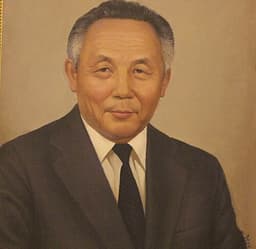
Jambyn Batmonkh
Politician · Modern
49.7Total

Lazaro Cardenas
Politician · Modern
63.2Total
Basic Information
Born
1926
1895
Died
—
1970
Era
Modern
Modern
Nationality
Mongolia
Mexico
Occupation
Politician
Politician
Civilization
Eastern
Western
Score Comparison
Military (10%)
14.6
41.6
Political (20%)
68.0
70.3
Influence (20%)
52.5
72.0
Legacy (20%)
44.2
52.0
Leadership (15%)
72.0
80.0
Strategy (15%)
30.6
54.6
TOTAL
49.7
63.2
Jambyn Batmonkh — Complete Timeline
1984 AD
Became General Secretary of the Mongolian People's Revolutionary PartyPolitical Action◆ Major
Batmonkh succeeded Yumjaagiin Tsedenbal as General Secretary of the MPRP, becoming the leader of Mongolia. He was seen as a reformist within the communist framework.
LeadershipCommunist Party
Impact: national
1986 AD
Initiated Economic Reforms Under PerestroikaReform◆ Major
Batmonkh introduced limited economic reforms inspired by Gorbachev's perestroika, including decentralization of state enterprises and encouragement of private enterprise. The reforms were modest but signaled a shift from Stalinist economics.
Economic ReformPerestroika
Impact: nationalconstructive
1990 AD
Peacefully Resigned After the 1990 Democratic RevolutionPolitical Action
Following massive pro-democracy protests in 1990, Batmonkh resigned as General Secretary and President, peacefully transferring power to a transitional government. This was a key moment in Mongolia's transition to democracy.
ResignationDemocratic TransitionPeaceful
Impact: nationalconstructive
1992 AD
Oversaw the Adoption of a New ConstitutionPolitical Action◆ Major
As a member of the transitional government, Batmonkh supported the adoption of a new democratic constitution in 1992, which established a multi-party system and protected civil liberties.
ConstitutionDemocracyReform
Impact: nationalconstructive
Lazaro Cardenas — Complete Timeline
1936 AD
Agrarian Reform ImplementationReform◆ Major
Cardenas redistributed over 44 million acres of land to peasants, creating ejidos (communal farms). This was the largest land reform in Mexican history, fulfilling a key revolutionary promise.
Land RedistributionEjidosPeasant Rights
Impact: nationalprogressive
Creation of the National Polytechnic InstituteReform◆ Major
Cardenas founded the National Polytechnic Institute (IPN) to promote technical and scientific education. The institution aimed to reduce dependence on foreign expertise and support industrialization.
EducationTechnical TrainingIndustrialization
Impact: nationalconstructive
1937 AD
Exile of Leon TrotskyPolitical Action◆ Major
Cardenas granted political asylum to Leon Trotsky, allowing him to live in Mexico. This decision placed Mexico in opposition to Stalin's USSR and highlighted Cardenas's leftist internationalism.
AsylumInternational PoliticsTrotsky
Impact: globalconstructive
1938 AD
Oil Expropriation DecreeReform
Cardenas nationalized the Mexican oil industry, expropriating assets of 17 foreign companies. The move asserted Mexican sovereignty over natural resources and created Petroleos Mexicanos (Pemex).
NationalizationEconomic SovereigntyPemex
Impact: globalprogressive
This comparison has not been analyzed yet.
One-time AI generation (~1 minute). Scores and timeline are already available below.
Rankings
🥇
Lazaro CardenasLeader
Mil: 41.6Pol: 70.3Inf: 72.0
63.2
🥈
Jambyn Batmonkh
Mil: 14.6Pol: 68.0Inf: 52.5
49.7
+13.5 behind
How This Comparison Works
Algorithm
Each figure is scored on 6 dimensions (0—100 scale) based on structured historical data: Military (10%), Political (20%), Influence (20%), Legacy (20%), Leadership (15%), Strategy (15%). The weighted total produces the final ranking.
Data Sources
Scores are computed from structured sub-indicators in the database. Scale factors adjust for era (Ancient ×0.85, Modern ×1.0) and civilization size (Eastern ×1.05, Other ×0.80) to account for differences in population and military scale.
Maximum 3 Figures
Comparisons are limited to 2—3 figures to ensure readability and statistical meaningfulness.
Error Margins
±5 points per dimension — Sub-scores are derived from historical records with inherent uncertainty. Two figures within 5 points on a dimension should be considered roughly equivalent in that area.
Total Score Accuracy
±3 points overall — The weighted combination of 6 dimensions produces a total score with approximately ±3 points of uncertainty. Differences of less than 3 points are not statistically significant— the figures are effectively tied.
Known Limitations
- Historical records are incomplete and uneven across civilizations
- Figures from oral-tradition societies may be underrepresented
- Occupation labels can misclassify multi-role figures
- Scores measure capability and impact, not moral character
- Quantitative scoring is a comparison tool, not absolute truth
Capability Radar
Military (10%) — Battles & Warfare
Battles
13
10
Win Rate
17
10
Expansion
20
10
Political (20%) — Governance & Reform
Reform
50
85
Diplomacy
55
75
Economy
45
80
Influence (20%) — Cultural & Global Reach
Cultural
30
60
Global
25
65
Legacy (20%) — Historical Impact
Historical
35
70
Longevity
30
65
Leadership (15%) — Power & Stability
Tenure
60
65
Stability
65
70
Strategy (15%) — Tactics & Innovation
Strategy
24
10
Tactics
29
10
Reform
27
30
Similar Comparisons
Comments & Discussion
No comments yet. Be the first to share your thoughts!