Loading...
Jambyn Batmonkh vs Napoleon Bonaparte
Napoleon Bonaparte leads by 21.2 pts · 2 figures compared
…
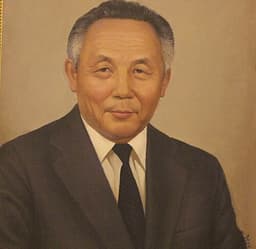
Jambyn Batmonkh
Politician · Modern
49.7Total

Napoleon Bonaparte
General · Modern
70.9Total
Basic Information
Born
1926
1769
Died
—
1821
Era
Modern
Modern
Nationality
Mongolia
France
Occupation
Politician
General
Civilization
Eastern
Western
Score Comparison
Military (10%)
14.6
94.0
Political (20%)
68.0
72.0
Influence (20%)
52.5
40.0
Legacy (20%)
44.2
80.0
Leadership (15%)
72.0
78.0
Strategy (15%)
30.6
90.0
TOTAL
49.7
70.9
Jambyn Batmonkh — Complete Timeline
1984 AD
Became General Secretary of the Mongolian People's Revolutionary PartyPolitical Action◆ Major
Batmonkh succeeded Yumjaagiin Tsedenbal as General Secretary of the MPRP, becoming the leader of Mongolia. He was seen as a reformist within the communist framework.
LeadershipCommunist Party
Impact: national
1986 AD
Initiated Economic Reforms Under PerestroikaReform◆ Major
Batmonkh introduced limited economic reforms inspired by Gorbachev's perestroika, including decentralization of state enterprises and encouragement of private enterprise. The reforms were modest but signaled a shift from Stalinist economics.
Economic ReformPerestroika
Impact: nationalconstructive
1990 AD
Peacefully Resigned After the 1990 Democratic RevolutionPolitical Action
Following massive pro-democracy protests in 1990, Batmonkh resigned as General Secretary and President, peacefully transferring power to a transitional government. This was a key moment in Mongolia's transition to democracy.
ResignationDemocratic TransitionPeaceful
Impact: nationalconstructive
1992 AD
Oversaw the Adoption of a New ConstitutionPolitical Action◆ Major
As a member of the transitional government, Batmonkh supported the adoption of a new democratic constitution in 1992, which established a multi-party system and protected civil liberties.
ConstitutionDemocracyReform
Impact: nationalconstructive
Napoleon Bonaparte — Complete Timeline
1799 AD
Coup of 18 BrumaireOther◆ Major
Napoleon Bonaparte, with support from his brother Lucien and key political figures, overthrew the Directory in a bloodless coup. He established the Consulate with himself as First Consul, effectively becoming the ruler of France. This event ended the French Revolution's most unstable period.
French RevolutionCoupRise to Power
Impact: regional
1804 AD
Promulgation of the Napoleonic CodeOther◆ Major
Napoleon enacted the Civil Code of the French, known as the Napoleonic Code, a comprehensive set of laws that replaced the fragmented feudal legal systems. The code established legal equality, protected property rights, and secularized law. It became the basis for legal systems in many European and world countries.
Legal ReformNapoleonic CodeCivil Law
Impact: globalconstructive
1805 AD
Battle of AusterlitzWar◆ Major
Napoleon's Grande Arm
Napoleonic WarsBattleDecisive Victory
Impact: global
1812 AD
Invasion of RussiaWar◆ Major
Napoleon led the Grande Arm
Napoleonic WarsInvasionDisaster
Impact: globaldestructive
1815 AD
Battle of WaterlooWar◆ Major
Napoleon's French army was defeated by the combined forces of the Duke of Wellington's Anglo-Allied army and Gebhard Leberecht von Bl
Napoleonic WarsBattleFinal Defeat
Impact: globaldestructive
Expert Analysis
jambyn-batmonkh-vs-napoleon-bonaparte
# The Emperor and the Peacemaker
In the winter of 1812, Napoleon Bonaparte stood before the smoldering ruins of Moscow, his Grande Armée of 600,000 men reduced to shivering specters. Less than two centuries later, in the spring of 1990, Jambyn Batmonkh sat in a modest office in Ulaanbaatar, watching television images of thousands of Mongolians demanding democracy. One man chose to fight until the bitter end, the other chose to let go. What makes a leader cling to power or surrender it? The answer lies not merely in circumstance, but in the deepest contours of character and the age that shapes it.
Origins
Napoleon was born in 1769 on the Mediterranean island of Corsica, a place conquered by France only months before his birth. His family was minor nobility, poor but proud, and young Napoleon grew up with a chip on his shoulder—a sense that he had something to prove to the French mainland that had annexed his homeland. He entered military school at nine, a short, intense boy mocked by wealthier classmates, and emerged with a burning ambition that would never cool.
Jambyn Batmonkh was born in 1926 in a remote herding family in northern Mongolia, a land that had known centuries of nomadic life before falling under Soviet influence. He grew up in a world where the horse still mattered more than the engine, where loyalty to clan and party were intertwined. His education came through the communist system, which lifted him from poverty and taught him that collective progress mattered more than personal glory.
The difference between these origins is not just geography but worldview. Napoleon’s Corsican pride and French Enlightenment education produced a man who believed he could reshape the world through sheer will. Batmonkh’s nomadic roots and Marxist training produced a man who understood that systems outlast individuals.
Rise to Power
Napoleon’s ascent was a cannonball. At twenty-four, he drove the British out of Toulon and became a general. At twenty-six, he crushed a royalist uprising in Paris with a "whiff of grapeshot." By thirty, he had conquered Italy and Egypt, his name a legend across Europe. His political genius matched his military brilliance: in 1799, he staged a coup and made himself First Consul, then Emperor in 1804. Each step was a gamble, each victory a building block of his own mythology.
Batmonkh’s rise was the slow accumulation of trust within a system that rewarded patience. He joined the Mongolian People’s Revolutionary Party in the 1950s, worked as an economist and professor, and climbed the bureaucratic ladder for three decades. When he became General Secretary in 1984, succeeding the long-ruling Yumjaagiin Tsedenbal, it was not through conquest but consensus. He was seen as a safe pair of hands, a technocrat rather than a visionary.
Where Napoleon seized history by the throat, Batmonkh let history carry him. One man’s path was a storm; the other’s was a river.
Leadership & Governance
Napoleon’s rule was a paradox of brilliance and overreach. He reformed French law with the Napoleonic Code, establishing principles of meritocracy and secular governance that influenced legal systems worldwide. He centralized education, built roads, and stabilized the currency. But his military genius—rated 94 in strategic acumen—drove him to conquer Spain, Austria, Prussia, and Russia, stretching his empire until it snapped. His political score of 75 reflects a leader who could win battles but not peace.
Batmonkh’s governance was quiet and adaptive. In 1986, inspired by Mikhail Gorbachev’s perestroika, he introduced limited economic reforms, decentralizing state enterprises and allowing small private businesses. His leadership score of 86 suggests a steady hand, but his military score of 22.8 is almost irrelevant—he never commanded an army. Instead, he navigated the crumbling Soviet bloc with caution, avoiding the violent repression seen in Tiananmen Square or the bloody collapse in Romania.
Napoleon believed he could impose order through force; Batmonkh understood that order sometimes requires yielding.
Triumph & Tragedy
Napoleon’s greatest triumph was Austerlitz in 1805, where he defeated a larger Russian-Austrian army with tactical genius. His greatest tragedy was the 1812 invasion of Russia, where he lost over 500,000 men to winter, hunger, and guerrilla attacks. He never recovered. Exiled to Elba, he escaped and ruled for 100 days, but Waterloo in 1815 ended his dream forever. He died in 1821 on Saint Helena, a prisoner of the British.
Batmonkh’s triumph was his peaceful resignation in 1990. When pro-democracy protests erupted in Ulaanbaatar, he did not call in tanks. He negotiated, then stepped aside, allowing a transition that preserved stability. He oversaw the adoption of a new democratic constitution in 1992, ensuring Mongolia became one of the few post-Soviet states to avoid civil war. His tragedy is that he is largely forgotten—a footnote in a history that celebrates revolutionaries, not those who let revolutions happen.
Character & Destiny
Napoleon’s personality was a furnace of ambition. He once said, “Impossible is a word to be found only in the dictionary of fools.” He trusted his own judgment above all, which made him brilliant in crisis and disastrous in reflection. His ego demanded constant validation through conquest, and it was this same ego that blinded him to the limits of power.
Batmonkh’s character was shaped by Mongolian stoicism and communist pragmatism. He understood that leadership was service, not glory. His decisions were collective, his speeches unmemorable, his legacy quiet. He lacked Napoleon’s charisma but possessed something rarer: the humility to know when to leave.
Legacy
Napoleon left behind a transformed Europe—the spread of nationalism, the codification of law, the redrawing of borders. His name is synonymous with military genius and tragic hubris. His total score of 82.4 reflects a figure of enormous, if flawed, impact.
Batmonkh left behind a functioning democracy in a landlocked nation sandwiched between Russia and China. His total score of 65.8 is modest, but his true measure is in the peace he preserved. Mongolia today is a free country, and that freedom began with a leader who chose to walk away.
Conclusion
Standing before Moscow’s ashes, Napoleon could not imagine surrender. Sitting before Ulaanbaatar’s protesters, Batmonkh could not imagine violence. Two leaders, two eras, two definitions of greatness. One conquered continents and lost everything; one surrendered power and gained a nation’s gratitude. History remembers the emperor who burned bright and died alone. But perhaps the greater lesson is the one whispered by the steppes: that sometimes the strongest hand is the one that opens to let go.
Rankings
🥇
Napoleon BonaparteLeader
Mil: 94.0Pol: 72.0Inf: 40.0
70.9
🥈
Jambyn Batmonkh
Mil: 14.6Pol: 68.0Inf: 52.5
49.7
+21.2 behind
How This Comparison Works
Algorithm
Each figure is scored on 6 dimensions (0—100 scale) based on structured historical data: Military (10%), Political (20%), Influence (20%), Legacy (20%), Leadership (15%), Strategy (15%). The weighted total produces the final ranking.
Data Sources
Scores are computed from structured sub-indicators in the database. Scale factors adjust for era (Ancient ×0.85, Modern ×1.0) and civilization size (Eastern ×1.05, Other ×0.80) to account for differences in population and military scale.
Maximum 3 Figures
Comparisons are limited to 2—3 figures to ensure readability and statistical meaningfulness.
Error Margins
±5 points per dimension — Sub-scores are derived from historical records with inherent uncertainty. Two figures within 5 points on a dimension should be considered roughly equivalent in that area.
Total Score Accuracy
±3 points overall — The weighted combination of 6 dimensions produces a total score with approximately ±3 points of uncertainty. Differences of less than 3 points are not statistically significant— the figures are effectively tied.
Known Limitations
- Historical records are incomplete and uneven across civilizations
- Figures from oral-tradition societies may be underrepresented
- Occupation labels can misclassify multi-role figures
- Scores measure capability and impact, not moral character
- Quantitative scoring is a comparison tool, not absolute truth
Capability Radar
Military (10%) — Battles & Warfare
Battles
13
95
Win Rate
17
90
Expansion
20
95
Political (20%) — Governance & Reform
Reform
50
95
Diplomacy
55
80
Economy
45
85
Influence (20%) — Cultural & Global Reach
Cultural
30
85
Global
25
90
Legacy (20%) — Historical Impact
Historical
35
95
Longevity
30
90
Leadership (15%) — Power & Stability
Tenure
60
85
Stability
65
70
Strategy (15%) — Tactics & Innovation
Strategy
24
95
Tactics
29
98
Reform
27
92
Similar Comparisons
Comments & Discussion
草原考证者6/17/2026
把蒙古的和平改革者跟法国的战争狂人放一起,简直把哈达跟刺刀混为一谈。Batmonkh 在1990年默默交权,避免了流血冲突,这是游牧民族的智者策略;而拿破仑一辈子打了60多场战争,最后还在滑铁卢硬刚到底。一个想着民族存续,一个想着个人荣耀。结果呢?蒙古没分裂,法兰西帝国却碎成了两半。
东方战略家6/17/2026
拿破仑是典型的“烈火英雄”,烧尽一切来铸就自己的传奇;Batmonkh 却是“静水哲人”,用沉默的智慧保全了民族的未来。两个人都面对过体制崩溃的危机,一个选择用炮火修补帝国的裂痕,一个选择用退让维系国家的完整。100年后,没人记得Batmonkh的名字,但蒙古还在;而拿破仑的名字响彻世界,但法兰西帝国早已不复存在。历史是残酷的账本,和平退让的收益往往高于军事胜利的狂欢。
BoldScribe976/17/2026
Let's be real—comparing a Napoleonic legend with a Soviet puppet is like comparing a monsoon to a drizzle. Napoleon conquered half of Europe, rewrote laws, and literally scared kings into hiding. Batmonkh? He inherited a mostly Soviet-led reform mess, avoided a civil war by rolling over, and is remembered mostly for... not being the guy who used tanks. Batmonkh was a caretaker, not a commander. Give me the Little Corporal any day.
Historian4296/17/2026
Look at the math: Napoleon's Grande Armée lost ~400,000 men in Russia alone. Batmonkh's transition caused zero military deaths. If we're scoring leadership by body count and legacy longevity, Napoleon's score is a blood-soaked 7/10; Batmonkh's is a quiet 9/10. Numbers don't lie—peaceful transition of power is historically rarer than military genius. Batmonkh understood when to fold. Napoleon never learned.