Loading...
Jeroboam I vs Julius Caesar
Julius Caesar leads by 35.8 pts · 2 figures compared
…
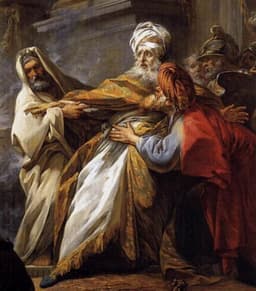
Jeroboam I
Emperor · Ancient
47.0Total

Julius Caesar
General · Ancient
82.8Total
Basic Information
Born
-931
-100
Died
-910
-44
Era
Ancient
Ancient
Nationality
Israel
Roman Republic
Occupation
Emperor
General
Civilization
Middle Eastern
Western
Score Comparison
Military (10%)
50.0
88.0
Political (20%)
37.9
78.0
Influence (20%)
48.6
85.0
Legacy (20%)
41.7
82.0
Leadership (15%)
62.2
80.0
Strategy (15%)
43.7
85.0
TOTAL
47.0
82.8
Jeroboam I — Complete Timeline
931 BC
Proclamation as King of Northern IsraelPolitical Action
After Rehoboam refused to lighten the tax burden, the ten northern tribes proclaimed Jeroboam as their king at Shechem. This established the Kingdom of Israel, separate from the Kingdom of Judah, fulfilling the prophecy of Ahijah.
Kingdom SplitIsraelRehoboam
Impact: national
930 BC
Establishment of Golden Calves at Dan and BethelCultural◆ Major
Jeroboam set up two golden calves, one at Bethel and one at Dan, as alternative worship sites to Jerusalem. He appointed non-Levitical priests and instituted festivals, leading to the establishment of a separate religious cult in Israel.
IdolatryReligionNorthern Kingdom
Impact: nationaldestructive
913 BC
War with Abijah of JudahWar◆ Major
Jeroboam fought a prolonged war with Abijah, king of Judah. Abijah's forces defeated Jeroboam's army, capturing several cities including Bethel, Jeshanah, and Ephron. This weakened Jeroboam's kingdom and reduced his territory.
WarJudahAbijah
Impact: regionaldestructive
Julius Caesar — Complete Timeline
58 BC
Gallic WarsWar◆ Major
Caesar, as proconsul of Gaul, launched a series of campaigns that conquered all of Gaul (modern France, Belgium, and parts of Switzerland). He fought numerous battles, including against the Helvetii, the Belgae, and the Gallic chieftain Vercingetorix. The wars brought immense wealth and a loyal army to Caesar.
Gallic WarsConquestRoman Expansion
Impact: regional
49 BC
Crossing the RubiconPolitical Action◆ Major
Caesar led Legio XIII across the Rubicon River into Italy, defying the Roman Senate's order to disband his army. This act triggered a civil war against Pompey and the Optimates, ultimately leading to Caesar's dictatorship and the end of the Roman Republic.
Roman Civil WarEnd of RepublicPower Struggle
Impact: global
48 BC
Battle of PharsalusWar◆ Major
Caesar's outnumbered army defeated the larger forces of Pompey the Great at Pharsalus in Greece. Caesar's tactical use of a reserve line to counter Pompey's cavalry charge proved decisive. Pompey fled to Egypt, where he was assassinated, leaving Caesar as the undisputed master of the Roman world.
Roman Civil WarBattleDecisive Victory
Impact: regional
44 BC
Appointment as Dictator for LifePolitical Action◆ Major
The Roman Senate appointed Caesar dictator perpetuo (dictator for life), granting him unprecedented personal power. This move concentrated military, legislative, and judicial authority in one person, effectively ending the Roman Republic's traditional system of checks and balances and alarming many senators.
DictatorshipEnd of RepublicPower Consolidation
Impact: regionaldestructive
Assassination on the Ides of MarchPolitical Action◆ Major
A group of Roman senators, led by Marcus Junius Brutus and Gaius Cassius Longinus, stabbed Caesar to death at a meeting of the Senate in the Theatre of Pompey. The assassination was intended to restore the Republic, but instead triggered another civil war that led to the rise of the Roman Empire.
AssassinationRoman PoliticsEnd of Republic
Impact: globaldestructive
Expert Analysis
jeroboam-i-vs-julius-caesar
# The Dictator and the Schismatic: Caesar and Jeroboam, Two Paths to Power
On the Ides of March in 44 BCE, a Roman dictator fell beneath twenty-three dagger blows in the Senate chamber. Nearly nine centuries earlier, in the highlands of Shechem, a former labor foreman stood before the assembled tribes of Israel, accepting a crown that would shatter a united kingdom. Julius Caesar and Jeroboam I—one a military titan whose name became synonymous with imperial ambition, the other a biblical king remembered chiefly for golden calves and schism—seem at first glance to inhabit different universes. Yet both men faced the same fundamental question: how does a leader seize power when the old order is crumbling? Their answers, separated by centuries and civilizations, reveal why some founders build empires while others build ruins.
Origins
Caesar was born into the twilight of the Roman Republic, a world of senatorial intrigue and aristocratic competition. His family, the Julii, claimed descent from the goddess Venus, but their political fortunes had faded. The young Caesar learned early that in Rome, reputation was currency, and debt was the price of ambition. He studied rhetoric in Rhodes, fled from Sulla’s proscriptions, and cultivated a network of allies that would one day carry him to the top. His era was one of civil wars and provincial conquests, where a general with loyal legions could rewrite the constitution.
Jeroboam emerged from a very different world: the ancient Near East of tribal alliances and divine kingship. He was the son of Nebat, an Ephraimite, and served as a high-ranking official under King Solomon. The biblical account describes him as a “mighty man of valor,” but his rise began with a prophet’s anointing—a divine mandate that promised him ten tribes if he would obey God’s laws. His era was one of inherited monarchy, where legitimacy flowed from Jerusalem’s temple and David’s lineage, not from popular acclaim or military might.
Rise to Power
Caesar’s ascent was a masterpiece of calculated risk. He borrowed fortunes to fund games and bribes, secured the governorship of Gaul at age forty, and spent eight years conquering a territory larger than Italy itself. His Commentaries turned military campaigns into political propaganda, making him a hero to the Roman people and a threat to the Senate. The Rubicon River, crossed in 49 BCE, was not a geographical boundary but a point of no return: by bringing his army into Italy, Caesar declared war on the Republic itself. Within four years, he was dictator for life.
Jeroboam’s rise was swifter but more fragile. In 931 BCE, when Solomon’s son Rehoboam refused to lighten the crushing tax burden, the ten northern tribes gathered at Shechem and proclaimed Jeroboam their king. No armies were needed—only popular grievance and the memory of Solomon’s forced labor. But Jeroboam faced an immediate crisis: his kingdom had no capital, no temple, and no religious legitimacy. The Davidic dynasty still ruled in Jerusalem, and the temple there drew pilgrims from every tribe.
Leadership & Governance
Caesar governed as a military innovator and political reformer. He reorganized the calendar, granted citizenship to provincials, initiated public works, and centralized power in his own hands while preserving the forms of republican government. His military genius—the siege of Alesia, the lightning campaign at Pharsalus—was matched by a strategic vision that understood empire required more than conquest. He pardoned former enemies, appointed Gauls to the Senate, and planned campaigns against Parthia that might have extended Roman dominion to India.
Jeroboam governed as a pragmatist haunted by insecurity. Fearing that pilgrimages to Jerusalem would turn his subjects’ loyalty back to David’s house, he established alternative worship sites at Dan and Bethel, complete with golden calves. “It is too much for you to go up to Jerusalem,” he told his people. The calves were not idols in the pagan sense—they were likely pedestals for Yahweh—but the act violated the covenant and earned him lasting condemnation. He fortified cities, built a new capital at Tirzah, and fought a prolonged war with Judah, but his military record was poor: in 913 BCE, Abijah of Judah defeated Jeroboam’s army, capturing several cities.
Triumph & Tragedy
Caesar’s greatest triumph was the conquest of Gaul, which brought him wealth, glory, and an army personally loyal to him. His greatest tragedy was his assassination—not because he fell, but because he failed to see that the Republic’s traditions could not be discarded without violence. The Ides of March was a republican backlash against monarchy, but it also ensured that his adopted heir, Octavian, would complete the transformation Caesar had begun.
Jeroboam’s triumph was the establishment of a viable northern kingdom that would endure for two centuries. His tragedy was the religious apostasy that defined his reign. The golden calves became a symbol of idolatry, and the prophets condemned his dynasty to destruction. His son Nadab was assassinated within two years, fulfilling the prophecy that Jeroboam’s house would be cut off.
Character & Destiny
Caesar was audacious, charismatic, and ruthlessly clear-eyed. He understood that power in Rome depended on perception, and he controlled the narrative with the same skill he commanded legions. His famous line—“The die is cast”—captures a man who embraced risk as a tool of destiny. Yet his arrogance blinded him to the limits of his authority; he dismissed the soothsayer’s warning, and the Senate’s daggers found him.
Jeroboam was cautious, defensive, and spiritually shortsighted. He saw political threats everywhere but failed to grasp that his legitimacy rested on divine favor, not popular will. The prophet Ahijah had promised him a lasting dynasty—if he obeyed God’s commands. Jeroboam chose expediency over faith, and his kingdom paid the price.
Legacy
Caesar’s legacy is monumental. His name became a title—Kaiser, Tsar—and his reforms shaped Western governance for millennia. He is remembered as a military genius, a political visionary, and a cautionary tale about the death of republics. His story is told in every classroom, his words studied in every military academy.
Jeroboam’s legacy is cautionary in a different key. In Jewish and Christian tradition, he is “Jeroboam son of Nebat, who caused Israel to sin”—a byword for religious corruption. His kingdom outlasted him, but his dynasty perished, and his name survives mostly as a warning against placing political expediency above divine law.
Conclusion
What drove these two men to such different outcomes? Caesar inherited a world where power was fluid, where a general with ambition could reshape civilization. Jeroboam inherited a world where power was sacred, where kingship required divine sanction. Caesar broke the old order and built a new one; Jeroboam broke the old order and built a fragile copy. Both seized their moment, but only one understood that lasting power requires not just conquest, but a vision that outlasts the conqueror. In the end, the difference between a founder and a schismatic is not talent or opportunity—it is the ability to see beyond the throne to the world it must serve.
Rankings
🥇
Julius CaesarLeader
Mil: 88.0Pol: 78.0Inf: 85.0
82.8
🥈
Jeroboam I
Mil: 50.0Pol: 37.9Inf: 48.6
47.0
+35.8 behind
How This Comparison Works
Algorithm
Each figure is scored on 6 dimensions (0—100 scale) based on structured historical data: Military (10%), Political (20%), Influence (20%), Legacy (20%), Leadership (15%), Strategy (15%). The weighted total produces the final ranking.
Data Sources
Scores are computed from structured sub-indicators in the database. Scale factors adjust for era (Ancient ×0.85, Modern ×1.0) and civilization size (Eastern ×1.05, Other ×0.80) to account for differences in population and military scale.
Maximum 3 Figures
Comparisons are limited to 2—3 figures to ensure readability and statistical meaningfulness.
Error Margins
±5 points per dimension — Sub-scores are derived from historical records with inherent uncertainty. Two figures within 5 points on a dimension should be considered roughly equivalent in that area.
Total Score Accuracy
±3 points overall — The weighted combination of 6 dimensions produces a total score with approximately ±3 points of uncertainty. Differences of less than 3 points are not statistically significant— the figures are effectively tied.
Known Limitations
- Historical records are incomplete and uneven across civilizations
- Figures from oral-tradition societies may be underrepresented
- Occupation labels can misclassify multi-role figures
- Scores measure capability and impact, not moral character
- Quantitative scoring is a comparison tool, not absolute truth
Capability Radar
Military (10%) — Battles & Warfare
Battles
20
95
Win Rate
20
92
Expansion
15
97
Political (20%) — Governance & Reform
Reform
40
90
Diplomacy
30
85
Economy
30
82
Influence (20%) — Cultural & Global Reach
Cultural
30
88
Global
20
94
Legacy (20%) — Historical Impact
Historical
40
95
Longevity
30
96
Leadership (15%) — Power & Stability
Tenure
60
75
Stability
20
60
Strategy (15%) — Tactics & Innovation
Strategy
20
94
Tactics
20
96
Reform
15
88
Similar Comparisons
Comments & Discussion
No comments yet. Be the first to share your thoughts!