Loading...
Jimmy Carter vs Sebastian Kurz
Jimmy Carter leads by 8.4 pts · 2 figures compared
…
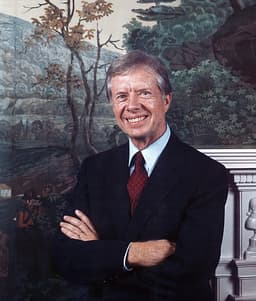
Jimmy Carter
Politician · Modern
59.1Total

Sebastian Kurz
Politician · Modern
50.7Total
Basic Information
Born
1924
1986
Died
—
—
Era
Modern
Modern
Nationality
United States
Austria
Occupation
Politician
Politician
Civilization
Western
Western
Score Comparison
Military (10%)
10.0
49.3
Political (20%)
60.0
61.3
Influence (20%)
82.0
51.8
Legacy (20%)
58.0
40.0
Leadership (15%)
68.0
62.2
Strategy (15%)
38.6
43.0
TOTAL
59.1
50.7
Jimmy Carter — Complete Timeline
1976 AD
Elected PresidentPolitical Action
Carter defeated incumbent Gerald Ford in the 1976 presidential election. He campaigned as a Washington outsider and promised honesty and human rights in foreign policy.
PresidencyElection
Impact: national
1978 AD
Brokered the Camp David AccordsPolitical Action
Carter mediated negotiations between Egyptian President Anwar Sadat and Israeli Prime Minister Menachem Begin at Camp David. The accords led to the Egypt-Israel Peace Treaty in 1979, a landmark in Middle East diplomacy.
Middle East PeaceDiplomacy
Impact: globalconstructive
1979 AD
Iran Hostage CrisisPolitical Action◆ Major
Iranian militants seized the US Embassy in Tehran, taking 52 American hostages. Carter's administration attempted a rescue mission that failed, and the crisis dominated his final year in office.
IranHostage Crisis
Impact: globaldestructive
1980 AD
Lost 1980 Presidential ElectionPolitical Action◆ Major
Carter lost the 1980 election to Ronald Reagan in a landslide. The defeat was attributed to economic stagflation, the Iran hostage crisis, and a perception of weak leadership.
ElectionDefeat
Impact: nationaldestructive
2002 AD
Awarded Nobel Peace PrizeCultural◆ Major
Carter was awarded the Nobel Peace Prize for his decades of work in conflict resolution, human rights, and democracy promotion through the Carter Center. The prize recognized his post-presidential efforts.
Nobel PrizeHuman Rights
Impact: globalconstructive
Sebastian Kurz — Complete Timeline
2017 AD
Appointed Chancellor of AustriaPolitical Action◆ Major
Sebastian Kurz became Chancellor of Austria on December 18, 2017, at age 31, the youngest in Austrian history. He led a coalition between his Austrian People's Party and the Freedom Party of Austria.
ChancellorshipYoungest Chancellor
Impact: national
2019 AD
Ibiza Affair and Government CollapsePolitical Action◆ Major
On May 18, 2019, a video surfaced showing Freedom Party leader Heinz-Christian Strache offering government contracts. Kurz ended the coalition on May 20, leading to a snap election. The scandal severely damaged the FP
ScandalCoalition Collapse
Impact: nationaldestructive
First Vote of No DefeatPolitical Action◆ Major
On May 27, 2019, Kurz lost a vote of no confidence in the National Council, the first successful such vote in Austrian history. He was removed from office and replaced by a caretaker government led by Brigitte Bierlein.
Vote of No ConfidenceRemoval from Office
Impact: nationaldestructive
2020 AD
Second Chancellorship and Corruption InvestigationPolitical Action◆ Major
Kurz returned as Chancellor on January 7, 2020, leading a coalition with the Greens. In October 2021, prosecutors raided his offices as part of a corruption investigation into alleged misuse of public funds for positive media coverage.
Corruption InvestigationCoalition with Greens
Impact: nationaldestructive
2021 AD
Resignation Amid Corruption ProbePolitical Action◆ Major
Kurz resigned as Chancellor on October 9, 2021, following the corruption investigation. He was succeeded by Alexander Schallenberg. Kurz remained party leader but stepped down from government to avoid further instability.
ResignationCorruption Scandal
Impact: nationaltragic
Expert Analysis
Origins
Jimmy Carter was born on October 1, 1924, in Plains, Georgia, to a peanut farming family. He graduated from the U.S. Naval Academy in 1946 and served as a naval officer before returning to run the family farm after his father's death. His entry into politics began with a seat in the Georgia State Senate in 1963, followed by his election as Governor of Georgia in 1971. Sebastian Kurz was born on August 27, 1986, in Vienna, Austria, to a middle-class family. He studied law at the University of Vienna but left before graduating. Kurz entered politics early, joining the youth wing of the Austrian People's Party (ÖVP) at age 17. He became a member of the Vienna City Council in 2010 and was appointed State Secretary for Integration in 2011 at age 25.
Rise to Power
Carter's rise was propelled by his campaign as a Washington outsider in the post-Watergate era. He won the Democratic nomination in 1976 and defeated incumbent Gerald Ford in the general election, taking office in January 1977. His key turning point was brokering the Camp David Accords in 1978, which earned him international acclaim. Kurz rose through the ÖVP ranks rapidly. He became chairman of the youth wing in 2009 and was elected to the National Council in 2011. In 2013, he was appointed Foreign Minister at age 27, the youngest in Austrian history. In the 2017 legislative election, he led the ÖVP to first place and became Chancellor on December 18, 2017, at age 31, the youngest in Austrian history.
Leadership & Governance
Carter's leadership style was detail-oriented and moralistic. He prioritized human rights in foreign policy, signed the Panama Canal Treaties, and established full diplomatic relations with China. Domestically, he deregulated the airline and trucking industries and created the Departments of Energy and Education. However, his administration struggled with stagflation and energy crises. Kurz governed as a centrist-right pragmatist. His first coalition with the far-right Freedom Party (FPÖ) focused on tax cuts, immigration restrictions, and digitization. His second coalition with the Greens, formed in 2020, emphasized environmental policies. Kurz's style was media-savvy and controlling, centralizing power in the chancellery.
Triumph & Tragedy
Carter's greatest success was the Camp David Accords, which led to a peace treaty between Egypt and Israel in 1979, a lasting achievement. His greatest failure was the Iran Hostage Crisis, where 52 Americans were held for 444 days. A rescue mission failed, and the crisis dominated his final year. He lost the 1980 election to Ronald Reagan in a landslide. Kurz's triumph was becoming the youngest chancellor and modernizing the ÖVP. However, his tenure was marred by the Ibiza Affair in 2019, which collapsed his first government. He faced a corruption investigation in 2021 and resigned on October 9, 2021, ending his political career.
Character & Destiny
Carter was known for his integrity and strong moral compass, but critics saw him as micromanaging and ineffective. His post-presidency work through the Carter Center earned him a Nobel Peace Prize in 2002. Kurz was ambitious and strategic, but his willingness to work with the far right and his involvement in corruption allegations tarnished his legacy. Historians assess Carter as a better former president than president, while Kurz is seen as a promising leader who fell to scandal.
Legacy
Carter's legacy is shaped by the Camp David Accords, his human rights advocacy, and extensive post-presidential humanitarian work. He scored 82.0 in influence and 58.0 in legacy. Kurz's legacy is mixed: he modernized Austrian politics but left amid corruption probes. His scores in influence (51.8) and legacy (40.0) reflect his shorter, more controversial tenure. Carter's impact on Middle East peace endures, while Kurz's reforms may be overshadowed by his fall.
Conclusion
Jimmy Carter had a greater impact than Sebastian Kurz, as evidenced by his total score of 59.1 compared to Kurz's 50.7. Carter's achievements in international diplomacy, particularly the Camp David Accords, have had lasting global significance, while Kurz's domestic reforms were limited by his short tenure and scandals. Carter's post-presidency also extended his influence, whereas Kurz's career ended prematurely. The 8.4-point score gap reflects Carter's superior leadership and legacy.
Rankings
🥇
Jimmy CarterLeader
Mil: 10.0Pol: 60.0Inf: 82.0
59.1
🥈
Sebastian Kurz
Mil: 49.3Pol: 61.3Inf: 51.8
50.7
+8.4 behind
How This Comparison Works
Algorithm
Each figure is scored on 6 dimensions (0—100 scale) based on structured historical data: Military (10%), Political (20%), Influence (20%), Legacy (20%), Leadership (15%), Strategy (15%). The weighted total produces the final ranking.
Data Sources
Scores are computed from structured sub-indicators in the database. Scale factors adjust for era (Ancient ×0.85, Modern ×1.0) and civilization size (Eastern ×1.05, Other ×0.80) to account for differences in population and military scale.
Maximum 3 Figures
Comparisons are limited to 2—3 figures to ensure readability and statistical meaningfulness.
Error Margins
±5 points per dimension — Sub-scores are derived from historical records with inherent uncertainty. Two figures within 5 points on a dimension should be considered roughly equivalent in that area.
Total Score Accuracy
±3 points overall — The weighted combination of 6 dimensions produces a total score with approximately ±3 points of uncertainty. Differences of less than 3 points are not statistically significant— the figures are effectively tied.
Known Limitations
- Historical records are incomplete and uneven across civilizations
- Figures from oral-tradition societies may be underrepresented
- Occupation labels can misclassify multi-role figures
- Scores measure capability and impact, not moral character
- Quantitative scoring is a comparison tool, not absolute truth
Capability Radar
Military (10%) — Battles & Warfare
Battles
0
29
Win Rate
0
34
Expansion
0
33
Political (20%) — Governance & Reform
Reform
55
40
Diplomacy
85
50
Economy
40
40
Influence (20%) — Cultural & Global Reach
Cultural
50
20
Global
60
30
Legacy (20%) — Historical Impact
Historical
65
25
Longevity
50
15
Leadership (15%) — Power & Stability
Tenure
60
30
Stability
45
30
Strategy (15%) — Tactics & Innovation
Strategy
0
39
Tactics
0
43
Reform
5
43
Similar Comparisons
Comments & Discussion
No comments yet. Be the first to share your thoughts!