Loading...
Joachim Murat vs Korechika Anami
Joachim Murat leads by 11.0 pts · 2 figures compared
…
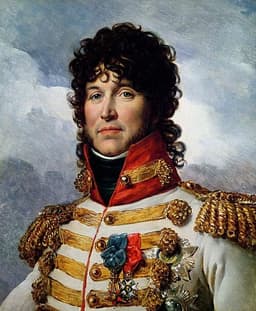
Joachim Murat
General · Modern
58.3Total

Korechika Anami
General · Modern
47.3Total
Basic Information
Born
1767
1887
Died
1815
1945
Era
Modern
Modern
Nationality
France
Japan
Occupation
General
General
Civilization
Western
Eastern
Score Comparison
Military (10%)
74.7
55.0
Political (20%)
68.0
32.2
Influence (20%)
58.3
51.8
Legacy (20%)
56.0
45.0
Leadership (15%)
40.0
55.3
Strategy (15%)
60.7
45.0
TOTAL
58.3
47.3
Joachim Murat — Complete Timeline
1798 AD
Battle of the PyramidsWar◆ Major
Murat led a cavalry charge that broke the Mamluk lines near Cairo. This victory secured French control of Lower Egypt during Napoleon's Egyptian campaign.
Egyptian CampaignCavalryNapoleonic Wars
Impact: regional
1799 AD
Battle of AbukirWar◆ Major
Murat led a decisive cavalry charge that defeated the Ottoman army at Abukir, Egypt. He captured the Ottoman commander and was promoted to general of division.
Egyptian CampaignCavalryNapoleonic Wars
Impact: regional
1805 AD
Battle of AusterlitzWar◆ Major
Murat commanded the French cavalry reserve at Austerlitz. His cavalry pursued the fleeing Russian and Austrian forces after the Allied center collapsed, contributing to the decisive French victory.
Napoleonic WarsBattleCavalry
Impact: global
1808 AD
Appointed King of NaplesPolitical Action◆ Major
Napoleon appointed Murat as King of Naples, replacing Joseph Bonaparte who became King of Spain. Murat ruled the Kingdom of Naples from 1808 to 1815, implementing French administrative reforms.
Kingdom of NaplesMonarchyNapoleonic Era
Impact: regional
1813 AD
Battle of LeipzigWar◆ Major
Murat commanded the French cavalry at the Battle of Leipzig. His forces were defeated by the Allied coalition, and he later negotiated with the Allies to preserve his throne, abandoning Napoleon.
Napoleonic WarsBattleDefeatBetrayal
Impact: global
1815 AD
Hundred Days CampaignWar◆ Major
Murat declared war on Austria in an attempt to regain his throne during Napoleon's Hundred Days. He was defeated at the Battle of Tolentino and fled to France, losing his kingdom.
Hundred DaysNapoleonic WarsDefeat
Impact: regionaltragic
Execution by Firing SquadPolitical Action◆ Major
Murat was captured by Bourbon forces after attempting to land in Calabria to reclaim his throne. He was tried by a military court and executed by firing squad at the Castello di Pizzo.
ExecutionBourbon RestorationDeath
Impact: nationaltragic
Korechika Anami — Complete Timeline
1945 AD
Appointed War MinisterPolitical Action◆ Major
Anami was appointed Minister of War in the cabinet of Prime Minister Kantaro Suzuki in April 1945. He held this position during the final months of World War II, advocating for continued resistance against the Allies.
World War IICabinetJapan
Impact: national
Committed SeppukuOther◆ Major
Following Emperor Hirohito's announcement of Japan's surrender on August 15, 1945, Anami committed seppuku (ritual suicide) at his residence. He left a death poem and expressed regret for his failure to achieve victory.
World War IISuicideSurrender
Impact: nationaltragic
Expert Analysis
Origins
Joachim Murat was born on March 25, 1767, in La Bastide-Fortunière, France, the son of an innkeeper. He initially studied for the priesthood but ran away to join a cavalry regiment in 1787. His dashing appearance and fearless nature quickly marked him for advancement during the French Revolutionary Wars. By 1795, he had become a captain and caught the attention of Napoleon Bonaparte. Murat's marriage to Napoleon's sister Caroline in 1800 cemented his ties to the Bonaparte family.
Korechika Anami was born on February 21, 1887, in Taketa, Ōita Prefecture, Japan, into a samurai family. He graduated from the Imperial Japanese Army Academy in 1905 and later from the Army War College. Anami served in the Siberian Intervention and rose through the ranks, becoming a general in 1943. His career was shaped by the bushido code and loyalty to the emperor.
Rise to Power
Murat's rise was meteoric. He distinguished himself at the Battle of the Pyramids in 1798, where his cavalry charge broke the Mamluk lines, securing French control of Lower Egypt. At the Battle of Abukir in 1799, he led a decisive charge that defeated the Ottoman army, capturing the commander and earning promotion to general of division. His role in the coup of 18 Brumaire (1799) was critical: he led the grenadiers who expelled the Council of Five Hundred, clearing the way for Napoleon's consulship. Murat's marriage to Caroline and his performance at Austerlitz (1805) where he commanded the cavalry reserve, pursuing the fleeing allies, solidified his position. In 1808, Napoleon appointed him King of Naples.
Anami's rise was steady within the imperial system. He served as a military attaché to Italy and later as commander of the 109th Division in China. In 1943, he became commander of the 11th Army Group in Manchukuo. His loyalty and hardline views on continuing the war brought him to the attention of the military clique. In April 1945, he was appointed Minister of War in Prime Minister Kantaro Suzuki's cabinet, at a time when Japan was facing imminent defeat.
Leadership & Governance
Murat as King of Naples (1808-1815) implemented Napoleonic reforms: abolished feudalism, introduced the Napoleonic Code, reorganized the army, and promoted public works. However, his rule was marked by financial strain and resentment from the nobility. His leadership style was flamboyant and impulsive. Militarily, Murat scored 74.7 in military ability, but his strategic score of 60.7 reflects his tendency to act without foresight. For instance, in 1815, during the Hundred Days, he declared war on Austria prematurely, leading to defeat at Tolentino and loss of his kingdom.
Anami, with a military score of 55.0 and leadership of 55.3, was a competent but not exceptional general. As War Minister, he faced the dilemma of surrender. He advocated for a final decisive battle (Ketsu-Go) on the Japanese mainland, despite the likely massive casualties. He resisted the Potsdam Declaration until after the atomic bombings. His governance focused on maintaining army morale and preparing for invasion. Anami's political score of 32.2 reflects his limited influence outside military circles.
Triumph & Tragedy
Murat's greatest triumph was his cavalry charge at the Battle of Austerlitz, which helped secure one of Napoleon's greatest victories. His personal bravery was legendary. However, his tragedy came in 1815: his ill-advised campaign to reclaim Naples failed, and after Napoleon's final defeat, Murat was captured and executed by firing squad in 1815. He scored 56.0 in legacy, remembered as a dashing but flawed figure.
Anami's triumph was his role in maintaining order during the final days of the war. He ensured a peaceful surrender despite his personal opposition. His tragedy was his seppuku on August 15, 1945, after the emperor's surrender broadcast. His legacy score of 45.0 reflects his association with militarism and his dramatic end. He left a note: "I believe in the eternal existence of the Japanese nation."
Character & Destiny
Murat was bold, vain, and impulsive. His character drove him to seek glory, but his lack of strategic depth led to his downfall. He once said, "I am not a politician, I am a soldier." This dichotomy between his martial prowess and political ineptitude shaped his fate. Anami was stoic, principled, and bound by duty. His character, rooted in bushido, led him to choose ritual suicide over surrender. His destiny was sealed by the war he helped prolong.
Legacy
Murat's legacy is tied to Napoleonic warfare and the Kingdom of Naples. His cavalry tactics influenced 19th-century military thought. He scored 56.0 in legacy, remembered in French and Italian history. Anami's legacy is more ambiguous: he is a symbol of Japanese militarism and the tragedy of war. His act of seppuku is often cited in discussions of honor and surrender.
Conclusion
Joachim Murat had a greater impact than Korechika Anami. With a total score of 58.3 vs 47.3, Murat's influence spans military tactics and governance, while Anami's impact is confined to a single moment of defiance. Murat's cavalry charges changed battles; Anami's role was reactive. Thus, Murat's legacy is more substantial.
Rankings
🥇
Joachim MuratLeader
Mil: 74.7Pol: 68.0Inf: 58.3
58.3
🥈
Korechika Anami
Mil: 55.0Pol: 32.2Inf: 51.8
47.3
+11.0 behind
How This Comparison Works
Algorithm
Each figure is scored on 6 dimensions (0—100 scale) based on structured historical data: Military (10%), Political (20%), Influence (20%), Legacy (20%), Leadership (15%), Strategy (15%). The weighted total produces the final ranking.
Data Sources
Scores are computed from structured sub-indicators in the database. Scale factors adjust for era (Ancient ×0.85, Modern ×1.0) and civilization size (Eastern ×1.05, Other ×0.80) to account for differences in population and military scale.
Maximum 3 Figures
Comparisons are limited to 2—3 figures to ensure readability and statistical meaningfulness.
Error Margins
±5 points per dimension — Sub-scores are derived from historical records with inherent uncertainty. Two figures within 5 points on a dimension should be considered roughly equivalent in that area.
Total Score Accuracy
±3 points overall — The weighted combination of 6 dimensions produces a total score with approximately ±3 points of uncertainty. Differences of less than 3 points are not statistically significant— the figures are effectively tied.
Known Limitations
- Historical records are incomplete and uneven across civilizations
- Figures from oral-tradition societies may be underrepresented
- Occupation labels can misclassify multi-role figures
- Scores measure capability and impact, not moral character
- Quantitative scoring is a comparison tool, not absolute truth
Capability Radar
Military (10%) — Battles & Warfare
Battles
75
30
Win Rate
70
30
Expansion
65
20
Political (20%) — Governance & Reform
Reform
45
15
Diplomacy
50
25
Economy
40
10
Influence (20%) — Cultural & Global Reach
Cultural
55
20
Global
55
20
Legacy (20%) — Historical Impact
Historical
60
40
Longevity
50
20
Leadership (15%) — Power & Stability
Tenure
60
40
Stability
35
10
Strategy (15%) — Tactics & Innovation
Strategy
55
35
Tactics
85
35
Reform
40
20
Similar Comparisons
Comments & Discussion
No comments yet. Be the first to share your thoughts!