Loading...
Joachim Murat vs Napoleon Bonaparte
Napoleon Bonaparte leads by 12.6 pts · 2 figures compared
…
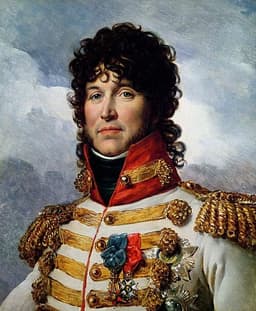
Joachim Murat
General · Modern
58.3Total

Napoleon Bonaparte
General · Modern
70.9Total
Basic Information
Born
1767
1769
Died
1815
1821
Era
Modern
Modern
Nationality
France
France
Occupation
General
General
Civilization
Western
Western
Score Comparison
Military (10%)
74.7
94.0
Political (20%)
68.0
72.0
Influence (20%)
58.3
40.0
Legacy (20%)
56.0
80.0
Leadership (15%)
40.0
78.0
Strategy (15%)
60.7
90.0
TOTAL
58.3
70.9
Joachim Murat — Complete Timeline
1798 AD
Battle of the PyramidsWar◆ Major
Murat led a cavalry charge that broke the Mamluk lines near Cairo. This victory secured French control of Lower Egypt during Napoleon's Egyptian campaign.
Egyptian CampaignCavalryNapoleonic Wars
Impact: regional
1799 AD
Battle of AbukirWar◆ Major
Murat led a decisive cavalry charge that defeated the Ottoman army at Abukir, Egypt. He captured the Ottoman commander and was promoted to general of division.
Egyptian CampaignCavalryNapoleonic Wars
Impact: regional
1805 AD
Battle of AusterlitzWar◆ Major
Murat commanded the French cavalry reserve at Austerlitz. His cavalry pursued the fleeing Russian and Austrian forces after the Allied center collapsed, contributing to the decisive French victory.
Napoleonic WarsBattleCavalry
Impact: global
1808 AD
Appointed King of NaplesPolitical Action◆ Major
Napoleon appointed Murat as King of Naples, replacing Joseph Bonaparte who became King of Spain. Murat ruled the Kingdom of Naples from 1808 to 1815, implementing French administrative reforms.
Kingdom of NaplesMonarchyNapoleonic Era
Impact: regional
1813 AD
Battle of LeipzigWar◆ Major
Murat commanded the French cavalry at the Battle of Leipzig. His forces were defeated by the Allied coalition, and he later negotiated with the Allies to preserve his throne, abandoning Napoleon.
Napoleonic WarsBattleDefeatBetrayal
Impact: global
1815 AD
Hundred Days CampaignWar◆ Major
Murat declared war on Austria in an attempt to regain his throne during Napoleon's Hundred Days. He was defeated at the Battle of Tolentino and fled to France, losing his kingdom.
Hundred DaysNapoleonic WarsDefeat
Impact: regionaltragic
Execution by Firing SquadPolitical Action◆ Major
Murat was captured by Bourbon forces after attempting to land in Calabria to reclaim his throne. He was tried by a military court and executed by firing squad at the Castello di Pizzo.
ExecutionBourbon RestorationDeath
Impact: nationaltragic
Napoleon Bonaparte — Complete Timeline
1799 AD
Coup of 18 BrumaireOther◆ Major
Napoleon Bonaparte, with support from his brother Lucien and key political figures, overthrew the Directory in a bloodless coup. He established the Consulate with himself as First Consul, effectively becoming the ruler of France. This event ended the French Revolution's most unstable period.
French RevolutionCoupRise to Power
Impact: regional
1804 AD
Promulgation of the Napoleonic CodeOther◆ Major
Napoleon enacted the Civil Code of the French, known as the Napoleonic Code, a comprehensive set of laws that replaced the fragmented feudal legal systems. The code established legal equality, protected property rights, and secularized law. It became the basis for legal systems in many European and world countries.
Legal ReformNapoleonic CodeCivil Law
Impact: globalconstructive
1805 AD
Battle of AusterlitzWar◆ Major
Napoleon's Grande Arm
Napoleonic WarsBattleDecisive Victory
Impact: global
1812 AD
Invasion of RussiaWar◆ Major
Napoleon led the Grande Arm
Napoleonic WarsInvasionDisaster
Impact: globaldestructive
1815 AD
Battle of WaterlooWar◆ Major
Napoleon's French army was defeated by the combined forces of the Duke of Wellington's Anglo-Allied army and Gebhard Leberecht von Bl
Napoleonic WarsBattleFinal Defeat
Impact: globaldestructive
Expert Analysis
Origins
Joachim Murat was born on March 25, 1767, in La Bastide-Fortunière, France, the son of an innkeeper and a postmaster's daughter. He initially studied for the priesthood but fled to join a cavalry regiment in 1787. His early military career was unremarkable until the French Revolution opened opportunities for rapid advancement.
Napoleon Bonaparte was born on August 15, 1769, in Ajaccio, Corsica, to a minor noble family. He studied at military schools in Brienne and Paris, graduating as a second lieutenant in 1785. His Corsican heritage shaped his early ambitions, and he initially supported Corsican independence before embracing the French Revolution.
Rise to Power
Murat's rise accelerated during the Italian campaign of 1796, where he served under Napoleon. He distinguished himself at the Battle of the Pyramids in 1798, leading a cavalry charge that broke the Mamluk lines near Cairo, securing French control of Lower Egypt. His decisive charge at the Battle of Abukir in 1799 captured the Ottoman commander and earned him promotion to general of division. He became Napoleon's brother-in-law by marrying Caroline Bonaparte in 1800, cementing his political position.
Napoleon's rise was meteoric. He captured Toulon in 1793, then commanded the Army of Italy in 1796, winning a series of battles against Austria. His Egyptian campaign (1798-1801) enhanced his fame despite eventual failure. On November 9, 1799, he staged the Coup of 18 Brumaire, overthrowing the Directory and establishing the Consulate, with himself as First Consul.
Leadership & Governance
Murat was a charismatic and courageous cavalry leader, known for his flamboyant uniforms and personal bravery. As King of Naples from 1808 to 1815, he attempted reforms, including abolishing feudalism and introducing the Napoleonic Code. However, his governance was marked by instability, as he frequently prioritized military glory over administration. His leadership style was impulsive, often acting without strategic foresight.
Napoleon was a strategic genius and a centralized administrator. He reorganized France's government, established the Bank of France, and implemented the Napoleonic Code, which standardized laws across Europe. His leadership combined military brilliance with political acumen, but his ambition led to overreach. He scored 93.0 in strategy, reflecting his ability to plan grand campaigns, but his political score of 75.0 indicates occasional miscalculations.
Triumph & Tragedy
Murat's greatest triumphs were his cavalry charges at Austerlitz (1805), where he commanded the French cavalry reserve and pursued fleeing allies after the Allied center collapsed, and at Abukir (1799). As king, he modernized Naples. His tragedy came during the Hundred Days in 1815, when he declared war on Austria to regain his throne. He was defeated at the Battle of Tolentino and fled, eventually captured and executed by firing squad on October 13, 1815. His score of 64.5 in strategy reflects his tactical brilliance but strategic failures.
Napoleon's triumphs include the Battle of Austerlitz (1805), a masterpiece of military strategy, and the Napoleonic Code, which influenced legal systems worldwide. His invasion of Russia in 1812 was a catastrophic failure, losing over 400,000 men. His final defeat at Waterloo on June 18, 1815, ended his rule. He died in exile on Saint Helena in 1821. Despite his military score of 94.0, his legacy includes both liberation and conquest.
Character & Destiny
Murat was flamboyant, courageous, but impulsive. His decisions often stemmed from personal loyalty to Napoleon, yet he also betrayed him by negotiating with the Allies in 1814 to save his throne. His character led to a tragic end, as he misjudged the political landscape. Historians note his lack of strategic depth, reflected in his strategy score of 64.5.
Napoleon was supremely confident, ambitious, and methodical. His character combined genius with hubris, leading to overexpansion. His destiny was shaped by his inability to compromise, evident in his Russian campaign. He scored 80.0 in leadership, indicating his ability to inspire, but his political score of 75.0 shows limitations in sustaining his empire.
Legacy
Murat is remembered as a skilled cavalry commander and a minor monarch. His legacy is tied to Napoleon's era, with limited independent impact. His military reforms in Naples had some influence, but his score of 66.4 in legacy reflects a lesser historical footprint.
Napoleon's legacy is profound. The Napoleonic Code influenced civil law in Europe and beyond. His military tactics are studied in war colleges. He redrew European borders and spread nationalism. His legacy score of 78.0 reflects his enduring impact, though his reputation is contested due to wars and authoritarianism.
Conclusion
Napoleon Bonaparte had greater impact, with a total score of 82.4 compared to Murat's 69.8. Napoleon's military (94.0) and strategy (93.0) far exceed Murat's 84.3 and 64.5. While Murat was a capable cavalry leader, Napoleon reshaped Europe through law, governance, and warfare. Murat's role, though important, was secondary. Thus, Napoleon stands as the more significant historical figure.
Rankings
🥇
Napoleon BonaparteLeader
Mil: 94.0Pol: 72.0Inf: 40.0
70.9
🥈
Joachim Murat
Mil: 74.7Pol: 68.0Inf: 58.3
58.3
+12.6 behind
How This Comparison Works
Algorithm
Each figure is scored on 6 dimensions (0—100 scale) based on structured historical data: Military (10%), Political (20%), Influence (20%), Legacy (20%), Leadership (15%), Strategy (15%). The weighted total produces the final ranking.
Data Sources
Scores are computed from structured sub-indicators in the database. Scale factors adjust for era (Ancient ×0.85, Modern ×1.0) and civilization size (Eastern ×1.05, Other ×0.80) to account for differences in population and military scale.
Maximum 3 Figures
Comparisons are limited to 2—3 figures to ensure readability and statistical meaningfulness.
Error Margins
±5 points per dimension — Sub-scores are derived from historical records with inherent uncertainty. Two figures within 5 points on a dimension should be considered roughly equivalent in that area.
Total Score Accuracy
±3 points overall — The weighted combination of 6 dimensions produces a total score with approximately ±3 points of uncertainty. Differences of less than 3 points are not statistically significant— the figures are effectively tied.
Known Limitations
- Historical records are incomplete and uneven across civilizations
- Figures from oral-tradition societies may be underrepresented
- Occupation labels can misclassify multi-role figures
- Scores measure capability and impact, not moral character
- Quantitative scoring is a comparison tool, not absolute truth
Capability Radar
Military (10%) — Battles & Warfare
Battles
75
95
Win Rate
70
90
Expansion
65
95
Political (20%) — Governance & Reform
Reform
45
95
Diplomacy
50
80
Economy
40
85
Influence (20%) — Cultural & Global Reach
Cultural
55
85
Global
55
90
Legacy (20%) — Historical Impact
Historical
60
95
Longevity
50
90
Leadership (15%) — Power & Stability
Tenure
60
85
Stability
35
70
Strategy (15%) — Tactics & Innovation
Strategy
55
95
Tactics
85
98
Reform
40
92
Similar Comparisons
Comments & Discussion
No comments yet. Be the first to share your thoughts!