Loading...
Jochi vs Julius Caesar
Julius Caesar leads by 33.7 pts · 2 figures compared
…
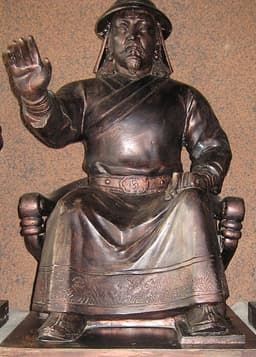
Jochi
Emperor · Medieval
49.1Total

Julius Caesar
General · Ancient
82.8Total
Basic Information
Born
1182
-100
Died
1227
-44
Era
Medieval
Ancient
Nationality
Mongol Empire
Roman Republic
Occupation
Emperor
General
Civilization
Eastern
Western
Score Comparison
Military (10%)
40.0
88.0
Political (20%)
29.3
78.0
Influence (20%)
58.0
85.0
Legacy (20%)
54.0
82.0
Leadership (15%)
45.0
80.0
Strategy (15%)
60.0
85.0
TOTAL
49.1
82.8
Jochi — Complete Timeline
1219 AD
Participation in the Conquest of KhwarezmWar◆ Major
Jochi commanded a Mongol army during the invasion of the Khwarezmian Empire. He led campaigns in the northern regions, capturing cities such as Jand and Yangikent, and securing the Syr Darya basin for the Mongols.
Mongol ConquestKhwarezm
Impact: regional
1225 AD
Dispute over SuccessionPolitical Action◆ Major
Jochi's legitimacy as Genghis Khan's eldest son was questioned by his brothers, particularly Chagatai. This dispute led to Jochi being passed over for succession, with Ogedei chosen as Great Khan instead, fueling tensions.
Mongol SuccessionFamily Feud
Impact: globaldestructive
1227 AD
Appointed as Ruler of the Jochi UlusPolitical Action◆ Major
After Genghis Khan's death, Jochi's sons inherited his territories in the western Mongol Empire, forming the Jochi Ulus, which later became the Golden Horde. Jochi himself died before Genghis, so his sons ruled in his stead.
Mongol EmpireGolden HordeSuccession
Impact: regional
Julius Caesar — Complete Timeline
58 BC
Gallic WarsWar◆ Major
Caesar, as proconsul of Gaul, launched a series of campaigns that conquered all of Gaul (modern France, Belgium, and parts of Switzerland). He fought numerous battles, including against the Helvetii, the Belgae, and the Gallic chieftain Vercingetorix. The wars brought immense wealth and a loyal army to Caesar.
Gallic WarsConquestRoman Expansion
Impact: regional
49 BC
Crossing the RubiconPolitical Action◆ Major
Caesar led Legio XIII across the Rubicon River into Italy, defying the Roman Senate's order to disband his army. This act triggered a civil war against Pompey and the Optimates, ultimately leading to Caesar's dictatorship and the end of the Roman Republic.
Roman Civil WarEnd of RepublicPower Struggle
Impact: global
48 BC
Battle of PharsalusWar◆ Major
Caesar's outnumbered army defeated the larger forces of Pompey the Great at Pharsalus in Greece. Caesar's tactical use of a reserve line to counter Pompey's cavalry charge proved decisive. Pompey fled to Egypt, where he was assassinated, leaving Caesar as the undisputed master of the Roman world.
Roman Civil WarBattleDecisive Victory
Impact: regional
44 BC
Appointment as Dictator for LifePolitical Action◆ Major
The Roman Senate appointed Caesar dictator perpetuo (dictator for life), granting him unprecedented personal power. This move concentrated military, legislative, and judicial authority in one person, effectively ending the Roman Republic's traditional system of checks and balances and alarming many senators.
DictatorshipEnd of RepublicPower Consolidation
Impact: regionaldestructive
Assassination on the Ides of MarchPolitical Action◆ Major
A group of Roman senators, led by Marcus Junius Brutus and Gaius Cassius Longinus, stabbed Caesar to death at a meeting of the Senate in the Theatre of Pompey. The assassination was intended to restore the Republic, but instead triggered another civil war that led to the rise of the Roman Empire.
AssassinationRoman PoliticsEnd of Republic
Impact: globaldestructive
Expert Analysis
jochi-vs-julius-caesar
### The Conqueror and the Shadow
On a March morning in 44 BCE, the most powerful man in the Roman world fell to twenty-three dagger blows at the foot of a statue of his great rival, Pompey. Half a world away and twelve centuries later, another son of a conqueror—Jochi, eldest of Genghis Khan—died in obscurity, perhaps poisoned, perhaps of illness, his name barely a whisper in the vast Eurasian steppe. Both were born to greatness, yet one remade the world in his image, while the other became a footnote to his father’s legend. What drove such different fates? The answer lies not in their bloodlines, but in the chasm between the worlds they inhabited and the choices they could not make.
### Origins
Julius Caesar was born into the twilight of the Roman Republic, a world of senatorial intrigue, civil wars, and a restless populace hungry for glory. His family, the Julii, claimed descent from the goddess Venus, but they were politically marginal. From his youth, Caesar learned to navigate a system where personal ambition was both a virtue and a mortal sin. He was a product of a civilization that worshipped individual achievement, where a man could rise from obscurity to the summit of power by sheer audacity.
Jochi, in contrast, was born on the unforgiving Mongolian steppe in 1182, the eldest son of a man who would unite the warring tribes. His world was one of clan loyalty, blood feuds, and absolute submission to the khan. Genghis Khan forged an empire through collective terror and discipline, not individual brilliance. Jochi’s identity was defined not by his own deeds, but by the shadow of his father and the whispers that followed him from birth: was he truly Genghis’s son, or the child of a captured Merkit woman? That doubt would haunt him forever.
### Rise to Power
Caesar’s path was a masterclass in political theater. He climbed the cursus honorum—the ladder of Roman offices—through debt, bribery, and alliances. He formed the First Triumvirate with Pompey and Crassus, then conquered Gaul in a decade of relentless warfare (58–50 BCE). His military genius was strategic and personal: he led from the front, shared hardships with his legionaries, and wrote his own propaganda in *Commentaries on the Gallic War*. When the Senate ordered him to disband his army, he crossed the Rubicon in 49 BCE, a gambit that launched a civil war and ended the Republic.
Jochi’s rise was not his own. In 1219, he commanded a wing of the Mongol army during the invasion of the Khwarezmian Empire, leading campaigns in the northern regions. He was a capable general, but his role was that of a prince executing his father’s will. The great decisions—the sieges, the massacres, the strategy of terror—were Genghis’s. Jochi’s moment came only when his father granted him the western territories, the future Golden Horde, as a fief. Yet even that inheritance was poisoned by the succession dispute of 1225, when his brother Chagatai openly questioned his legitimacy, calling him a “bastard.” Jochi’s power was a gift, not a conquest.
### Leadership & Governance
Caesar ruled as a revolutionary reformer. As dictator, he overhauled the calendar, granted citizenship to provincials, initiated public works, and centralized authority. His leadership was charismatic and ruthless: he pardoned enemies to win loyalty, but crushed opposition without mercy. Militarily, his strategy at Alesia (52 BCE)—walling in a Gallic army while fending off a relief force—remains a textbook example of siegecraft. Yet his political wisdom was flawed: he underestimated the senatorial aristocracy’s hatred, dismissing warnings of conspiracy.
Jochi governed as a steward. His Jochi Ulus was a vast, sparsely populated domain stretching from the Caspian to the Urals. He ruled through Mongol customs—tribute, hostages, and occasional raids—but his authority was always contingent on his father’s favor. He showed no ambition to reform or expand; his military score of 19.2 reflects a man who fought in his father’s wars, not his own. Where Caesar was a creator, Jochi was a placeholder.
### Triumph & Tragedy
Caesar’s greatest triumph was his own apotheosis: he was made dictator for life, his image stamped on coins, his name synonymous with absolute power. His tragedy was the Ides of March: assassinated by men he had pardoned, his body left to bleed on the Senate floor. The Republic he had destroyed was not rebuilt; instead, his adopted heir, Octavian, became Augustus, the first emperor.
Jochi’s triumph was more modest: he fathered the lineage that would rule the Golden Horde for centuries, shaping the history of Russia and Central Asia. His tragedy was his obscurity. He died in 1227, just months before Genghis Khan, his death shrouded in rumor. Some said he was poisoned on his father’s orders; others, that he succumbed to illness. He left no grand narrative, no memoirs, no monuments. His legacy was genetic, not historical.
### Character & Destiny
Caesar’s personality was his engine. He was ambitious, calculating, and supremely confident—a man who believed he could defy fate itself. His decisions were driven by a hunger for glory that bordered on madness: he crossed the Rubicon knowing it meant civil war, he dismissed the soothsayer’s warning about the Ides of March. His destiny was to be both a creator and a destroyer, a man who could not stop until he had remade the world.
Jochi’s character was shaped by doubt. He was a son whose legitimacy was never certain, a prince whose father’s love was conditional. His decisions—or lack thereof—were cautious, defensive. He did not challenge his brothers, did not seize power, did not write his own story. His destiny was to be forgotten, a mere link in a chain of khans. Where Caesar was a force of nature, Jochi was a leaf carried by the wind.
### Legacy
Caesar’s legacy is monumental. His name became a title—Kaiser, Tsar—and his conquests laid the foundation for the Roman Empire, which endured for five centuries in the West and a millennium in the East. He is remembered as a military genius, a political visionary, and a cautionary tale about the price of ambition. His scores—Military 88, Political 78, Influence 85, Legacy 82—reflect a man who shaped Western civilization.
Jochi’s legacy is more diffuse. His descendants, the khans of the Golden Horde, ruled Russia for two hundred years, but his individual impact is near zero. His scores—Military 19.2, Political 45.5, Influence 73.2, Legacy 68.6—tell the story of a man who mattered only through his bloodline. He is remembered, if at all, as a footnote in Genghis Khan’s epic, a shadow who could not escape his father’s light.
### Conclusion
Caesar and Jochi stand as polar opposites in the gallery of history. One was a man who bent the world to his will, the other a man who was bent by his world. Their differences are not merely personal—they are structural. Caesar lived in a civilization that celebrated individual ambition; Jochi lived in one that demanded collective obedience. Caesar had the freedom to forge his own destiny; Jochi had the burden of a destiny already written. In the end, the lesson is not that one was greater than the other, but that history rewards those who seize the pen—and forgets those who let others write their story.
Rankings
🥇
Julius CaesarLeader
Mil: 88.0Pol: 78.0Inf: 85.0
82.8
🥈
Jochi
Mil: 40.0Pol: 29.3Inf: 58.0
49.1
+33.7 behind
How This Comparison Works
Algorithm
Each figure is scored on 6 dimensions (0—100 scale) based on structured historical data: Military (10%), Political (20%), Influence (20%), Legacy (20%), Leadership (15%), Strategy (15%). The weighted total produces the final ranking.
Data Sources
Scores are computed from structured sub-indicators in the database. Scale factors adjust for era (Ancient ×0.85, Modern ×1.0) and civilization size (Eastern ×1.05, Other ×0.80) to account for differences in population and military scale.
Maximum 3 Figures
Comparisons are limited to 2—3 figures to ensure readability and statistical meaningfulness.
Error Margins
±5 points per dimension — Sub-scores are derived from historical records with inherent uncertainty. Two figures within 5 points on a dimension should be considered roughly equivalent in that area.
Total Score Accuracy
±3 points overall — The weighted combination of 6 dimensions produces a total score with approximately ±3 points of uncertainty. Differences of less than 3 points are not statistically significant— the figures are effectively tied.
Known Limitations
- Historical records are incomplete and uneven across civilizations
- Figures from oral-tradition societies may be underrepresented
- Occupation labels can misclassify multi-role figures
- Scores measure capability and impact, not moral character
- Quantitative scoring is a comparison tool, not absolute truth
Capability Radar
Military (10%) — Battles & Warfare
Battles
40
95
Win Rate
45
92
Expansion
50
97
Political (20%) — Governance & Reform
Reform
15
90
Diplomacy
35
85
Economy
20
82
Influence (20%) — Cultural & Global Reach
Cultural
40
88
Global
50
94
Legacy (20%) — Historical Impact
Historical
55
95
Longevity
60
96
Leadership (15%) — Power & Stability
Tenure
30
75
Stability
25
60
Strategy (15%) — Tactics & Innovation
Strategy
40
94
Tactics
35
96
Reform
20
88
Similar Comparisons
Comments & Discussion
历史辩手张三6/17/2026
数据党别吹了。你拿Alesia说事,但蒙古骑兵在卡尔卡河战役把罗斯联军打得找不着北,而高卢人最后还不是被屠了?Jochi真指挥过比这更大的行动吗?没有——他就是个帝国边界的马背快递员。Caesar赢在宣传战,他自个儿写的《高卢战记》就是历史洗白文。别拿死亡率当勋章,咱得看实际战果。Jochi的统治区域是西征的跳板,不是终点。|
ClassicsSage6/17/2026
Scholars fixate on statecraft, but let’s talk cultural DNA. Caesar, in Plutarch’s account, wept at Alexander’s statue—he craved legacy as epic poetry. Jochi? His Mongol context meant legacy was bloodlines and conquest quotas. Caesar’s assassination became a Shakespeare play; Jochi’s obscure death is a Mongol chronicle footnote. Caesar remixed Roman identity; Jochi was a tool for Genghis’s expansion. One wrote his own tombstone; the other got erased. The cultural impact gap is a canyon, not a cra
历史反叛者莉莉6/17/2026
Revisionist critic在此:凭啥把Jochi贬成配菜?Caesar是罗马精英圈的内战赢家,资源堆出来的;Jochi从草根蒙古战士起家,在部落政治里硬扛。Caesar在元老院耍手段,Jochi在草原干仗——两码事。别忘了Jochi的领地被父亲怀疑,但他没反叛,比Caesar那帮叛徒老实。说Jochi不重要?他儿子拔都建立了金帐汗国,才是真影响史。Caesar的帝国光速垮了,Jochi的血脉统治了几世纪。谁是影子?|
NomadReality6/17/2026
History buff here—Jochi died quietly near the Aral Sea in 1225, around age 43, while drinking with comrades. Caesar died famous, but Jochi’s death sparked a Mongol succession crisis that shaped half
Historian9866/17/2026
As a military historian, the Jochi-Caesar comparison is apples to steppe warfare chariots. Caesar was a tactical genius who wrote his own battle reports—the Siege of Alesia shows he could outthink any foe. Jochi? He inherited Mamluks and got a footnote. Caesar commanded legions that marched in formation; Jochi’s horde was nomadic chaos. Caesar died a martyr; Jochi died suspiciously, maybe from his father’s distrust. Jochi’s realm collapsed; Caesar’s legacy birthed an empire. Clear winner: Caesar