Loading...
John II of Castile vs Julius Caesar
Julius Caesar leads by 46.5 pts · 2 figures compared
…
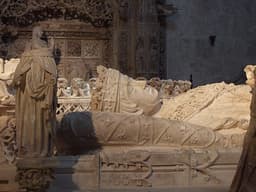
John II of Castile
Emperor · Medieval
36.3Total

Julius Caesar
General · Ancient
82.8Total
Basic Information
Born
1405
-100
Died
1454
-44
Era
Medieval
Ancient
Nationality
Castile
Roman Republic
Occupation
Emperor
General
Civilization
Western
Western
Score Comparison
Military (10%)
10.2
88.0
Political (20%)
30.7
78.0
Influence (20%)
46.3
85.0
Legacy (20%)
37.5
82.0
Leadership (15%)
34.6
80.0
Strategy (15%)
45.0
85.0
TOTAL
36.3
82.8
John II of Castile — Complete Timeline
1423 AD
Appointed Álvaro de Luna as ConstablePolitical Action◆ Major
John II appointed
Castilian PoliticsRoyal FavoritismÁlvaro de Luna
Impact: national
1445 AD
Battle of OlmedoWar◆ Major
John II and
Castilian Civil WarBattleNoble Rebellion
Impact: national
1453 AD
Execution of Álvaro de LunaPolitical Action
Under pressure from the nobility and his second wife, Isabella of Portugal, John II ordered the execution of his longtime favorite
Castilian PoliticsRoyal FavoritismExecution
Impact: nationaltragic
Julius Caesar — Complete Timeline
58 BC
Gallic WarsWar◆ Major
Caesar, as proconsul of Gaul, launched a series of campaigns that conquered all of Gaul (modern France, Belgium, and parts of Switzerland). He fought numerous battles, including against the Helvetii, the Belgae, and the Gallic chieftain Vercingetorix. The wars brought immense wealth and a loyal army to Caesar.
Gallic WarsConquestRoman Expansion
Impact: regional
49 BC
Crossing the RubiconPolitical Action◆ Major
Caesar led Legio XIII across the Rubicon River into Italy, defying the Roman Senate's order to disband his army. This act triggered a civil war against Pompey and the Optimates, ultimately leading to Caesar's dictatorship and the end of the Roman Republic.
Roman Civil WarEnd of RepublicPower Struggle
Impact: global
48 BC
Battle of PharsalusWar◆ Major
Caesar's outnumbered army defeated the larger forces of Pompey the Great at Pharsalus in Greece. Caesar's tactical use of a reserve line to counter Pompey's cavalry charge proved decisive. Pompey fled to Egypt, where he was assassinated, leaving Caesar as the undisputed master of the Roman world.
Roman Civil WarBattleDecisive Victory
Impact: regional
44 BC
Appointment as Dictator for LifePolitical Action◆ Major
The Roman Senate appointed Caesar dictator perpetuo (dictator for life), granting him unprecedented personal power. This move concentrated military, legislative, and judicial authority in one person, effectively ending the Roman Republic's traditional system of checks and balances and alarming many senators.
DictatorshipEnd of RepublicPower Consolidation
Impact: regionaldestructive
Assassination on the Ides of MarchPolitical Action◆ Major
A group of Roman senators, led by Marcus Junius Brutus and Gaius Cassius Longinus, stabbed Caesar to death at a meeting of the Senate in the Theatre of Pompey. The assassination was intended to restore the Republic, but instead triggered another civil war that led to the rise of the Roman Empire.
AssassinationRoman PoliticsEnd of Republic
Impact: globaldestructive
Expert Analysis
john-ii-of-castile-vs-julius-caesar
# The Man Who Crossed the Rubicon and the King Who Could Not Cross a Room
On a January morning in 49 BCE, Julius Caesar stood at the banks of the Rubicon River, a small stream that marked the boundary between his province of Gaul and Italy proper. To cross with his army was treason, a declaration of civil war against the Roman Senate. He paused, reportedly muttered *“Alea iacta est”* — the die is cast — and marched his legions into history. Fourteen centuries later, in the fortified halls of Medina del Campo, John II of Castile sat in a chamber surrounded by whispering nobles, unable to decide whether to dismiss his own constable. The difference between these two rulers is not merely one of success or failure; it is a study in how personality, circumstance, and the very structure of power shape the fate of nations.
Origins
Julius Caesar was born into the patrician Julian clan in 100 BCE, a family with ancient lineage but diminished political clout. Rome was a republic in crisis, torn between populist reformers and aristocratic optimates. Caesar’s childhood unfolded amid civil wars, proscriptions, and the dictatorship of Sulla, who nearly had the young man executed for refusing to divorce his wife. This crucible forged a survivor: Caesar learned that politics was a knife fight, and that the only safety lay in seizing power before others seized it for themselves.
John II of Castile, born in 1405, inherited a kingdom that was nominally unified but fractured by overmighty nobles. His father, Henry III, had died when John was barely a year old, leaving a regency council that squabbled like dogs over a bone. Unlike Caesar, who grew up watching men kill for power, John grew up watching men manipulate for influence. His education emphasized piety and deference, not ambition. Where Caesar learned to command, John learned to comply.
Rise to Power
Caesar’s ascent was a masterwork of calculated risk. He climbed the Roman *cursus honorum* — quaestor, aedile, praetor — borrowing fortunes to fund games and bribes that bought popularity. His military genius emerged in Gaul between 58 and 50 BCE, where he conquered a vast territory, crossed the Rhine, and landed in Britain. His *Commentaries* turned war into propaganda, making his name synonymous with invincibility. When the Senate ordered him to disband his army, he gambled everything on the Rubicon.
John II’s rise was not a climb but a descent into dependency. In 1423, aged eighteen, he appointed Álvaro de Luna as Constable of Castile, handing the reins of government to a man of low birth but extraordinary political talent. De Luna crushed the king’s enemies, enriched the crown, and fought the rebellious League of Nobles at the Battle of Olmedo in 1445 — a victory that temporarily stabilized the realm. But John never truly ruled. He reigned while de Luna governed, and the king’s weakness became his defining trait.
Leadership & Governance
Caesar governed as he fought: decisively, ruthlessly, and with an eye on posterity. As dictator, he reformed the calendar, granted citizenship to provincials, redistributed land to veterans, and centralized administration. His clemency toward former enemies — “Let the die be cast,” he said, but also “I would rather be first in a village than second in Rome” — was a calculated tool, not kindness. He understood that power required both the sword and the olive branch.
John II governed by absence. He was a patron of poets and musicians, a man who loved books more than battles. His court was a theater of intrigue, where the queen, Isabella of Portugal, and the nobles conspired to destroy de Luna. In 1453, under immense pressure, John ordered the execution of his constable — the man who had served him for thirty years. It was the only decisive act of his reign, and it broke him. He died the following year, a hollow king.
Triumph & Tragedy
Caesar’s greatest triumph was his dictatorship, a position that allowed him to reshape Rome from a republic into an empire in all but name. His tragedy was the Ides of March, 44 BCE, when sixty senators stabbed him to death in the Theater of Pompey. He fell at the feet of a statue of his rival, bleeding out his ambitions. The assassination did not save the Republic; it only ensured that Caesar’s adopted heir, Octavian, would finish what he started.
John II’s triumph was the Battle of Olmedo, a fleeting victory that silenced his enemies for a season. His tragedy was his entire reign: a lifetime of watching others rule in his name, culminating in the execution of the one man who had made him powerful. He died not by the knife, but by the slow erosion of his own will.
Character & Destiny
Caesar was audacity incarnate. He pardoned his enemies, seduced their wives, and gambled on outcomes that would have ruined a lesser man. His personality was his destiny: he could not stop reaching for more, and that reaching killed him. John II was timidity made flesh. He trusted too easily, doubted too late, and never learned that kingship requires the willingness to be feared. His personality was his prison.
Legacy
Caesar’s legacy is the Roman Empire itself. His name became a title — *Kaiser*, *Tsar* — and his reforms outlasted the Republic he destroyed. He is remembered as a military genius, a political revolutionary, and a cautionary tale about ambition. His scores — Military 88, Political 78, Influence 85, Legacy 82, Leadership 82, Strategy 88 — reflect a man who dominated every arena he entered.
John II of Castile is remembered, if at all, as the father of Isabella the Catholic, the queen who unified Spain and sponsored Columbus. His own scores — Military 43.3, Political 42.3, Influence 61.4, Legacy 49.4, Leadership 39.9, Strategy 30.0 — tell the story of a king who was never truly king. He is a footnote, a lesson in the cost of weakness.
Conclusion
Caesar crossed the Rubicon and changed the world. John II could not cross the room between his throne and his own authority. Their stories remind us that history is not a game of chance but a mirror of character. The die is cast every day, in small decisions and large, and the difference between a Caesar and a John is not circumstance alone — it is the will to seize what the moment offers, or the fear that lets it slip away.
Rankings
🥇
Julius CaesarLeader
Mil: 88.0Pol: 78.0Inf: 85.0
82.8
🥈
John II of Castile
Mil: 10.2Pol: 30.7Inf: 46.3
36.3
+46.5 behind
How This Comparison Works
Algorithm
Each figure is scored on 6 dimensions (0—100 scale) based on structured historical data: Military (10%), Political (20%), Influence (20%), Legacy (20%), Leadership (15%), Strategy (15%). The weighted total produces the final ranking.
Data Sources
Scores are computed from structured sub-indicators in the database. Scale factors adjust for era (Ancient ×0.85, Modern ×1.0) and civilization size (Eastern ×1.05, Other ×0.80) to account for differences in population and military scale.
Maximum 3 Figures
Comparisons are limited to 2—3 figures to ensure readability and statistical meaningfulness.
Error Margins
±5 points per dimension — Sub-scores are derived from historical records with inherent uncertainty. Two figures within 5 points on a dimension should be considered roughly equivalent in that area.
Total Score Accuracy
±3 points overall — The weighted combination of 6 dimensions produces a total score with approximately ±3 points of uncertainty. Differences of less than 3 points are not statistically significant— the figures are effectively tied.
Known Limitations
- Historical records are incomplete and uneven across civilizations
- Figures from oral-tradition societies may be underrepresented
- Occupation labels can misclassify multi-role figures
- Scores measure capability and impact, not moral character
- Quantitative scoring is a comparison tool, not absolute truth
Capability Radar
Military (10%) — Battles & Warfare
Battles
10
95
Win Rate
10
92
Expansion
5
97
Political (20%) — Governance & Reform
Reform
10
90
Diplomacy
15
85
Economy
10
82
Influence (20%) — Cultural & Global Reach
Cultural
10
88
Global
5
94
Legacy (20%) — Historical Impact
Historical
15
95
Longevity
10
96
Leadership (15%) — Power & Stability
Tenure
30
75
Stability
10
60
Strategy (15%) — Tactics & Innovation
Strategy
5
94
Tactics
5
96
Reform
5
88
Similar Comparisons
Comments & Discussion
**GaiusGrit**6/17/2026
Caesar didn't just cross a river—he gambled an entire republic on a single dice roll. John II couldn't even cross a throne room without whining. Caesar commanded legions across Gaul, wrote his own propaganda, and redefined power. John spent decades being bossed around by his constable while Castile burned. One man marched on Rome; the other couldn't march past his own chamber door. The difference? One had balls of steel, the other had a spine of jelly. Case closed.|
**历史杠精老李**6/17/2026
说约翰二世弱鸡的,怕是没看过15世纪卡斯蒂利亚的宫廷史。他爹恩里克三世死时他才一岁,摄政团撕成碎片,贵族武装叛乱,国库空得能听见回声。换成凯撒在同样位置,估计也得被阿拉贡的费尔南多和卡斯蒂利亚的贵族们玩死。别拿罗马共和末期的单点英雄主义套中世纪的权力博弈,环境差太多了。|
**DataDork**6/17/2026
Stop romanticizing the Rubicon. Caesar's "bold move" was actually a calculated risk based on overwhelming force—he had one legion, but knew Rome was undefended. John II faced a far more precarious situation: Castile had multiple power centers, no standing army comparable to Roman legions, and an economy 90% agrarian. Caesar's "decisiveness" was luxury of empire; John's "indecision" was survival in a system where one wrong alliance meant your head on a pike.|
**拉丁文狂魔**6/17/2026
你们忘了关键一点:凯撒的"Alea iacta est"其实是希腊戏剧台词,他演戏给士兵看呢。这位可是把政治当舞台的天才,每一步都是广告表演。反观约翰二世,写诗是能手,但治国需要的是去控制像阿尔瓦罗·德·卢纳那样的强势宠臣。凯撒能培养出自己的安东尼,约翰却连个忠诚的副手都管不住——权力人格的差距,比年纪差更致命。|
**RealistRex**6/17/2026
Everyone compares achievement, but let's compare inheritance. Caesar got a late Republic ripe for takeover—senate corruption, landless veterans, urban mobs ready to riot. John inherited a Castile that was a fragile patchwork of semi-autonomous nobles, frontier kingdoms, and 14th-century constitutional constraints. Caesar could afford to be bold because the system was already dying. John had to tiptoe because one false move would shatter what his great-grandfather barely glued together. Context m
**墙头草粉碎机**6/17/2026
少拿中世纪复杂性洗白。约翰二世二十岁继位,三十岁出头还让宠臣卢纳把持朝政到快四十岁