Loading...
Jose Maria Guido vs Mahamadou Issoufou
Mahamadou Issoufou leads by 11.6 pts · 2 figures compared
…

Jose Maria Guido
Politician · Modern
40.5Total
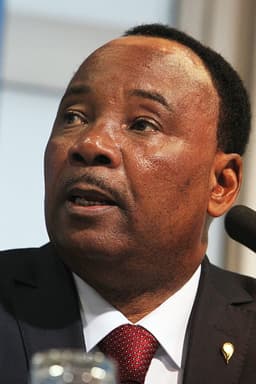
Mahamadou Issoufou
Politician · Modern
52.1Total
Basic Information
Born
1910
1952
Died
1975
—
Era
Modern
Modern
Nationality
Argentina
Niger
Occupation
Politician
Politician
Civilization
Western
Other
Score Comparison
Military (10%)
49.7
42.3
Political (20%)
30.7
68.0
Influence (20%)
45.5
51.8
Legacy (20%)
35.8
41.7
Leadership (15%)
33.6
66.0
Strategy (15%)
55.5
43.7
TOTAL
40.5
52.1
Jose Maria Guido — Complete Timeline
1962 AD
Appointed President by Military JuntaPolitical Action◆ Major
After the military coup that ousted President Arturo Frondizi, the armed forces appointed Guido, then President of the Senate, as president. He served as a civilian figurehead while the military retained actual power.
Military CoupPuppet PresidentArgentina
Impact: national
Annuled 1962 ElectionsPolitical Action◆ Major
Guido, under military pressure, annulled the results of the 1962 legislative and gubernatorial elections that had seen Peronist victories. This action deepened political instability and alienated Peronist supporters.
Election AnnulmentPeronismPolitical Crisis
Impact: nationaldestructive
1963 AD
Presided Over Military CrackdownOther◆ Major
Guido's administration oversaw a military crackdown on Peronist and leftist groups, including the banning of political parties and the arrest of opposition leaders. This period saw increased state violence and censorship.
RepressionMilitary RuleArgentina
Impact: nationaldestructive
Transferred Power to Elected PresidentOther◆ Major
Guido oversaw the transition to civilian rule after the 1963 elections, handing power to President-elect Arturo Illia. This marked the end of the military interregnum and a return to constitutional government.
TransitionDemocracyArgentina
Impact: national
Mahamadou Issoufou — Complete Timeline
2011 AD
Elected President of NigerPolitical Action◆ Major
Mahamadou Issoufou won the Nigerien presidential election in a runoff, defeating former prime minister Seini Oumarou. His victory marked a transition to civilian rule after a 2010 military coup.
ElectionDemocracyCivilian Rule
Impact: nationalconstructive
2015 AD
Led Fight Against Boko HaramWar◆ Major
Issoufou committed Nigerien troops to the Multinational Joint Task Force against Boko Haram in the Lake Chad region. Niger faced repeated attacks, and the campaign strained resources but contained the insurgency.
Boko HaramCounterterrorismMilitary
Impact: regional
2016 AD
Re-elected President of NigerPolitical Action◆ Major
Issoufou won a second term with 92% of the vote in an election boycotted by the main opposition. The result was criticized internationally as lacking credibility, though Issoufou remained in power.
ElectionControversySecond Term
Impact: national
2021 AD
Stepped Down After Two TermsPolitical Action
Issoufou voluntarily stepped down after completing two terms, handing power to elected successor Mohamed Bazoum. This was a rare peaceful transfer of power in Niger's history, strengthening democratic norms.
DemocracyPeaceful TransitionLegacy
Impact: nationalconstructive
Expert Analysis
Origins
Jose Maria Guido was born on August 29, 1910, in Buenos Aires, Argentina, into a middle-class family. He studied law at the University of Buenos Aires, graduating in 1934. He entered politics as a member of the Radical Civic Union (UCR), serving as a senator from 1958. His background was legal and political, with no military experience.
Mahamadou Issoufou was born on January 1, 1952, in Dandaji, Niger, into a Tuareg family from the Tahoua Region. He studied at the University of Niamey and then the École des Mines de Paris, earning a degree in mining engineering. He worked as a mining engineer before entering politics in the 1990s, founding the Nigerien Party for Democracy and Socialism (PNDS).
Rise to Power
Guido rose to power not through elections but as a constitutional figurehead. In March 1962, the Argentine military ousted President Arturo Frondizi. As President of the Senate, Guido was appointed president by the military junta on March 29, 1962. His role was to serve as a civilian placeholder while the military controlled the government. He had no independent political base.
Issoufou first ran for president in 1993, losing to Mahamane Ousmane. He became Prime Minister in 1993-1994 under Ousmane. After a coup in 1996, he ran again in 1996 and 1999, losing both times. He finally won the presidency in 2011 in a runoff against Seini Oumarou, with 58% of the vote. His persistence and role as a opposition leader defined his rise.
Leadership & Governance
Guido's leadership was constrained by the military. He annulled the 1962 elections that saw Peronist victories, banned political parties, and cracked down on opponents. His government oversaw a military crackdown on Peronists and leftists, with arrests and restrictions on civil liberties. He had little autonomy, scoring 33.6 in leadership and 30.7 in political skill. His governance was a facade for military rule.
Issoufou, scoring 66.0 in leadership and 68.0 in politics, governed democratically. He implemented economic reforms, investing in infrastructure and energy. He led Niger's fight against Boko Haram, committing troops to the Multinational Joint Task Force. However, his 2016 re-election with 92% of the vote was criticized as lacking legitimacy due to opposition boycotts. He stepped down after two terms, a rare event in West Africa.
Triumph & Tragedy
Guido's greatest success was overseeing the transition to elected President Arturo Illia in 1963, restoring civilian rule. His failure was his subservience to the military, annulling elections and repressing opponents. He left office with a legacy score of 35.8, as a weak puppet.
Issoufou's triumph was the peaceful transfer of power in 2021 to his successor Mohamed Bazoum, a model for African democracies. He also improved Niger's security cooperation. His tragedy was the flawed 2016 election and persistent poverty in Niger. He scored 41.7 in legacy.
Character & Destiny
Guido was a legalist who accepted military domination. His character was passive, leading to a brief tenure with no lasting impact. Historians view him as a constitutional fig leaf.
Issoufou was determined and strategic, willing to compromise. His character drove him to step down, securing his legacy. He is seen as a democratic stabilizer in a volatile region.
Legacy
Guido's legacy is negligible; he is a footnote in Argentine history. His annulment of elections deepened political instability.
Issoufou's legacy includes democratic consolidation and anti-terrorism efforts. His voluntary exit set a precedent. He scored 41.7 vs Guido's 35.8 in legacy.
Conclusion
Mahamadou Issoufou had greater impact. His total score of 52.1 outweighs Guido's 40.5. Issoufou's democratic leadership and peaceful transition contrast sharply with Guido's puppet rule. While neither transformed their nation, Issoufou's actions had lasting positive effects on Niger's political culture. Guido's tenure merely perpetuated military dominance. Thus, Issoufou stands as the more consequential leader.
Rankings
🥇
Mahamadou IssoufouLeader
Mil: 42.3Pol: 68.0Inf: 51.8
52.1
🥈
Jose Maria Guido
Mil: 49.7Pol: 30.7Inf: 45.5
40.5
+11.6 behind
How This Comparison Works
Algorithm
Each figure is scored on 6 dimensions (0—100 scale) based on structured historical data: Military (10%), Political (20%), Influence (20%), Legacy (20%), Leadership (15%), Strategy (15%). The weighted total produces the final ranking.
Data Sources
Scores are computed from structured sub-indicators in the database. Scale factors adjust for era (Ancient ×0.85, Modern ×1.0) and civilization size (Eastern ×1.05, Other ×0.80) to account for differences in population and military scale.
Maximum 3 Figures
Comparisons are limited to 2—3 figures to ensure readability and statistical meaningfulness.
Error Margins
±5 points per dimension — Sub-scores are derived from historical records with inherent uncertainty. Two figures within 5 points on a dimension should be considered roughly equivalent in that area.
Total Score Accuracy
±3 points overall — The weighted combination of 6 dimensions produces a total score with approximately ±3 points of uncertainty. Differences of less than 3 points are not statistically significant— the figures are effectively tied.
Known Limitations
- Historical records are incomplete and uneven across civilizations
- Figures from oral-tradition societies may be underrepresented
- Occupation labels can misclassify multi-role figures
- Scores measure capability and impact, not moral character
- Quantitative scoring is a comparison tool, not absolute truth
Capability Radar
Military (10%) — Battles & Warfare
Battles
32
23
Win Rate
32
23
Expansion
32
27
Political (20%) — Governance & Reform
Reform
5
55
Diplomacy
10
60
Economy
5
50
Influence (20%) — Cultural & Global Reach
Cultural
5
20
Global
5
20
Legacy (20%) — Historical Impact
Historical
10
30
Longevity
5
20
Leadership (15%) — Power & Stability
Tenure
5
60
Stability
5
55
Strategy (15%) — Tactics & Innovation
Strategy
40
31
Tactics
38
33
Reform
46
37
Similar Comparisons
Comments & Discussion
No comments yet. Be the first to share your thoughts!