Loading...
Jurelang Zedkaia vs Mahamadou Issoufou
Mahamadou Issoufou leads by 11.2 pts · 2 figures compared
…

Jurelang Zedkaia
Politician · Modern
40.9Total
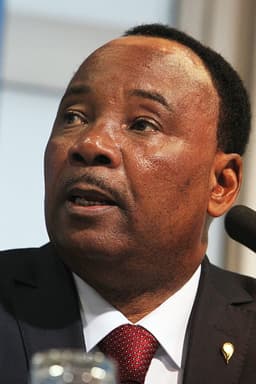
Mahamadou Issoufou
Politician · Modern
52.1Total
Basic Information
Born
1950
1952
Died
—
—
Era
Modern
Modern
Nationality
Marshall Islands
Niger
Occupation
Politician
Politician
Civilization
Other
Other
Score Comparison
Military (10%)
50.0
42.3
Political (20%)
26.4
68.0
Influence (20%)
46.3
51.8
Legacy (20%)
36.7
41.7
Leadership (15%)
45.0
66.0
Strategy (15%)
44.8
43.7
TOTAL
40.9
52.1
Jurelang Zedkaia — Complete Timeline
2009 AD
Elected President of the Marshall IslandsPolitical Action◆ Major
Jurelang Zedkaia was elected President by the Nitijela, succeeding Litokwa Tomeing. As a traditional iroij chief, his presidency blended customary authority with modern governance.
PresidencyTraditional Leadership
Impact: national
2012 AD
Lost Re-election BidPolitical Action
Zedkaia was defeated in the presidential election by Christopher Loeak. His loss ended his term as president.
Election LossPolitical Transition
Impact: national
Mahamadou Issoufou — Complete Timeline
2011 AD
Elected President of NigerPolitical Action◆ Major
Mahamadou Issoufou won the Nigerien presidential election in a runoff, defeating former prime minister Seini Oumarou. His victory marked a transition to civilian rule after a 2010 military coup.
ElectionDemocracyCivilian Rule
Impact: nationalconstructive
2015 AD
Led Fight Against Boko HaramWar◆ Major
Issoufou committed Nigerien troops to the Multinational Joint Task Force against Boko Haram in the Lake Chad region. Niger faced repeated attacks, and the campaign strained resources but contained the insurgency.
Boko HaramCounterterrorismMilitary
Impact: regional
2016 AD
Re-elected President of NigerPolitical Action◆ Major
Issoufou won a second term with 92% of the vote in an election boycotted by the main opposition. The result was criticized internationally as lacking credibility, though Issoufou remained in power.
ElectionControversySecond Term
Impact: national
2021 AD
Stepped Down After Two TermsPolitical Action
Issoufou voluntarily stepped down after completing two terms, handing power to elected successor Mohamed Bazoum. This was a rare peaceful transfer of power in Niger's history, strengthening democratic norms.
DemocracyPeaceful TransitionLegacy
Impact: nationalconstructive
Expert Analysis
Origins
Jurelang Zedkaia was born in 1950 in the Marshall Islands, a remote Pacific nation consisting of 29 atolls. He came from a lineage of traditional iroij (paramount chiefs) and was educated in local schools before pursuing a career in public service. His early life was steeped in Marshallese customs, where chieftainship carried significant social and political weight. Zedkaia worked as a teacher and later entered politics, serving in the Nitijela (parliament) from 1999 onward. His background as a traditional leader shaped his governance style, blending customary authority with democratic processes.
Mahamadou Issoufou was born in 1952 in Dandaji, Niger, a landlocked West African country. He studied mining engineering at the University of Niamey and later in France, earning a degree in applied mathematics. Issoufou worked as a mining engineer and became active in trade unions and political opposition during Niger's military regimes. He was imprisoned multiple times for his activism. His early career reflected a technocratic and reformist bent, distinct from Zedkaia's hereditary path.
Rise to Power
Zedkaia's rise was gradual. He served as Minister of Education and later as Speaker of the Nitijela from 2008 to 2009. In 2009, following a political crisis that ousted President Litokwa Tomeing, Zedkaia was elected President by the Nitijela on November 2, 2009. His election was notable as he was a traditional iroij chief, marking a fusion of customary and modern governance. However, his presidency was short-lived; he lost the next presidential election in 2012 to Christopher Loeak, receiving only 10 out of 33 votes.
Issoufou's ascent was more contested. He ran for president multiple times, finally winning in 2011 after a runoff against Seini Oumarou. His victory came amid Niger's transition to democracy after a 2010 coup. He was re-elected in 2016 with 92% of the vote, though the election was boycotted by the opposition and criticized internationally. His political score of 68.0 reflects his ability to navigate Niger's turbulent politics, while Zedkaia's 26.4 shows his limited electoral success.
Leadership & Governance
Zedkaia governed as a consensus-builder, relying on traditional chiefly networks. He focused on climate change advocacy, as the Marshall Islands face existential threats from rising sea levels. He signed the Majuro Declaration in 2013, a Pacific Islands initiative on climate action. However, his domestic policies were constrained by a weak economy and reliance on US aid under the Compact of Free Association. His leadership score of 45.0 indicates moderate effectiveness.
Issoufou led with a more assertive, technocratic style. He prioritized infrastructure development, including roads and energy projects, and fought corruption. He also committed Nigerien troops to the Multinational Joint Task Force against Boko Haram, raising Niger's military profile. However, his second term saw democratic backsliding, with crackdowns on opposition and media. His political score of 68.0 and leadership score of 66.0 reflect stronger governance but with authoritarian tendencies.
Triumph & Tragedy
Zedkaia's greatest success was elevating the Marshall Islands' voice on climate change, securing international attention. His tragedy was his short, ineffectual presidency; he failed to address economic stagnation or improve governance. His legacy score of 36.7 reflects modest impact.
Issoufou's triumph was his voluntary step-down after two terms in 2021, handing power to Mohamed Bazoum in a rare peaceful transfer in West Africa. This act bolstered Niger's democratic credentials. His tragedy was the flawed 2016 election and increasing repression, which damaged his legacy. His legacy score of 41.7 is slightly higher than Zedkaia's.
Character & Destiny
Zedkaia was a traditionalist, patient and deferential to custom, which limited his assertiveness in a modern political system. His character suited a ceremonial chief but not a proactive president. His destiny was to be a transitional figure.
Issoufou was pragmatic and ambitious, willing to compromise on democracy for stability. He was a survivor, enduring imprisonment and political exile. His character drove him to seek power and then relinquish it at the right moment, securing his place in history.
Legacy
Zedkaia is remembered as a traditional chief who briefly held the presidency, but his impact on Marshallese politics is minimal. The Majuro Declaration remains his key legacy, but it has not halted climate change.
Issoufou's legacy is more substantial: he stabilized Niger, fought terrorism, and ensured a democratic transition. However, his authoritarian leanings tarnish his record. He scored 41.7 in legacy, compared to Zedkaia's 36.7.
Conclusion
Mahamadou Issoufou had greater impact than Jurelang Zedkaia. Issoufou's total score of 52.1 versus Zedkaia's 40.9 reflects his more consequential presidency. Issoufou influenced regional security and democratic norms in Niger, while Zedkaia's tenure was too brief to effect lasting change. Issoufou's decision to step down after two terms sets a precedent in a region plagued by coups, whereas Zedkaia's legacy is confined to climate advocacy without tangible results. Thus, Issoufou emerges as the more significant figure.
Rankings
🥇
Mahamadou IssoufouLeader
Mil: 42.3Pol: 68.0Inf: 51.8
52.1
🥈
Jurelang Zedkaia
Mil: 50.0Pol: 26.4Inf: 46.3
40.9
+11.2 behind
How This Comparison Works
Algorithm
Each figure is scored on 6 dimensions (0—100 scale) based on structured historical data: Military (10%), Political (20%), Influence (20%), Legacy (20%), Leadership (15%), Strategy (15%). The weighted total produces the final ranking.
Data Sources
Scores are computed from structured sub-indicators in the database. Scale factors adjust for era (Ancient ×0.85, Modern ×1.0) and civilization size (Eastern ×1.05, Other ×0.80) to account for differences in population and military scale.
Maximum 3 Figures
Comparisons are limited to 2—3 figures to ensure readability and statistical meaningfulness.
Error Margins
±5 points per dimension — Sub-scores are derived from historical records with inherent uncertainty. Two figures within 5 points on a dimension should be considered roughly equivalent in that area.
Total Score Accuracy
±3 points overall — The weighted combination of 6 dimensions produces a total score with approximately ±3 points of uncertainty. Differences of less than 3 points are not statistically significant— the figures are effectively tied.
Known Limitations
- Historical records are incomplete and uneven across civilizations
- Figures from oral-tradition societies may be underrepresented
- Occupation labels can misclassify multi-role figures
- Scores measure capability and impact, not moral character
- Quantitative scoring is a comparison tool, not absolute truth
Capability Radar
Military (10%) — Battles & Warfare
Battles
22
23
Win Rate
26
23
Expansion
28
27
Political (20%) — Governance & Reform
Reform
10
55
Diplomacy
15
60
Economy
10
50
Influence (20%) — Cultural & Global Reach
Cultural
10
20
Global
5
20
Legacy (20%) — Historical Impact
Historical
10
30
Longevity
10
20
Leadership (15%) — Power & Stability
Tenure
20
60
Stability
15
55
Strategy (15%) — Tactics & Innovation
Strategy
30
31
Tactics
32
33
Reform
37
37
Similar Comparisons
Comments & Discussion
No comments yet. Be the first to share your thoughts!