Loading...
Jozef Pilsudski vs Mohamed Farrah Aidid
Jozef Pilsudski leads by 17.9 pts · 2 figures compared
…
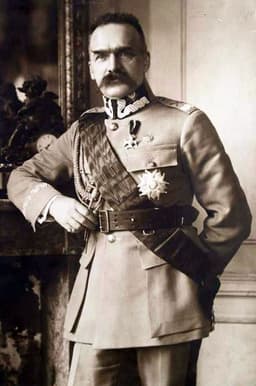
Jozef Pilsudski
General · Modern
65.7Total

Mohamed Farrah Aidid
General · Modern
47.8Total
Basic Information
Born
1867
1934
Died
1935
—
Era
Modern
Modern
Nationality
Poland
Somalia
Occupation
General
General
Civilization
Western
Other
Score Comparison
Military (10%)
61.7
47.5
Political (20%)
72.0
36.5
Influence (20%)
72.0
54.9
Legacy (20%)
55.0
45.0
Leadership (15%)
68.0
47.3
Strategy (15%)
68.0
55.0
TOTAL
65.7
47.8
Jozef Pilsudski — Complete Timeline
1914 AD
Founded the Polish LegionsOther◆ Major
At the outbreak of World War I, Pilsudski formed the Polish Legions, volunteer military units fighting alongside Austria-Hungary against Russia. The Legions aimed to create a core for a future Polish army and advance the cause of Polish independence from partitioning powers.
Polish IndependenceWorld War IMilitary Formation
Impact: national
1918 AD
Proclaimed Independence of PolandOther◆ Major
On November 11, 1918, Pilsudski was released from German internment and returned to Warsaw. He assumed command of Polish forces and proclaimed the independence of the Second Polish Republic, becoming the nation's first Chief of State after 123 years of partition.
Polish IndependenceStatehoodNational Founding
Impact: nationalconstructive
1920 AD
Led the Battle of Warsaw (Miracle on the Vistula)War◆ Major
During the Polish-Soviet War, Pilsudski personally planned and commanded the counteroffensive at the Battle of Warsaw in August 1920. Polish forces repelled the advancing Red Army, securing Polish independence and halting the spread of Bolshevism into Central Europe.
Polish-Soviet WarMilitary VictoryNational Survival
Impact: regionalconstructive
1926 AD
Executed the May Coup d'ÉtatPolitical Action◆ Major
In May 1926, Pilsudski led a military coup against the Polish government, marching loyal troops into Warsaw. After three days of fighting, President Wojciechowski resigned and Pilsudski assumed de facto dictatorial power, establishing the Sanacja regime that ruled Poland until 1939.
Coup d'ÉtatAuthoritarianismPolish Politics
Impact: nationaldestructive
1932 AD
Signed the Polish-Soviet Non-Aggression PactOther◆ Major
Pilsudski's government signed a non-aggression pact with the Soviet Union on July 25, 1932. The treaty normalized relations between the two countries for ten years, though it was later broken by the Soviet invasion of Poland in 1939.
DiplomacySoviet-Polish RelationsTreaty
Impact: regional
Mohamed Farrah Aidid — Complete Timeline
1993 AD
Battle of Mogadishu (Black Hawk Down)War
Mohamed Farrah Aidid's militia shot down two U.S. Black Hawk helicopters and engaged in a prolonged firefight with U.S. Army Rangers and Delta Force in Mogadishu. The battle resulted in 18 American deaths and the eventual withdrawal of U.S. forces from Somalia.
Battle of MogadishuBlack Hawk DownUS Intervention
Impact: globaldestructive
Resisted UNOSOM IIWar◆ Major
Aidid's forces actively resisted the United Nations Operation in Somalia II (UNOSOM II), attacking Pakistani peacekeepers and ambushing UN convoys. This resistance led to the UN Security Council authorizing his arrest, escalating the conflict.
UNOSOMPeacekeepingResistance
Impact: regionaldestructive
1995 AD
Declared Himself President of SomaliaPolitical Action◆ Major
After the withdrawal of UN and U.S. forces, Mohamed Farrah Aidid declared himself President of Somalia. His claim was not internationally recognized and was contested by other faction leaders, perpetuating the civil war.
Self-DeclarationCivil WarSomalia
Impact: nationaldestructive
1996 AD
Died from Battle WoundsWar◆ Major
Mohamed Farrah Aidid died from wounds sustained during a battle in Mogadishu against rival faction forces. His death led to a power struggle within his clan and the eventual decline of his faction's influence.
DeathCivil WarSomalia
Impact: nationaltragic
Expert Analysis
Origins
Jozef Pilsudski was born on December 5, 1867, in Zulowo, then part of the Russian Empire, into a Polish noble family with a tradition of resistance against partitions. His father, a landowner, instilled patriotic values. Pilsudski studied at the University of Kharkiv but was expelled for political activity in 1885. He was exiled to Siberia in 1887 for alleged involvement in a plot to assassinate Tsar Alexander III, an experience that radicalized him. Upon return, he joined the Polish Socialist Party, becoming a leading figure in the underground independence movement.
Mohamed Farrah Aidid was born on December 15, 1934, in Beledweyne, Italian Somaliland, into the Habr Gidr sub-clan of the Hawiye clan. He received a military education in Italy and later in the Soviet Union, graduating from the Frunze Military Academy. Aidid served in the Somali National Army under Siad Barre, rising to the rank of general. He participated in the 1977-1978 Ogaden War against Ethiopia, where he developed strategic skills. However, his ambitions led to conflict with Barre, and he was imprisoned in 1985.
Rise to Power
Pilsudski rose through revolutionary activity and military organization. During World War I, he formed the Polish Legions in 1914, fighting alongside Austria-Hungary against Russia. In 1917, he refused to swear loyalty to the Central Powers, leading to his internment in Magdeburg. Released in November 1918, he returned to Warsaw and was declared Chief of State on November 22. He quickly consolidated power, proclaiming Poland's independence on November 11, 1918. His leadership during the Polish-Soviet War (1919-1921) was pivotal, especially the Battle of Warsaw in August 1920, where his counteroffensive repelled the Red Army.
Aidid rose as a warlord after the collapse of Siad Barre's regime in 1991. He was a key figure in the United Somali Congress (USC) that ousted Barre. However, a power struggle with Ali Mahdi Muhammad led to civil war. Aidid's faction controlled parts of Mogadishu. His resistance to UNOSOM II in 1993, including the ambush of Pakistani peacekeepers in June and the Battle of Mogadishu in October, brought him international notoriety. The battle resulted in the deaths of 18 U.S. soldiers and hundreds of Somalis, leading to U.S. withdrawal.
Leadership & Governance
Pilsudski governed Poland with a strong hand. He was authoritarian but pragmatic, implementing the "Sanation" (sanacja) regime after the 1926 May Coup, aiming to cleanse politics of corruption. He suppressed opposition but allowed limited pluralism. His foreign policy focused on balancing between Germany and the Soviet Union, signing non-aggression pacts with both in 1932 and 1934. He prioritized military modernization and national unity. His leadership scored 68.0 in leadership, reflecting his decisive control.
Aidid's governance was fragmented. After declaring himself president in 1995, he controlled only parts of Mogadishu. His rule was marked by clan-based warfare, lack of infrastructure, and humanitarian crisis. He offered no coherent policy beyond resisting foreign intervention. His political score of 36.5 and leadership of 47.3 reflect his inability to unify Somalia. Unlike Pilsudski, who built a state, Aidid contributed to state collapse.
Triumph & Tragedy
Pilsudski's greatest triumph was Poland's independence, achieved through military and diplomatic skill. The Battle of Warsaw (1920) is considered one of the decisive battles of European history, stopping Soviet expansion. His tragedy was the failure to secure lasting democracy; his coup in 1926 undermined democratic institutions, and his successors could not prevent the 1939 invasion. He died in 1935 before seeing Poland's destruction.
Aidid's triumph was successfully resisting U.S. and UN forces, forcing their withdrawal in 1994. This was a symbolic victory for a local warlord against a superpower. His tragedy was that his actions deepened Somalia's chaos. He never achieved stable control, and his death in 1996 from battle wounds led to factional infighting. His legacy is the "Black Hawk Down" incident, not state-building.
Character & Destiny
Pilsudski was determined and charismatic, with a strategic mind. He scored 68.0 in strategy. His early revolutionary experience made him distrustful of both Russia and Germany. He believed in a strong, independent Poland and was willing to use force. His authoritarian turn reflected his frustration with parliamentary gridlock. He shaped his destiny by seizing opportunities, but his reliance on personal rule left Poland vulnerable.
Aidid was ruthless and ambitious, with a score of 55.0 in strategy. He exploited clan loyalties and foreign media. His decision to target U.S. forces was a calculated risk that backfired in terms of international support. His character—stubborn and confrontational—prevented compromise. He died in conflict, never achieving his goal of presidency.
Legacy
Pilsudski is revered in Poland as a founding father. His military strategy is studied, and his role in Polish independence is celebrated. However, his authoritarian legacy is criticized. Poland's interwar republic ultimately failed, but his efforts laid groundwork for the post-Communist state. His scores: Influence 72.0, Legacy 55.0.
Aidid is remembered as a symbol of Somali resistance and the failure of international intervention. His legacy is mixed: he is a hero to some Somalis, but also a figure who contributed to anarchy. His influence is limited to the Horn of Africa. Scores: Influence 54.9, Legacy 45.0.
Conclusion
Jozef Pilsudski had a greater impact by a wide margin. His total score of 65.7 versus Aidid's 47.8 reflects his success in building a nation from scratch, while Aidid only deepened a failed state. Pilsudski's military, political, and strategic achievements reshaped Europe, whereas Aidid's actions remain a regional tragedy. The data supports Pilsudski as the more consequential figure.
Rankings
🥇
Jozef PilsudskiLeader
Mil: 61.7Pol: 72.0Inf: 72.0
65.7
🥈
Mohamed Farrah Aidid
Mil: 47.5Pol: 36.5Inf: 54.9
47.8
+17.9 behind
How This Comparison Works
Algorithm
Each figure is scored on 6 dimensions (0—100 scale) based on structured historical data: Military (10%), Political (20%), Influence (20%), Legacy (20%), Leadership (15%), Strategy (15%). The weighted total produces the final ranking.
Data Sources
Scores are computed from structured sub-indicators in the database. Scale factors adjust for era (Ancient ×0.85, Modern ×1.0) and civilization size (Eastern ×1.05, Other ×0.80) to account for differences in population and military scale.
Maximum 3 Figures
Comparisons are limited to 2—3 figures to ensure readability and statistical meaningfulness.
Error Margins
±5 points per dimension — Sub-scores are derived from historical records with inherent uncertainty. Two figures within 5 points on a dimension should be considered roughly equivalent in that area.
Total Score Accuracy
±3 points overall — The weighted combination of 6 dimensions produces a total score with approximately ±3 points of uncertainty. Differences of less than 3 points are not statistically significant— the figures are effectively tied.
Known Limitations
- Historical records are incomplete and uneven across civilizations
- Figures from oral-tradition societies may be underrepresented
- Occupation labels can misclassify multi-role figures
- Scores measure capability and impact, not moral character
- Quantitative scoring is a comparison tool, not absolute truth
Capability Radar
Military (10%) — Battles & Warfare
Battles
70
60
Win Rate
65
45
Expansion
60
40
Political (20%) — Governance & Reform
Reform
75
20
Diplomacy
80
30
Economy
55
15
Influence (20%) — Cultural & Global Reach
Cultural
65
25
Global
60
35
Legacy (20%) — Historical Impact
Historical
75
40
Longevity
60
20
Leadership (15%) — Power & Stability
Tenure
70
35
Stability
50
10
Strategy (15%) — Tactics & Innovation
Strategy
80
55
Tactics
75
65
Reform
85
30
Similar Comparisons
Comments & Discussion
No comments yet. Be the first to share your thoughts!