Loading...
Jozef Pilsudski vs Than Shwe
Jozef Pilsudski leads by 20.1 pts · 2 figures compared
…
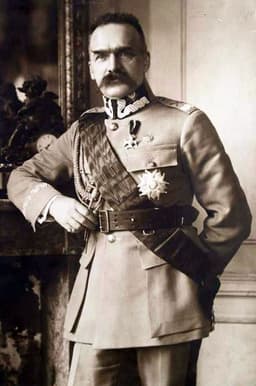
Jozef Pilsudski
General · Modern
65.7Total

Than Shwe
General · Modern
45.6Total
Basic Information
Born
1867
1933
Died
1935
—
Era
Modern
Modern
Nationality
Poland
Myanmar
Occupation
General
General
Civilization
Western
Eastern
Score Comparison
Military (10%)
61.7
50.0
Political (20%)
72.0
25.0
Influence (20%)
72.0
48.6
Legacy (20%)
55.0
40.8
Leadership (15%)
68.0
71.0
Strategy (15%)
68.0
38.6
TOTAL
65.7
45.6
Jozef Pilsudski — Complete Timeline
1914 AD
Founded the Polish LegionsOther◆ Major
At the outbreak of World War I, Pilsudski formed the Polish Legions, volunteer military units fighting alongside Austria-Hungary against Russia. The Legions aimed to create a core for a future Polish army and advance the cause of Polish independence from partitioning powers.
Polish IndependenceWorld War IMilitary Formation
Impact: national
1918 AD
Proclaimed Independence of PolandOther◆ Major
On November 11, 1918, Pilsudski was released from German internment and returned to Warsaw. He assumed command of Polish forces and proclaimed the independence of the Second Polish Republic, becoming the nation's first Chief of State after 123 years of partition.
Polish IndependenceStatehoodNational Founding
Impact: nationalconstructive
1920 AD
Led the Battle of Warsaw (Miracle on the Vistula)War◆ Major
During the Polish-Soviet War, Pilsudski personally planned and commanded the counteroffensive at the Battle of Warsaw in August 1920. Polish forces repelled the advancing Red Army, securing Polish independence and halting the spread of Bolshevism into Central Europe.
Polish-Soviet WarMilitary VictoryNational Survival
Impact: regionalconstructive
1926 AD
Executed the May Coup d'ÉtatPolitical Action◆ Major
In May 1926, Pilsudski led a military coup against the Polish government, marching loyal troops into Warsaw. After three days of fighting, President Wojciechowski resigned and Pilsudski assumed de facto dictatorial power, establishing the Sanacja regime that ruled Poland until 1939.
Coup d'ÉtatAuthoritarianismPolish Politics
Impact: nationaldestructive
1932 AD
Signed the Polish-Soviet Non-Aggression PactOther◆ Major
Pilsudski's government signed a non-aggression pact with the Soviet Union on July 25, 1932. The treaty normalized relations between the two countries for ten years, though it was later broken by the Soviet invasion of Poland in 1939.
DiplomacySoviet-Polish RelationsTreaty
Impact: regional
Than Shwe — Complete Timeline
1989 AD
Placed Aung San Suu Kyi under house arrestPolitical Action◆ Major
Than Shwe ordered the house arrest of Aung San Suu Kyi, the leader of the National League for Democracy. She remained under detention for most of the next two decades, becoming a symbol of resistance.
RepressionHouse ArrestAung San Suu Kyi
Impact: nationaldestructive
1992 AD
Seized power in a coupPolitical Action◆ Major
Than Shwe became the head of the State Law and Order Restoration Council (SLORC) after a coup that ousted the previous junta leader. He consolidated power and ruled Myanmar with an iron fist.
CoupMilitary JuntaDictatorship
Impact: nationaldestructive
2003 AD
Announced the 'Roadmap to Democracy'Political Action◆ Major
Than Shwe announced a seven-step 'Roadmap to Democracy' that included a new constitution and elections. Critics viewed it as a ploy to legitimize military rule, as the constitution reserved 25% of parliamentary seats for the military.
RoadmapConstitutionPolitical Reform
Impact: national
2007 AD
Suppressed the Saffron RevolutionPolitical Action◆ Major
Than Shwe ordered a violent crackdown on the Saffron Revolution, a series of protests led by Buddhist monks. Security forces killed dozens and arrested thousands, drawing international condemnation.
RepressionSaffron RevolutionHuman Rights
Impact: nationaldestructive
2011 AD
Stepped down from powerPolitical Action◆ Major
Than Shwe formally stepped down as head of the junta, handing power to a nominally civilian government led by Thein Sein. He remained influential behind the scenes, but his departure marked the end of direct military rule.
TransitionEnd of JuntaPolitical Change
Impact: national
Expert Analysis
Origins
Jozef Klemens Pilsudski was born on December 5, 1867, in Zalavas, then part of the Russian Empire. His family belonged to the Polish gentry, with a strong tradition of patriotic resistance. Pilsudski's father was involved in the January Uprising (1863–64), shaping his anti-Russian sentiment. He attended school in Vilnius and later studied medicine at Kharkiv University but was expelled for political activities. Exiled to Siberia for five years for his involvement in a socialist conspiracy, he returned to become a leading figure in the Polish Socialist Party.
Than Shwe was born on February 2, 1933, in Kyaukse, British Burma, into a modest family. His father was a farmer. He attended local schools and later joined the military, graduating from the Officers Training School in 1959. His early career was shaped by the authoritarian regime of Ne Win, which he served loyally.
Rise to Power
Pilsudski's rise began with his leadership of the Polish Legions during World War I (1914–1917), where he commanded volunteer forces fighting alongside Austria-Hungary against Russia. In 1917, he was interned by the Germans for refusing to swear allegiance. Released in November 1918, he proclaimed Poland's independence on November 11, 1918, and became Chief of State. His pivotal moment came in the Polish-Soviet War (1919–1921), where he personally planned and led the counteroffensive at the Battle of Warsaw in August 1920, known as the "Miracle on the Vistula," repelling the Red Army.
Than Shwe rose through the ranks of the Burmese military, becoming a loyal subordinate to General Ne Win. He played a key role in suppressing protests in 1988, and after a coup in 1992, he ousted General Saw Maung to become chairman of the State Law and Order Restoration Council (SLORC). He consolidated power by eliminating rivals and placing Aung San Suu Kyi under house arrest in 1989.
Leadership & Governance
Pilsudski's leadership style was authoritarian but pragmatic. After the May Coup of 1926, he ruled as a strongman, sidelining parliament but avoiding a full dictatorship. He implemented the "Sanation" (moral cleansing) program, aiming to reduce corruption and stabilize the economy. His governance focused on military preparedness and national unity, but he suppressed opposition parties and jailed critics.
Than Shwe ruled Myanmar with an iron fist from 1992 to 2011. He suppressed all dissent, enforced censorship, and maintained the military's monopoly on power. His "Roadmap to Democracy" (2003) was widely criticized as a sham to legitimize military control. He ordered the violent crackdown on the Saffron Revolution in 2007, killing dozens of monks and protesters. His economic policies led to stagnation, with Myanmar becoming one of the poorest countries in Asia.
Triumph & Tragedy
Pilsudski's greatest triumph was restoring Polish independence after 123 years of partition and defeating the Soviet army in 1920, securing Poland's borders. His military strategy scored 61.7, reflecting his success in the Polish-Soviet War. However, his tragedy was the authoritarian turn after 1926, which weakened democratic institutions and paved the way for the later collapse in 1939. His political score of 72.0 reflects his mixed legacy.
Than Shwe's triumph was maintaining the junta's power for nearly two decades, avoiding a popular uprising until his retirement. His leadership score of 71.0 indicates his ability to control the military. However, his tragedy is the devastation he wrought: brutal repression, economic decline, and international isolation. His political score of 25.0 reflects his failure to transition to democracy or improve living standards.
Character & Destiny
Pilsudski was a charismatic, decisive leader with a visionary goal of Polish independence. His personality was combative and stubborn, often clashing with allies. His authoritarian tendencies were tempered by a genuine desire for Polish sovereignty. His destiny was shaped by the geopolitical turmoil of early 20th-century Europe, where he played a crucial role.
Than Shwe was reclusive, ruthless, and paranoid. He shunned public appearances and relied on a small circle of generals. His character—suspicious of outsiders and resistant to change—led to Myanmar's isolation. His destiny was to preside over a stagnant, repressive regime that eventually crumbled under internal and external pressure.
Legacy
Pilsudski is revered in Poland as a founding father, though his authoritarian legacy is controversial. His military victory in 1920 is celebrated, and his influence score of 72.0 reflects his enduring impact. However, his coup and authoritarian rule weakened democracy, contributing to Poland's vulnerability in 1939. His legacy is complex: a liberator and a dictator.
Than Shwe's legacy is overwhelmingly negative. He is remembered as a brutal dictator who crushed democracy and impoverished Myanmar. His influence score of 48.6 indicates limited positive impact. The transition to a nominally civilian government in 2011 did little to change the military's dominance. His legacy is one of repression and failure.
Conclusion
Jozef Pilsudski had greater impact, scoring 65.7 total versus Than Shwe's 45.6. Pilsudski restored a nation and shaped Eastern Europe, while Than Shwe merely preserved a junta. Pilsudski's actions had lasting geopolitical consequences, whereas Than Shwe's legacy is largely negative and limited to Myanmar. Despite his flaws, Pilsudski's contributions to Polish independence are undeniable, making him the more significant historical figure.
Rankings
🥇
Jozef PilsudskiLeader
Mil: 61.7Pol: 72.0Inf: 72.0
65.7
🥈
Than Shwe
Mil: 50.0Pol: 25.0Inf: 48.6
45.6
+20.1 behind
How This Comparison Works
Algorithm
Each figure is scored on 6 dimensions (0—100 scale) based on structured historical data: Military (10%), Political (20%), Influence (20%), Legacy (20%), Leadership (15%), Strategy (15%). The weighted total produces the final ranking.
Data Sources
Scores are computed from structured sub-indicators in the database. Scale factors adjust for era (Ancient ×0.85, Modern ×1.0) and civilization size (Eastern ×1.05, Other ×0.80) to account for differences in population and military scale.
Maximum 3 Figures
Comparisons are limited to 2—3 figures to ensure readability and statistical meaningfulness.
Error Margins
±5 points per dimension — Sub-scores are derived from historical records with inherent uncertainty. Two figures within 5 points on a dimension should be considered roughly equivalent in that area.
Total Score Accuracy
±3 points overall — The weighted combination of 6 dimensions produces a total score with approximately ±3 points of uncertainty. Differences of less than 3 points are not statistically significant— the figures are effectively tied.
Known Limitations
- Historical records are incomplete and uneven across civilizations
- Figures from oral-tradition societies may be underrepresented
- Occupation labels can misclassify multi-role figures
- Scores measure capability and impact, not moral character
- Quantitative scoring is a comparison tool, not absolute truth
Capability Radar
Military (10%) — Battles & Warfare
Battles
70
10
Win Rate
65
15
Expansion
60
10
Political (20%) — Governance & Reform
Reform
75
5
Diplomacy
80
10
Economy
55
10
Influence (20%) — Cultural & Global Reach
Cultural
65
10
Global
60
10
Legacy (20%) — Historical Impact
Historical
75
20
Longevity
60
15
Leadership (15%) — Power & Stability
Tenure
70
70
Stability
50
20
Strategy (15%) — Tactics & Innovation
Strategy
80
25
Tactics
75
20
Reform
85
15
Similar Comparisons
Comments & Discussion
No comments yet. Be the first to share your thoughts!