Loading...
Juba I of Numidia vs Julius Caesar
Julius Caesar leads by 42.9 pts · 2 figures compared
…
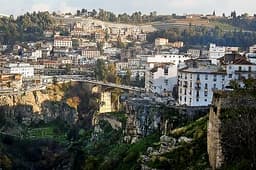
Juba I of Numidia
Emperor · Ancient
39.9Total

Julius Caesar
General · Ancient
82.8Total
Basic Information
Born
-85
-100
Died
-46
-44
Era
Ancient
Ancient
Nationality
Numidia
Roman Republic
Occupation
Emperor
General
Civilization
Other
Western
Score Comparison
Military (10%)
10.0
88.0
Political (20%)
36.5
78.0
Influence (20%)
46.3
85.0
Legacy (20%)
38.3
82.0
Leadership (15%)
51.9
80.0
Strategy (15%)
45.0
85.0
TOTAL
39.9
82.8
Juba I of Numidia — Complete Timeline
49 BC
Alliance with PompeyPolitical Action
Juba I formed a military alliance with Pompey the Great and the Optimates against Julius Caesar. He provided troops and resources to the Pompeian cause, hoping to maintain Numidian independence and expand his influence in North Africa.
Roman Civil WarAlliancePompey
Impact: regional
46 BC
Battle of ThapsusWar◆ Major
Juba I of Numidia allied with the Optimates and fought against Julius Caesar at the Battle of Thapsus. Caesar's forces decisively defeated the Pompeian-Numidian army. Juba's kingdom was annexed by Rome, and he committed suicide to avoid capture.
Caesar's Civil WarBattleNumidia
Impact: regionaltragic
Julius Caesar — Complete Timeline
58 BC
Gallic WarsWar◆ Major
Caesar, as proconsul of Gaul, launched a series of campaigns that conquered all of Gaul (modern France, Belgium, and parts of Switzerland). He fought numerous battles, including against the Helvetii, the Belgae, and the Gallic chieftain Vercingetorix. The wars brought immense wealth and a loyal army to Caesar.
Gallic WarsConquestRoman Expansion
Impact: regional
49 BC
Crossing the RubiconPolitical Action◆ Major
Caesar led Legio XIII across the Rubicon River into Italy, defying the Roman Senate's order to disband his army. This act triggered a civil war against Pompey and the Optimates, ultimately leading to Caesar's dictatorship and the end of the Roman Republic.
Roman Civil WarEnd of RepublicPower Struggle
Impact: global
48 BC
Battle of PharsalusWar◆ Major
Caesar's outnumbered army defeated the larger forces of Pompey the Great at Pharsalus in Greece. Caesar's tactical use of a reserve line to counter Pompey's cavalry charge proved decisive. Pompey fled to Egypt, where he was assassinated, leaving Caesar as the undisputed master of the Roman world.
Roman Civil WarBattleDecisive Victory
Impact: regional
44 BC
Appointment as Dictator for LifePolitical Action◆ Major
The Roman Senate appointed Caesar dictator perpetuo (dictator for life), granting him unprecedented personal power. This move concentrated military, legislative, and judicial authority in one person, effectively ending the Roman Republic's traditional system of checks and balances and alarming many senators.
DictatorshipEnd of RepublicPower Consolidation
Impact: regionaldestructive
Assassination on the Ides of MarchPolitical Action◆ Major
A group of Roman senators, led by Marcus Junius Brutus and Gaius Cassius Longinus, stabbed Caesar to death at a meeting of the Senate in the Theatre of Pompey. The assassination was intended to restore the Republic, but instead triggered another civil war that led to the rise of the Roman Empire.
AssassinationRoman PoliticsEnd of Republic
Impact: globaldestructive
Expert Analysis
juba-i-of-numidia-vs-julius-caesar
# The Lion and the Jackal: Caesar, Juba, and the Death of a Kingdom
On a spring afternoon in 46 BCE, two men faced each other across a battlefield in North Africa—not literally, but historically, their fates intertwined like threads in a tapestry of empire. One was Gaius Julius Caesar, the conqueror of Gaul, the man who had crossed the Rubicon and set the Roman world ablaze. The other was Juba I, king of Numidia, a sovereign of an ancient land who had gambled everything on the losing side of a civil war. Within months, one would be dead by his own hand, the other would be master of the Mediterranean. How did these two lives, born barely fifteen years apart, diverge so dramatically? The answer lies not merely in their choices, but in the worlds that shaped them.
Origins
Caesar was born into the chaos of the late Roman Republic, a society that worshipped ambition and rewarded audacity. His family, the Julii, claimed descent from the goddess Venus, but their political fortunes had faded. From childhood, Caesar absorbed the brutal logic of Roman politics: power came not from birth alone but from military glory, popular support, and the willingness to break rules. His uncle Marius had been a populist reformer; his father-in-law Cinna a revolutionary. Caesar grew up in a world where the old aristocratic order was crumbling, and a man could remake himself through sheer force of will.
Juba I inherited a different legacy. Numidia was a kingdom, not a republic—a client state of Rome that had once been a formidable power under Masinissa, the ally of Scipio Africanus. But by Juba’s time, the kingdom was a shadow of its former self, caught between Roman factions and internal dynastic squabbles. Juba was a king by blood, but his throne rested on Roman sufferance. His father, Hiempsal II, had been a loyal ally of Rome, and Juba understood that his survival depended on navigating the treacherous currents of Roman politics. He was not a man who could invent his own destiny; he could only choose which Roman patron to serve.
Rise to Power
Caesar’s path to power was a masterclass in strategic patience and calculated risk. He climbed the traditional ladder of Roman offices—quaestor, aedile, praetor—but he did so with flair, spending borrowed fortunes on games and bribes to win popular favor. His real breakthrough came in 58 BCE, when he secured command of Gaul. Over eight years, he conquered a territory larger than Italy, built a loyal army, and amassed wealth that dwarfed the Roman treasury. He wrote his own propaganda in the *Commentaries*, crafting a legend that would outlast him.
Juba’s rise was far simpler: he was born king. But kingship in Numidia was no easy throne. He had to manage a court of rival nobles, maintain the loyalty of Numidian cavalry—some of the finest horsemen in the ancient world—and keep Rome happy. When Caesar crossed the Rubicon in 49 BCE, Juba faced a choice. The Optimates, led by Pompey, controlled the Roman Senate and much of the eastern Mediterranean. Caesar was a rebel, a man who had turned his legions against the state. To the cautious Juba, the choice seemed obvious: Pompey was the legitimate power, the protector of the old order. Juba allied with Pompey, sending troops and supplies. It was a decision that would seal his fate.
Leadership & Governance
Caesar governed through audacity and speed. He was a general who led from the front, sharing the hardships of his soldiers, inspiring loyalty that bordered on worship. At the Battle of Alesia in 52 BCE, he built a ring of fortifications around a Gallic army while simultaneously besieging a relief force—a feat of logistics and nerve that remains a textbook example of military genius. As a politician, he was ruthless but pragmatic. He pardoned defeated enemies, extended citizenship to provincials, and reformed the calendar. His dictatorship was a paradox: he concentrated power in his own hands while dismantling the oligarchic structures that had resisted change.
Juba ruled as a traditional Hellenistic monarch, surrounded by courtiers and dependent on Roman approval. He was not a military innovator; his strength lay in the Numidian cavalry, which he deployed as auxiliaries for Roman commanders. At the Battle of the Bagradas River in 49 BCE, he crushed a Caesarian force under Curio, using a feigned retreat to lure the Romans into a trap. It was a genuine victory, but it was a tactical success within a strategic framework he did not control. Juba was a capable lieutenant, not a commander of armies.
Triumph & Tragedy
Caesar’s greatest triumph was his own life. He conquered Gaul, defeated Pompey at Pharsalus in 48 BCE, and returned to Rome as dictator. He reformed the state, planned campaigns against Parthia, and dreamed of a new order. His tragedy came on the Ides of March, 44 BCE, when a conspiracy of senators stabbed him to death in the Pompey’s Theatre. He had centralized power so thoroughly that his assassination plunged Rome into another civil war, but his name and legacy survived to become the title of emperors.
Juba’s tragedy was more complete. After Caesar’s victory over Pompey at Pharsalus, the surviving Optimates fled to Africa, where Juba joined them. At the Battle of Thapsus in 46 BCE, Caesar’s veterans smashed the coalition. Juba escaped the battlefield but found his kingdom overrun, his capital captured, and his family taken. Rather than be paraded in Caesar’s triumph, he committed suicide, dying by the sword in a farmhouse with his companion Petreius. His kingdom was dissolved, turned into the Roman province of Africa Nova.
Character & Destiny
Caesar’s character was a engine of history—ambitious, calculating, and utterly convinced of his own destiny. He was a gambler who understood odds, a writer who controlled narratives, a lover who seduced enemies’ wives. His flaw was the same as his strength: he could not imagine a world where he was not central. The assassination was a failure of imagination, not of nerve.
Juba’s character was shaped by limitation. He was a king in a world of emperors, a Numidian in a Roman universe. His alliance with Pompey was not a miscalculation born of stupidity; it was a rational choice by a man who saw no other path. He fought well, lost, and accepted the consequences. His death was not a tragedy of ambition but of circumstance—a lion caught between two elephants.
Legacy
Caesar’s legacy is the Roman Empire. His name became synonymous with autocracy, his calendar used for two millennia, his writings studied in every school. He is the archetype of the military dictator, the man who ends a republic and begins a monarchy.
Juba’s legacy is more obscure. His son, Juba II, was taken to Rome, educated, and later installed as a client king of Mauretania. He became a scholar, writing books on history and geography. The Numidian kingdom vanished, but its bloodline survived in the libraries of the empire.
Conclusion
Standing on the field of Thapsus, one might have thought Juba and Caesar were equals—two men, two armies, one fate. But history is not a contest of equals. Caesar was a force of nature, a man who bent the world to his will. Juba was a man of his time, trapped by forces he could not control. Their stories remind us that greatness is not merely a matter of talent or courage, but of context. Caesar built an empire because the Republic was ready to fall; Juba lost a kingdom because Numidia was too small to resist the fall. In the end, the difference between them was not just character—it was the scale of the stage on which they performed.
Rankings
🥇
Julius CaesarLeader
Mil: 88.0Pol: 78.0Inf: 85.0
82.8
🥈
Juba I of Numidia
Mil: 10.0Pol: 36.5Inf: 46.3
39.9
+42.9 behind
How This Comparison Works
Algorithm
Each figure is scored on 6 dimensions (0—100 scale) based on structured historical data: Military (10%), Political (20%), Influence (20%), Legacy (20%), Leadership (15%), Strategy (15%). The weighted total produces the final ranking.
Data Sources
Scores are computed from structured sub-indicators in the database. Scale factors adjust for era (Ancient ×0.85, Modern ×1.0) and civilization size (Eastern ×1.05, Other ×0.80) to account for differences in population and military scale.
Maximum 3 Figures
Comparisons are limited to 2—3 figures to ensure readability and statistical meaningfulness.
Error Margins
±5 points per dimension — Sub-scores are derived from historical records with inherent uncertainty. Two figures within 5 points on a dimension should be considered roughly equivalent in that area.
Total Score Accuracy
±3 points overall — The weighted combination of 6 dimensions produces a total score with approximately ±3 points of uncertainty. Differences of less than 3 points are not statistically significant— the figures are effectively tied.
Known Limitations
- Historical records are incomplete and uneven across civilizations
- Figures from oral-tradition societies may be underrepresented
- Occupation labels can misclassify multi-role figures
- Scores measure capability and impact, not moral character
- Quantitative scoring is a comparison tool, not absolute truth
Capability Radar
Military (10%) — Battles & Warfare
Battles
45
95
Win Rate
40
92
Expansion
25
97
Political (20%) — Governance & Reform
Reform
20
90
Diplomacy
45
85
Economy
30
82
Influence (20%) — Cultural & Global Reach
Cultural
20
88
Global
15
94
Legacy (20%) — Historical Impact
Historical
30
95
Longevity
20
96
Leadership (15%) — Power & Stability
Tenure
40
75
Stability
25
60
Strategy (15%) — Tactics & Innovation
Strategy
30
94
Tactics
35
96
Reform
20
88
Similar Comparisons
Comments & Discussion
CaesarSlayer466/17/2026
Caesar wasn't facing a real threat here—Juba was a client king playing Roman politics, not a military mind. Juba's real mistake wasn't fighting Caesar; it was committing fully to the Pompeian faction without any fallback. When he fled after Thapsus and committed suicide, he left his kingdom to rot. Compare that to Caesar, who crossed the Rubicon knowing exile or death was the price. One man gambled on empire; the other gambled on loyalty and lost his whole legacy. Juba's kingdom wasn't even his
非洲历史狂6/17/2026
别美化尤巴了。他根本不是什么悲壮君主,而是个被罗马政治绑架的附庸国王。他死后,努米底亚直接被肢解成罗马行省,连根毛都没剩。相反,凯撒把高卢打造成了帝国基业。尤巴的错误不在于站错队,而在于他以为自己能和罗马平起平坐。一个国王连自己的领土都守不住,还谈什么尊严?他更像是个被历史抛弃的配角,而不是狮子。
BreadAndCircuses6/17/2026
People romanticize Juba's suicide as noble resistance. It wasn't. It was the logical end for a client king who misread the map. Caesar wasn't just a general—he was a political animal who knew when to deploy clemency and when to crush. Juba offered none of that flexibility. He burned his own capital, Zama, rather than let Caesar take it? That's not defiance—that's self-sabotage. Caesar pardoned former enemies to build loyalty; Juba made martyrs of his own kingdom. No wonder his son ended up a pup
金戈铁马6/17/2026
你们都在谈战略,但这场对决的本质是制度差异。凯撒的背后是罗马共和国——一个能把个人野心转化为国家扩张的机器。而尤巴继承的是部落王国,贵族议政、血统继承,根本扛不住中央集权的罗马军团。尤巴在塔普苏斯战役前集结了六万大军,比凯撒多一倍,但他指挥不动,因为军队是部落联盟而非职业军团。这不是个人对决,而是古代世界两种政治形态的死刑判决。
NumidianGhost6/17/2026
Let's not pretend Caesar was some master strategist here. Thapsus was won by his legions' discipline, not his genius. Juba had elephants, cavalry superiority, and a solid defensive position near the coast. But Caesar's veterans held the line while his cavalry crushed the Numidian flanks. The real story? Juba's Numidian ally, the Roman general Scipio, botched the battle plan by splitting forces. Juba never trusted his own generals enough to command alone. That indecision killed him more than Caes