Loading...
Juba II vs Julius Caesar
Julius Caesar leads by 32.9 pts · 2 figures compared
…
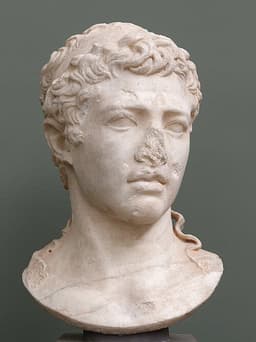
Juba II
Emperor · Ancient
49.9Total

Julius Caesar
General · Ancient
82.8Total
Basic Information
Born
-48
-100
Died
23
-44
Era
Ancient
Ancient
Nationality
Mauretania
Roman Republic
Occupation
Emperor
General
Civilization
Other
Western
Score Comparison
Military (10%)
50.0
88.0
Political (20%)
46.6
78.0
Influence (20%)
52.5
85.0
Legacy (20%)
42.5
82.0
Leadership (15%)
74.0
80.0
Strategy (15%)
30.3
85.0
TOTAL
49.9
82.8
Juba II — Complete Timeline
25 BC
Marriage to Cleopatra Selene IIPolitical Action◆ Major
Juba II married Cleopatra Selene II, daughter of Cleopatra VII and Mark Antony. The marriage was arranged by Augustus to unite the client kingdoms of Mauretania and Numidia under a loyal couple, consolidating Roman influence in North Africa.
Marriage AllianceRoman Client KingdomNorth Africa
Impact: regionalconstructive
Reign as King of MauretaniaPolitical Action◆ Major
Augustus appointed Juba II as king of Mauretania, a Roman client kingdom. Juba ruled for nearly 50 years, promoting Romanization, urban development, and trade. He established the capital at Caesarea (modern Cherchell) and fostered cultural exchange.
KingshipRomanizationUrban Development
Impact: regionalconstructive
20 BC
Publication of Scholarly WorksCultural◆ Major
Juba II wrote numerous scholarly works in Greek on history, geography, natural history, and art. His writings, though mostly lost, were cited by later authors like Pliny the Elder and Plutarch. He was considered one of the most learned kings of antiquity.
ScholarshipGreek LiteratureNatural History
Impact: regionalconstructive
10 BC
Expedition to the Canary IslandsOther
Juba II sent an expedition to the Canary Islands, which he named after the large dogs (canes) found there. He described the islands in his writings, providing one of the earliest known accounts of the archipelago. This expedition expanded geographical knowledge.
ExplorationGeographyCanary Islands
Impact: regionalconstructive
Julius Caesar — Complete Timeline
58 BC
Gallic WarsWar◆ Major
Caesar, as proconsul of Gaul, launched a series of campaigns that conquered all of Gaul (modern France, Belgium, and parts of Switzerland). He fought numerous battles, including against the Helvetii, the Belgae, and the Gallic chieftain Vercingetorix. The wars brought immense wealth and a loyal army to Caesar.
Gallic WarsConquestRoman Expansion
Impact: regional
49 BC
Crossing the RubiconPolitical Action◆ Major
Caesar led Legio XIII across the Rubicon River into Italy, defying the Roman Senate's order to disband his army. This act triggered a civil war against Pompey and the Optimates, ultimately leading to Caesar's dictatorship and the end of the Roman Republic.
Roman Civil WarEnd of RepublicPower Struggle
Impact: global
48 BC
Battle of PharsalusWar◆ Major
Caesar's outnumbered army defeated the larger forces of Pompey the Great at Pharsalus in Greece. Caesar's tactical use of a reserve line to counter Pompey's cavalry charge proved decisive. Pompey fled to Egypt, where he was assassinated, leaving Caesar as the undisputed master of the Roman world.
Roman Civil WarBattleDecisive Victory
Impact: regional
44 BC
Appointment as Dictator for LifePolitical Action◆ Major
The Roman Senate appointed Caesar dictator perpetuo (dictator for life), granting him unprecedented personal power. This move concentrated military, legislative, and judicial authority in one person, effectively ending the Roman Republic's traditional system of checks and balances and alarming many senators.
DictatorshipEnd of RepublicPower Consolidation
Impact: regionaldestructive
Assassination on the Ides of MarchPolitical Action◆ Major
A group of Roman senators, led by Marcus Junius Brutus and Gaius Cassius Longinus, stabbed Caesar to death at a meeting of the Senate in the Theatre of Pompey. The assassination was intended to restore the Republic, but instead triggered another civil war that led to the rise of the Roman Empire.
AssassinationRoman PoliticsEnd of Republic
Impact: globaldestructive
Expert Analysis
juba-ii-vs-julius-caesar
# The Conqueror and the King: Two Paths from the Shadow of Rome
On the Ides of March, 44 BCE, a dictator fell beneath twenty-three dagger strokes in the Senate chamber of Rome. The man who had conquered Gaul, crossed the Rubicon, and changed the course of Western history lay bleeding on the marble floor. Across the Mediterranean, in the royal palace of Mauretania, a different kind of ruler was beginning his reign—a man who would never command a legion in battle, yet whose influence would quietly shape the intellectual life of the Roman world for decades. Julius Caesar and Juba II: one a titan of military ambition, the other a scholar-king who chose books over bloodshed. What drove them so far apart, and what does their contrast reveal about the nature of power itself?
Origins
Caesar was born into the twilight of the Roman Republic, a world of senatorial intrigue, civil strife, and relentless expansion. His family, the Julii, claimed descent from the goddess Venus, but their political fortunes had waned. From childhood, Caesar absorbed the brutal logic of Roman politics: glory was won through conquest, influence through patronage, and survival through ruthlessness. The Republic was a machine that devoured the weak, and Caesar learned early to be its master.
Juba II was born into the wreckage of that same machine. His father, King Juba I of Numidia, had sided with Pompey against Caesar in the great civil war. When Caesar triumphed, the elder Juba died by his own hand, and the infant prince was paraded through Rome in Caesar’s triumph—a trophy of defeat. Yet Augustus, Caesar’s heir, saw potential in the captive boy. Juba was educated alongside the imperial family, immersed in Greek philosophy, Roman law, and the arts. Where Caesar learned to command, Juba learned to observe. His kingdom was not inherited through blood, but granted by the conqueror’s grace.
Rise to Power
Caesar’s path was forged through crisis. As a young man, he was captured by pirates and famously told them they would one day be crucified—a promise he kept. He climbed the cursus honorum through military commands in Spain, then formed the First Triumvirate with Pompey and Crassus. His appointment as governor of Gaul in 58 BCE unleashed a decade of conquest that brought millions under Roman rule and made him the richest man in the Republic. When the Senate ordered him to disband his army, he chose civil war instead. The crossing of the Rubicon in 49 BCE was not a gamble—it was the logical conclusion of a life built on calculated risk.
Juba’s rise was quieter, but no less strategic. In 25 BCE, at the age of twenty-three, Augustus appointed him king of Mauretania, a Roman client kingdom straddling modern Morocco and Algeria. The marriage that same year to Cleopatra Selene II, daughter of Cleopatra VII and Mark Antony, was purely political—a union of two royal orphans designed to stabilize Rome’s African frontier. Juba accepted his role as a client king, knowing that independence meant annihilation. He would rule for nearly fifty years, not as a conqueror, but as a mediator between two worlds.
Leadership & Governance
Caesar governed through personal magnetism and military might. As dictator, he reformed the calendar, extended citizenship to provincials, initiated public works, and centralized authority in his own hands. His military genius lay in speed and surprise—the siege of Alesia, the lightning campaign at Pharsalus, the audacious Egyptian intervention. Yet his political wisdom faltered at the critical moment. He pardoned his enemies, refused a crown, but accepted the title “dictator for life.” This contradiction—absolute power without the legitimacy of kingship—sealed his fate.
Juba governed through scholarship and diplomacy. He built a capital at Caesarea (modern Cherchell) modeled on Roman cities, with temples, libraries, and a theater. He minted coins that blended Roman imagery with local symbols, and his court became a center of learning. His writings—on history, geography, natural history, and art—were composed in Greek and widely read in Rome. In 10 BCE, he sent an expedition to the Canary Islands, naming them for the large dogs (canes) found there, and described their flora and fauna with scientific precision. He never commanded an army, but his leadership score of 78.6 reflects a different kind of authority: the power of knowledge in a world that respected Roman arms.
Triumph & Tragedy
Caesar’s greatest triumph was Gaul—the complete subjugation of a vast territory, documented in his own Commentaries. His most devastating failure was his inability to read the conspiracy forming around him. The Ides of March was a tragedy of overconfidence. He had survived Sulla’s proscriptions, pirate captivity, and civil war, only to fall to senators he had pardoned. His last words, according to tradition, were “Et tu, Brute?”—a recognition that the deepest wounds come from those we trust.
Juba’s triumphs were quieter. His marriage to Cleopatra Selene produced children who carried the blood of both the Ptolemaic and Numidian dynasties. His scholarly works, though mostly lost, were cited by Pliny the Elder and Plutarch, ensuring his intellectual legacy. His tragedy was that he ruled a client kingdom in an empire that would eventually absorb it entirely. After his death in 23 AD, Mauretania was annexed by Rome within a generation. His son Ptolemy was executed by Caligula. The kingdom vanished, but the scholar-king’s name survived in the pages of natural history.
Character & Destiny
Caesar’s character was forged in ambition. He believed in his own destiny, cultivated an image of divine favor, and acted with a decisiveness that bordered on recklessness. His personality shaped history because he refused to accept limits—on his power, his glory, or his life. That refusal made him immortal, but also mortal.
Juba’s character was shaped by survival. He had seen his father destroyed by Roman power, and he understood that the only way to preserve his kingdom was to become indispensable to Rome. He chose intellectual achievement over military glory, knowing that a scholar-king posed no threat to the empire that had made him. His strategy score of 30.0 reflects not a lack of intelligence, but a different calculus: in a world where Roman legions could crush any rebellion, the wisest strategy was to build something that would be remembered when the kingdom was gone.
Legacy
Caesar’s legacy is the Roman Empire itself. His name became a title—Kaiser, Tsar—and his reforms laid the foundation for imperial rule. He is remembered as a military genius, a political visionary, and a cautionary tale about the cost of unchecked ambition. His scores—Military 88, Political 78, Influence 85, Legacy 82—reflect a man who reshaped the world, for better and worse.
Juba II left a different mark. His legacy is intellectual: the first detailed description of the Canary Islands, the preservation of Numidian history, the model of a Romanized African kingdom. His scores—Military 47.8, Political 72, Influence 70.4, Legacy 56.5—tell the story of a man who chose the library over the battlefield. He is remembered not by emperors, but by scholars.
Conclusion
Standing on the Palatine Hill in Rome, one can still feel the shadow of Caesar—the weight of a man who dared to break the Republic. In the ruins of Caesarea, one finds the quieter echo of Juba II, a king who built a world within the cracks of empire. Their lives offer a profound contrast: one man changed the course of history through conquest, the other through curiosity. Both were products of their age, but they chose radically different responses to the same fundamental question: how does one wield power in a world dominated by Rome? Caesar answered with the sword. Juba answered with the scroll. In the end, both were consumed by the empire they served, but their stories remind us that greatness takes many forms—and that the quietest legacies sometimes outlast the loudest.
Rankings
🥇
Julius CaesarLeader
Mil: 88.0Pol: 78.0Inf: 85.0
82.8
🥈
Juba II
Mil: 50.0Pol: 46.6Inf: 52.5
49.9
+32.9 behind
How This Comparison Works
Algorithm
Each figure is scored on 6 dimensions (0—100 scale) based on structured historical data: Military (10%), Political (20%), Influence (20%), Legacy (20%), Leadership (15%), Strategy (15%). The weighted total produces the final ranking.
Data Sources
Scores are computed from structured sub-indicators in the database. Scale factors adjust for era (Ancient ×0.85, Modern ×1.0) and civilization size (Eastern ×1.05, Other ×0.80) to account for differences in population and military scale.
Maximum 3 Figures
Comparisons are limited to 2—3 figures to ensure readability and statistical meaningfulness.
Error Margins
±5 points per dimension — Sub-scores are derived from historical records with inherent uncertainty. Two figures within 5 points on a dimension should be considered roughly equivalent in that area.
Total Score Accuracy
±3 points overall — The weighted combination of 6 dimensions produces a total score with approximately ±3 points of uncertainty. Differences of less than 3 points are not statistically significant— the figures are effectively tied.
Known Limitations
- Historical records are incomplete and uneven across civilizations
- Figures from oral-tradition societies may be underrepresented
- Occupation labels can misclassify multi-role figures
- Scores measure capability and impact, not moral character
- Quantitative scoring is a comparison tool, not absolute truth
Capability Radar
Military (10%) — Battles & Warfare
Battles
15
95
Win Rate
10
92
Expansion
10
97
Political (20%) — Governance & Reform
Reform
30
90
Diplomacy
60
85
Economy
40
82
Influence (20%) — Cultural & Global Reach
Cultural
45
88
Global
30
94
Legacy (20%) — Historical Impact
Historical
40
95
Longevity
35
96
Leadership (15%) — Power & Stability
Tenure
55
75
Stability
50
60
Strategy (15%) — Tactics & Innovation
Strategy
15
94
Tactics
20
96
Reform
5
88
Similar Comparisons
Comments & Discussion
CONQUESTORVISION6/17/2026
Let’s be real—Caesar was a military machine, not a thinker. Juba II actually contributed something lasting: his writings on history and geography shaped Roman science. Caesar’s “commentaries” are just self-glorifying propaganda dressed as history. One man burned cities, the other built libraries. Easy choice.|
地理狂人6/17/2026
说穿了,恺撒不过是靠剑说话,而朱巴二世用笔思考。非洲海岸线是他绘制的,本土植物是他分类的。恺撒连数学都不懂——他改历法全靠希腊人的脑袋。你管这叫文明?这叫暴力加外包的才智。|
CLASSICSOBSERVER6/17/2026
Caesar’s mind was sharp as a gladius—his reforms to the calendar and his tactical genius show pure intellectual rigor. But Juba II had the harder task: to build cultural authority as a client king. His Numidian ancestry gave him a unique lens on Roman power, writing in Greek about Mauretania’s elephants and Atlas Mountains. Caesar conquered; Juba understood.|
修正编年史6/17/2026
别被罗马的宣传洗脑了。恺撒的“仁慈”只是策略,他对高卢的屠杀是种族灭绝——上百万人倒下。朱巴二世从父亲的血泊中站起来,却用知识抵抗征服。谁更强大?那个杀人的将军,还是那个撰写历史的国王?我选后者,不犹豫。|
WARCHEOLOGIST6/17/2026
Caesar’s siege of Alesia was a masterpiece—double fortifications, brilliant logistics, crushing victory. Juba II never held a command. He sat in his library while his kingdom was Romanized. You can admire his learning, but he ruled under Rome’s shadow, never on his own terms. Caesar changed the world; Juba just annotated it.|
历史实验家6/17/2026
比较这两人如同比较流星与恒星。恺撒是瞬爆的火光,改写了罗马的命脉;朱巴二世是持久的光,默默塑造了北非的学者传统。前者死得早,成就耀眼却短暂。后者活了五十多年,他的著作直到中世纪还被引用。谁留下更深的痕迹?时间自有答案。|