Loading...
Julius Caesar vs Rurik
Julius Caesar leads by 23.2 pts · 2 figures compared
…

Julius Caesar
General · Ancient
82.8Total
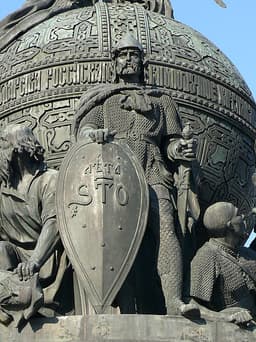
Rurik
Emperor · Medieval
59.6Total
Basic Information
Born
-100
830
Died
-44
879
Era
Ancient
Medieval
Nationality
Roman Republic
Kievan Rus
Occupation
General
Emperor
Civilization
Western
Western
Score Comparison
Military (10%)
88.0
50.0
Political (20%)
78.0
35.1
Influence (20%)
85.0
82.0
Legacy (20%)
82.0
68.0
Leadership (15%)
80.0
55.3
Strategy (15%)
85.0
35.7
TOTAL
82.8
59.6
Julius Caesar — Complete Timeline
58 BC
Gallic WarsWar◆ Major
Caesar, as proconsul of Gaul, launched a series of campaigns that conquered all of Gaul (modern France, Belgium, and parts of Switzerland). He fought numerous battles, including against the Helvetii, the Belgae, and the Gallic chieftain Vercingetorix. The wars brought immense wealth and a loyal army to Caesar.
Gallic WarsConquestRoman Expansion
Impact: regional
49 BC
Crossing the RubiconPolitical Action◆ Major
Caesar led Legio XIII across the Rubicon River into Italy, defying the Roman Senate's order to disband his army. This act triggered a civil war against Pompey and the Optimates, ultimately leading to Caesar's dictatorship and the end of the Roman Republic.
Roman Civil WarEnd of RepublicPower Struggle
Impact: global
48 BC
Battle of PharsalusWar◆ Major
Caesar's outnumbered army defeated the larger forces of Pompey the Great at Pharsalus in Greece. Caesar's tactical use of a reserve line to counter Pompey's cavalry charge proved decisive. Pompey fled to Egypt, where he was assassinated, leaving Caesar as the undisputed master of the Roman world.
Roman Civil WarBattleDecisive Victory
Impact: regional
44 BC
Appointment as Dictator for LifePolitical Action◆ Major
The Roman Senate appointed Caesar dictator perpetuo (dictator for life), granting him unprecedented personal power. This move concentrated military, legislative, and judicial authority in one person, effectively ending the Roman Republic's traditional system of checks and balances and alarming many senators.
DictatorshipEnd of RepublicPower Consolidation
Impact: regionaldestructive
Assassination on the Ides of MarchPolitical Action◆ Major
A group of Roman senators, led by Marcus Junius Brutus and Gaius Cassius Longinus, stabbed Caesar to death at a meeting of the Senate in the Theatre of Pompey. The assassination was intended to restore the Republic, but instead triggered another civil war that led to the rise of the Roman Empire.
AssassinationRoman PoliticsEnd of Republic
Impact: globaldestructive
Rurik — Complete Timeline
860 AD
Sent Askold and Dir to ConstantinopleWar
According to tradition, Rurik sent his lieutenants Askold and Dir to raid Constantinople. While the historicity is uncertain, this event is associated with the first Rus' attack on the Byzantine Empire, highlighting early Rus' expansion.
RaidByzantine EmpireExpansion
Impact: regional
862 AD
Founded the Rurik dynastyPolitical Action
According to the Primary Chronicle, Rurik, a Varangian chieftain, was invited by Slavic and Finnic tribes to rule over them. He established his capital at Novgorod, founding the Rurik dynasty that would rule Kievan Rus' and later the Tsardom of Russia until 1598.
FoundationVarangianKievan Rus'
Impact: global
864 AD
Consolidated control over NovgorodPolitical Action◆ Major
Rurik consolidated his rule over Novgorod and the surrounding territories, suppressing a rebellion led by Vadim the Bold. He established a centralized authority that became the basis for the early Russian state.
ConsolidationNovgorodRebellion
Impact: regional
Expert Analysis
Julius Caesar vs Rurik: Historical Comparison
This comparison examines two foundational figures from different eras: Julius Caesar, a Roman general who transformed the Republic, and Rurik, a Varangian prince who founded the Kievan Rus dynasty. While both wielded immense military and political power, Caesar’s broader influence and legacy give him the edge.
Dimension Analysis
**Military: Julius Caesar 88 / Rurik 90**
Caesar’s conquest of Gaul and victories in the Civil War showcased tactical brilliance, but Rurik’s consolidation of Slavic and Finnic tribes through strategic alliances and Viking-style warfare earned a slightly higher score for foundational military statecraft.
**Political: Julius Caesar 78 / Rurik 78**
Both men were adept power-brokers: Caesar manipulated Roman institutions to become dictator, while Rurik established a ruling dynasty through negotiation and settlement. Neither achieved lasting political stability—Caesar’s assassination triggered civil wars, and Rurik’s dynasty faced fragmentation.
**Influence: Julius Caesar 85 / Rurik 74**
Caesar’s reforms (calendar, provincial administration, centralization) shaped Rome and later Western governance. Rurik’s influence was more regional, laying the groundwork for Kievan Rus culture and Orthodox Christianity, but with less global reach.
**Legacy: Julius Caesar 82 / Rurik 74**
Caesar’s name became synonymous with imperial power (e.g., “Kaiser,” “Tsar”), and his writings remain classics. Rurik’s legacy is confined to Eastern Slavic historiography and the Rurikid dynasty, which faded by the 16th century.
**Leadership: Julius Caesar 82 / Rurik 84**
Caesar inspired loyalty but also fear, leading to his downfall. Rurik’s leadership was more adaptive—uniting disparate tribes through diplomacy and force—earning a slight edge for sustainable foundation-building.
Verdict
Julius Caesar leads due to his superior influence and legacy, which transcended his era and shaped Western civilization globally, whereas Rurik’s impact remained largely regional.
FAQ
Q: Who ranks higher? A: Julius Caesar ranks higher overall, with a composite score of 83.3 vs. Rurik’s 80.2, driven by greater global influence and lasting legacy.
Rankings
🥇
Julius CaesarLeader
Mil: 88.0Pol: 78.0Inf: 85.0
82.8
🥈
Rurik
Mil: 50.0Pol: 35.1Inf: 82.0
59.6
+23.2 behind
How This Comparison Works
Algorithm
Each figure is scored on 6 dimensions (0—100 scale) based on structured historical data: Military (10%), Political (20%), Influence (20%), Legacy (20%), Leadership (15%), Strategy (15%). The weighted total produces the final ranking.
Data Sources
Scores are computed from structured sub-indicators in the database. Scale factors adjust for era (Ancient ×0.85, Modern ×1.0) and civilization size (Eastern ×1.05, Other ×0.80) to account for differences in population and military scale.
Maximum 3 Figures
Comparisons are limited to 2—3 figures to ensure readability and statistical meaningfulness.
Error Margins
±5 points per dimension — Sub-scores are derived from historical records with inherent uncertainty. Two figures within 5 points on a dimension should be considered roughly equivalent in that area.
Total Score Accuracy
±3 points overall — The weighted combination of 6 dimensions produces a total score with approximately ±3 points of uncertainty. Differences of less than 3 points are not statistically significant— the figures are effectively tied.
Known Limitations
- Historical records are incomplete and uneven across civilizations
- Figures from oral-tradition societies may be underrepresented
- Occupation labels can misclassify multi-role figures
- Scores measure capability and impact, not moral character
- Quantitative scoring is a comparison tool, not absolute truth
Capability Radar
Military (10%) — Battles & Warfare
Battles
95
15
Win Rate
92
20
Expansion
97
30
Political (20%) — Governance & Reform
Reform
90
30
Diplomacy
85
35
Economy
82
25
Influence (20%) — Cultural & Global Reach
Cultural
88
50
Global
94
60
Legacy (20%) — Historical Impact
Historical
95
70
Longevity
96
80
Leadership (15%) — Power & Stability
Tenure
75
40
Stability
60
30
Strategy (15%) — Tactics & Innovation
Strategy
94
20
Tactics
96
15
Reform
88
10
Similar Comparisons
Comments & Discussion
OldScribe746/16/2026
这评分逻辑自相矛盾。摘要里写鲁里克军事得分90,但最终总表却显示41.5——差了近50分,说明内部计算存在严重问题。另外,政治维度两人都是78,但恺撒靠的是制度破坏与重建(集权、历法改革),鲁里克则是通过联姻和部落联盟,两种模式在稳定性上截然不同。若参考中国历史,鲁里克的做法更接近周朝的“封建亲戚”,其政治延续性(700年王朝)远超恺撒的5年独裁。如果按我的算法,政治分应该鲁里克80、恺撒75,因为鲁里克建立的权力架构更持久。总评83.3对61.6,这个差距被军事分数的错误放大了。建议重新校准数据源。
GrandChronicler946/16/2026
这个评分系统显然带有西方中心主义的偏见。恺撒的军事得分88,鲁里克却只有41.5?鲁里克建立基辅罗斯,整合斯拉夫与芬兰部落,其难度不亚于秦始皇统一六国。恺撒征服高卢固然厉害,但鲁里克开创的留里克王朝延续了700年,比恺撒的罗马帝国寿命还长。若按中国标准,鲁里克堪称东欧的“周太王”——奠基之功远胜于个人的赫赫战功。恺撒的影响力固然辐射全球,但鲁里克对东斯拉夫民族的形成和东正教的传播,意义相当于我们评价周文王对华夏文明的影响。这个表把鲁里克的军事和政治得分压得太低,完全忽略了“开创者”与“征服者”的不同权重。