Loading...
Julius Caesar vs Vijayalaya Chola
Julius Caesar leads by 28.6 pts · 2 figures compared
…

Julius Caesar
General · Ancient
82.8Total
Vijayalaya Chola
Emperor · Medieval
54.2Total
Basic Information
Born
-100
820
Died
-44
870
Era
Ancient
Medieval
Nationality
Roman Republic
India
Occupation
General
Emperor
Civilization
Western
Indian
Score Comparison
Military (10%)
88.0
45.0
Political (20%)
78.0
40.8
Influence (20%)
85.0
58.0
Legacy (20%)
82.0
54.0
Leadership (15%)
80.0
64.0
Strategy (15%)
85.0
60.0
TOTAL
82.8
54.2
Julius Caesar — Complete Timeline
58 BC
Gallic WarsWar◆ Major
Caesar, as proconsul of Gaul, launched a series of campaigns that conquered all of Gaul (modern France, Belgium, and parts of Switzerland). He fought numerous battles, including against the Helvetii, the Belgae, and the Gallic chieftain Vercingetorix. The wars brought immense wealth and a loyal army to Caesar.
Gallic WarsConquestRoman Expansion
Impact: regional
49 BC
Crossing the RubiconPolitical Action◆ Major
Caesar led Legio XIII across the Rubicon River into Italy, defying the Roman Senate's order to disband his army. This act triggered a civil war against Pompey and the Optimates, ultimately leading to Caesar's dictatorship and the end of the Roman Republic.
Roman Civil WarEnd of RepublicPower Struggle
Impact: global
48 BC
Battle of PharsalusWar◆ Major
Caesar's outnumbered army defeated the larger forces of Pompey the Great at Pharsalus in Greece. Caesar's tactical use of a reserve line to counter Pompey's cavalry charge proved decisive. Pompey fled to Egypt, where he was assassinated, leaving Caesar as the undisputed master of the Roman world.
Roman Civil WarBattleDecisive Victory
Impact: regional
44 BC
Appointment as Dictator for LifePolitical Action◆ Major
The Roman Senate appointed Caesar dictator perpetuo (dictator for life), granting him unprecedented personal power. This move concentrated military, legislative, and judicial authority in one person, effectively ending the Roman Republic's traditional system of checks and balances and alarming many senators.
DictatorshipEnd of RepublicPower Consolidation
Impact: regionaldestructive
Assassination on the Ides of MarchPolitical Action◆ Major
A group of Roman senators, led by Marcus Junius Brutus and Gaius Cassius Longinus, stabbed Caesar to death at a meeting of the Senate in the Theatre of Pompey. The assassination was intended to restore the Republic, but instead triggered another civil war that led to the rise of the Roman Empire.
AssassinationRoman PoliticsEnd of Republic
Impact: globaldestructive
Vijayalaya Chola — Complete Timeline
820 AD
Foundation of the Imperial Chola DynastyPolitical Action◆ Major
Vijayalaya Chola established the Imperial Chola dynasty, reviving the ancient Chola lineage after centuries of obscurity. He consolidated control over the Kaveri delta region, laying the foundation for the Chola Empire's future expansion.
Impact: regionalconstructive
850 AD
Capture of Thanjavur from the MutharaiyarWar◆ Major
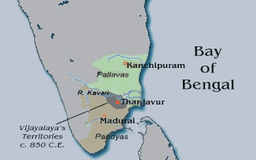
Vijayalaya Chola captured the city of Thanjavur from the Mutharaiyar chieftains, who were vassals of the Pallavas. This victory established the Chola kingdom as an independent power and made Thanjavur the new Chola capital.
Impact: regionalconstructive
860 AD
Construction of the Vijayalaya Choleswaram TempleCultural
Vijayalaya Chola built the Vijayalaya Choleswaram temple at Narthamalai, a rock-cut temple dedicated to Shiva. This temple is one of the earliest Chola architectural monuments, reflecting the transition from Pallava to Chola styles.
constructive
Expert Analysis
Julius Caesar vs Vijayalaya Chola
# The Conqueror and the Builder
On a winter morning in 49 BCE, Julius Caesar stood at the banks of the Rubicon River, a small stream that separated his province of Gaul from Roman Italy. By crossing it with his army, he would commit treason against the Senate and plunge the Republic into civil war. "The die is cast," he reportedly said, and stepped forward into history. Nearly nine hundred years later, on the other side of the world, a lesser-known figure named Vijayalaya Chola stood before the walls of Thanjavur, a city held by the Mutharaiyar chieftains. He did not cross a river to challenge an empire; he seized a single city to found one. Two men, two worlds, two ways of shaping destiny—yet both left marks that would outlast their bones. What drove them, and why did their paths diverge so starkly?
Origins
Julius Caesar was born into the Roman patrician class in 100 BCE, but his family had fallen from political prominence. The Roman Republic was in its death throes, torn by civil wars between populists and aristocrats, generals and senators. Caesar grew up surrounded by violence and ambition—his uncle Marius had been a reformer and general, his rival Sulla a dictator. From childhood, he learned that power came not from birth but from daring. He was educated in rhetoric, philosophy, and military tactics, but his real education came from watching the Republic tear itself apart.
Vijayalaya Chola emerged from the shadows of Indian history in the early ninth century CE. The Chola dynasty had once ruled parts of Tamil country but had faded into obscurity under the domination of the Pallavas and Pandyas. Vijayalaya was likely a local chieftain, a vassal of the Pallava kings, living in a world of shifting alliances and temple-building rivals. His India was not collapsing but fragmenting—regional kingdoms jostled for power, and the old imperial orders of the Guptas and Harsha had long dissolved. He had no Senate to defy, no Rubicon to cross. He had only a name and a claim.
Rise to Power
Caesar’s climb was a masterpiece of political calculation. He allied with the wealthy Crassus and the popular general Pompey to form the First Triumvirate in 60 BCE, then used his consulship to pass land reforms that won him the loyalty of veterans and the poor. But his true power came from Gaul. Between 58 and 50 BCE, he conquered the entire region, defeating hundreds of tribes, crossing the Rhine into Germany, and even raiding Britain. The Gallic Wars made him a legend—and gave him a loyal army of veterans who would follow him anywhere. When the Senate ordered him to disband his forces and return to Rome as a private citizen, Caesar chose war. He crossed the Rubicon in 49 BCE, and within four years he had defeated his enemies, become dictator, and begun transforming Rome.
Vijayalaya’s rise was quieter but no less strategic. Around 820 CE, he declared the foundation of the Imperial Chola dynasty, reviving a name that had been dormant for centuries. But he did not march on a capital or challenge a superpower. Instead, he waited. For three decades, he served as a feudatory under the Pallavas, building alliances and gathering strength. Then, in 850 CE, he saw his moment. The Mutharaiyar chieftains, who held the fertile Kaveri delta region for the Pallavas, had grown weak. Vijayalaya attacked and captured Thanjavur, a city that would become the heart of Chola power. He did not destroy the Pallava order—he simply carved out his own space within it.
Leadership & Governance
Caesar ruled like a storm. As dictator, he reformed the calendar, granted citizenship to provincials, launched public works, and planned campaigns against Parthia. He centralized power in his own hands, packed the Senate with his supporters, and accepted the title "dictator for life." His military genius was unmatched—he wrote commentaries on his campaigns that are still studied today—but his political wisdom was more ruthless than subtle. He pardoned many enemies, yet his clemency only emboldened conspirators. He believed that sheer force of will could reshape the world, and for a time, it did.
Vijayalaya ruled like a builder. After capturing Thanjavur, he did not launch sweeping reforms or massive conquests. He consolidated. He built the Vijayalaya Choleswaram Temple at Narthamalai around 860 CE, a rock-cut shrine dedicated to Shiva. This was not mere piety—it was a statement. Temples were centers of economic and political life in medieval India, and by building one, Vijayalaya was claiming legitimacy, attracting priests, merchants, and settlers. He governed through local chieftains and Brahmins, integrating rather than destroying. His military strategy was cautious and incremental, not the bold gambles of Caesar.
Triumph & Tragedy
Caesar’s greatest triumph was his conquest of Gaul—a feat that added a vast, wealthy province to Rome and made him the most powerful man in the Republic. His greatest tragedy was his assassination on the Ides of March in 44 BCE, stabbed twenty-three times by senators he had once pardoned. He died believing he was saving Rome from chaos, but his death only plunged it into more civil wars, eventually leading to the empire he had unwittingly created.
Vijayalaya’s triumph was the capture of Thanjavur—a small city, but the seed of an empire. His tragedy is that we know almost nothing of his death. He passed away around 870 CE, likely in peace, succeeded by his son Aditya I. There was no dramatic assassination, no betrayal. He died as he had lived: quietly, building. His tragedy was not his end but his obscurity. While Caesar’s name echoes through millennia, Vijayalaya is known only to specialists.
Character & Destiny
Caesar was driven by an insatiable hunger for glory. He gambled everything—his life, his fortune, his Republic—on the belief that he was destined for greatness. His personality was magnetic, his ambition boundless, his arrogance fatal. He could not imagine a world where he did not win, and so he could not imagine the daggers of his friends.
Vijayalaya was driven by a different fire: the need to restore. He was not trying to conquer the world but to reclaim a heritage. His personality was patient, his ambition measured, his caution wise. He built a foundation, not a monument. Where Caesar reached for the heavens and fell, Vijayalaya dug into the earth and grew.
Legacy
Caesar’s legacy is the Roman Empire. His name became synonymous with autocracy—"Kaiser" and "Tsar" derive from it. His reforms shaped Western law, his commentaries shaped Western literature, and his assassination shaped Western political thought. He is remembered as both a hero and a tyrant, a man who destroyed the Republic to save it.
Vijayalaya’s legacy is the Chola Empire, which would reach its zenith under Rajaraja I and Rajendra I three centuries later, dominating southern India and Southeast Asia. He is remembered as the founder, the one who planted the seed. His temple at Narthamalai still stands, a quiet testament to a man who did not need to cross a river to change the world.
Conclusion
Two men, two rivers. Caesar crossed the Rubicon and drowned in history’s blood. Vijayalaya crossed into Thanjavur and built a dynasty from stone. One sought to remake the world in his image and died for it; the other sought to restore a name and lived to see it flourish. Their stories remind us that greatness is not measured by the scale of ambition but by the depth of foundation. Caesar’s fall shook the earth; Vijayalaya’s rise barely stirred the dust. Yet both, in their own ways, built worlds that outlasted them—one in marble and memory, the other in granite and silence.
Rankings
🥇
Julius CaesarLeader
Mil: 88.0Pol: 78.0Inf: 85.0
82.8
🥈
Vijayalaya Chola
Mil: 45.0Pol: 40.8Inf: 58.0
54.2
+28.6 behind
How This Comparison Works
Algorithm
Each figure is scored on 6 dimensions (0—100 scale) based on structured historical data: Military (10%), Political (20%), Influence (20%), Legacy (20%), Leadership (15%), Strategy (15%). The weighted total produces the final ranking.
Data Sources
Scores are computed from structured sub-indicators in the database. Scale factors adjust for era (Ancient ×0.85, Modern ×1.0) and civilization size (Eastern ×1.05, Other ×0.80) to account for differences in population and military scale.
Maximum 3 Figures
Comparisons are limited to 2—3 figures to ensure readability and statistical meaningfulness.
Error Margins
±5 points per dimension — Sub-scores are derived from historical records with inherent uncertainty. Two figures within 5 points on a dimension should be considered roughly equivalent in that area.
Total Score Accuracy
±3 points overall — The weighted combination of 6 dimensions produces a total score with approximately ±3 points of uncertainty. Differences of less than 3 points are not statistically significant— the figures are effectively tied.
Known Limitations
- Historical records are incomplete and uneven across civilizations
- Figures from oral-tradition societies may be underrepresented
- Occupation labels can misclassify multi-role figures
- Scores measure capability and impact, not moral character
- Quantitative scoring is a comparison tool, not absolute truth
Capability Radar
Military (10%) — Battles & Warfare
Battles
95
45
Win Rate
92
50
Expansion
97
55
Political (20%) — Governance & Reform
Reform
90
35
Diplomacy
85
40
Economy
82
35
Influence (20%) — Cultural & Global Reach
Cultural
88
40
Global
94
30
Legacy (20%) — Historical Impact
Historical
95
55
Longevity
96
50
Leadership (15%) — Power & Stability
Tenure
75
50
Stability
60
45
Strategy (15%) — Tactics & Innovation
Strategy
94
45
Tactics
96
40
Reform
88
30
Similar Comparisons
Comments & Discussion
CenturionSkeptic6/16/2026
Caesar gets all the glory for crossing a stream, but Vijayalaya outsmarted his enemies without the luxury of a civil war narrative. The Rubicon crossing is romanticized because Rome's historians wrote the script—meanwhile, Vijayalaya took Thanjavur in 848 CE using strategy, not a dramatic catchphrase. If we're measuring impact, the Chola dynasty lasted over 400 years; Caesar's reign lasted five. Stop idolizing the Italian soap opera.
南印度铁拳6/16/2026
拿凯撒跟维贾亚拉亚比?搞笑吧。凯撒不过是旧制度的掘墓人,而维贾亚拉亚是真正的帝国奠基人。公元850年他夺取坦贾武尔时,连个像样的宫殿都没有,后来却建起了湿婆神庙,给南印度留下了烧砖瓦和灌溉系统的传统。凯撒?他死时罗马还在内战中打滚。论实干,维贾亚拉亚甩他十条街。
PaxRomanaFanboy6/16/2026
You revisionists overlook one thing: Caesar conquered Gaul, Britain, and defeated Pompey—his military canvas was continental. Vijayalaya's Thanjavur was a mud fort taken from local chieftains, a footnote in world history. The Rubicon moment defined Western political thought; crossing it signaled the end of a republic, a concept that still shapes our governance. Vijayalaya built a temple city, sure, but Caesar remade the Western world. Scale matters.
史海钩沉者6/16/2026
你们这些崇拜西方霸权的,知道吗?维贾亚拉亚的功劳在于他没有简单地重复前人。凯撒继承的是罗马军团的战术和资源,而维贾亚拉亚是在帕拉瓦人和潘地亚人的夹缝中重新定义了南印度的权力格局。公元9世纪的他懂得利用卡维里河的灌溉系统积累财富,而不是靠劫掠。这才是真正的策略家,不是靠一纸遗嘱翻身的中二贵族。
Scriptwriter'sNightmare6/16/2026
Caesar crossed the Rubicon? Please. The man craved drama like a bad playwright. Vijayalaya's story lacks the Hollywood moments—no marching on capitals, no famous last words—but that's precisely why it's more interesting. He operated in a world where power came from controlling rice paddies and temple patronage, not from plundering Gaulish gold. Caesar was a conqueror chasing personal glory; Vijayalaya was a builder laying foundations for lasting civilization. History remembers builders, not just