Loading...
This comparison has not been analyzed yet.
One-time AI generation (~1 minute). Scores and timeline are already available below.
Jung Bahadur Rana vs Kim Jong-gak
Jung Bahadur Rana leads by 18.9 pts · 2 figures compared
…
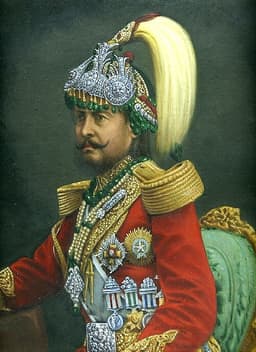
Jung Bahadur Rana
General · Modern
61.4Total

Kim Jong-gak
General · Modern
42.5Total
Basic Information
Born
1817
1941
Died
1877
—
Era
Modern
Modern
Nationality
Nepal
North Korea
Occupation
General
General
Civilization
Indian
Eastern
Score Comparison
Military (10%)
55.0
22.6
Political (20%)
72.0
27.9
Influence (20%)
56.7
50.2
Legacy (20%)
55.0
37.5
Leadership (15%)
78.0
67.0
Strategy (15%)
55.0
41.0
TOTAL
61.4
42.5
Jung Bahadur Rana — Complete Timeline
1846 AD
Kot MassacrePolitical Action
Jung Bahadur Runa orchestrated the Kot Massacre in Kathmandu, where dozens of nobles and courtiers were killed. This event eliminated his political rivals and allowed him to seize effective control of the Nepalese government, establishing the hereditary Rana prime ministership.
CoupMassacreRana Dynasty
Impact: nationaldestructive
Establishment of Rana DynastyPolitical Action◆ Major
Following the Kot Massacre, Jung Bahadur Rana appointed himself prime minister and commander-in-chief. He made the position hereditary, founding the Rana dynasty that ruled Nepal for over a century, reducing the Shah monarchs to figureheads.
DynastyGovernmentNepal
Impact: national
1850 AD
Visit to EuropeCultural
Jung Bahadur Rana traveled to Britain and France, becoming the first South Asian ruler to visit Europe. He observed Western military and industrial technology, which influenced his modernization efforts in Nepal, including army reforms.
DiplomacyModernizationTravel
Impact: nationalconstructive
1856 AD
Nepal-Tibet War and Treaty of ThapathaliWar◆ Major
Jung Bahadur Rana led a Nepalese military campaign into Tibet. The conflict ended with the Treaty of Thapathali, which secured Nepalese territorial claims and established a tributary relationship with Tibet, enhancing Nepal's regional influence.
WarTreatyTibet
Impact: regional
Kim Jong-gak — Complete Timeline
2012 AD
Appointed Minister of People's Armed ForcesPolitical Action◆ Major
Kim Jong-gak was appointed as Minister of the People's Armed Forces of North Korea, replacing Kim Jong-un's uncle Jang Song-thaek. This appointment placed him in charge of the country's military forces.
Military AppointmentNorth KoreaKim Jong-un
Impact: national
Promoted to Vice MarshalOther◆ Major
Kim Jong-gak was promoted to the rank of Vice Marshal (Chasu) in the Korean People's Army. This rank is one of the highest in North Korea's military hierarchy, reflecting his seniority and loyalty.
Military RankPromotionNorth Korea
Impact: national
2013 AD
Removed as Defense MinisterOther◆ Major
Kim Jong-gak was dismissed as Minister of the People's Armed Forces after less than a year in office. His removal was part of a broader purge of military officials by Kim Jong-un, though he was not executed.
PurgeDismissalNorth Korea
Impact: nationaldestructive
This comparison has not been analyzed yet.
One-time AI generation (~1 minute). Scores and timeline are already available below.
Rankings
🥇
Jung Bahadur RanaLeader
Mil: 55.0Pol: 72.0Inf: 56.7
61.4
🥈
Kim Jong-gak
Mil: 22.6Pol: 27.9Inf: 50.2
42.5
+18.9 behind
How This Comparison Works
Algorithm
Each figure is scored on 6 dimensions (0—100 scale) based on structured historical data: Military (10%), Political (20%), Influence (20%), Legacy (20%), Leadership (15%), Strategy (15%). The weighted total produces the final ranking.
Data Sources
Scores are computed from structured sub-indicators in the database. Scale factors adjust for era (Ancient ×0.85, Modern ×1.0) and civilization size (Eastern ×1.05, Other ×0.80) to account for differences in population and military scale.
Maximum 3 Figures
Comparisons are limited to 2—3 figures to ensure readability and statistical meaningfulness.
Error Margins
±5 points per dimension — Sub-scores are derived from historical records with inherent uncertainty. Two figures within 5 points on a dimension should be considered roughly equivalent in that area.
Total Score Accuracy
±3 points overall — The weighted combination of 6 dimensions produces a total score with approximately ±3 points of uncertainty. Differences of less than 3 points are not statistically significant— the figures are effectively tied.
Known Limitations
- Historical records are incomplete and uneven across civilizations
- Figures from oral-tradition societies may be underrepresented
- Occupation labels can misclassify multi-role figures
- Scores measure capability and impact, not moral character
- Quantitative scoring is a comparison tool, not absolute truth
Capability Radar
Military (10%) — Battles & Warfare
Battles
45
10
Win Rate
50
10
Expansion
40
5
Political (20%) — Governance & Reform
Reform
75
10
Diplomacy
70
20
Economy
65
5
Influence (20%) — Cultural & Global Reach
Cultural
55
5
Global
40
5
Legacy (20%) — Historical Impact
Historical
65
10
Longevity
60
5
Leadership (15%) — Power & Stability
Tenure
80
40
Stability
60
30
Strategy (15%) — Tactics & Innovation
Strategy
60
15
Tactics
55
15
Reform
70
20
Similar Comparisons
Comments & Discussion
No comments yet. Be the first to share your thoughts!