Loading...
This comparison has not been analyzed yet.
One-time AI generation (~1 minute). Scores and timeline are already available below.
Kalakaua vs Senzangakhona kaJama
Kalakaua leads by 9.8 pts · 2 figures compared
…
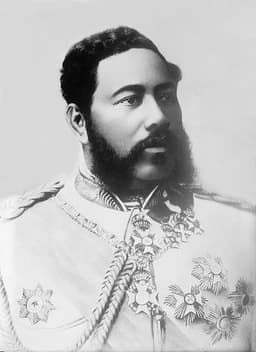
Kalakaua
Emperor · Modern
51.8Total

Senzangakhona kaJama
Emperor · Modern
42.0Total
Basic Information
Born
1836
1762
Died
1891
1816
Era
Modern
Modern
Nationality
Hawaii
Zulu Kingdom
Occupation
Emperor
Emperor
Civilization
Other
Other
Score Comparison
Military (10%)
13.3
20.0
Political (20%)
72.0
29.3
Influence (20%)
61.0
49.4
Legacy (20%)
49.2
40.0
Leadership (15%)
53.2
51.9
Strategy (15%)
41.6
54.3
TOTAL
51.8
42.0
Kalakaua — Complete Timeline
1874 AD
Elected King of HawaiiPolitical Action◆ Major
David Kalākaua was elected king by the Hawaiian legislature after the death of King Lunalilo. His election sparked a riot by supporters of Queen Emma, which was suppressed by American and British troops.
ElectionMonarchy
Impact: national
1875 AD
Signed the Reciprocity Treaty of 1875Political Action◆ Major
Kalākaua signed a reciprocity treaty with the United States that eliminated tariffs on Hawaiian sugar and other products. In exchange, the US gained exclusive rights to use Pearl Harbor as a naval base, increasing American influence.
TradePearl Harbor
Impact: national
1881 AD
Circumnavigated the GlobeOther◆ Major
Kalākaua became the first monarch to circumnavigate the globe, traveling to the United States, Europe, and Asia. He sought to strengthen diplomatic ties, promote Hawaiian culture, and recruit immigrants to work on sugar plantations.
DiplomacyTravel
Impact: globalconstructive
1882 AD
Built ʻIolani PalaceCultural◆ Major
Kalākaua completed the construction of ʻIolani Palace in Honolulu, the only royal palace in the United States. The palace was equipped with modern amenities like electricity and telephones, symbolizing Hawaiian modernization.
ArchitectureRoyal palace
Impact: nationalconstructive
1887 AD
Forced to Sign the Bayonet ConstitutionPolitical Action◆ Major
Kalākaua was forced by a group of American and European businessmen, backed by the Honolulu Rifles militia, to sign a new constitution. The Bayonet Constitution stripped the monarchy of power, gave voting rights only to wealthy landowners, and favored foreign interests.
ConstitutionCoup
Impact: nationaldestructive
1891 AD
Died in San FranciscoOther◆ Major
Kalākaua died in San Francisco while on a diplomatic trip to the United States. His death was attributed to Bright's disease (kidney failure). He was the last reigning king of Hawaii.
DeathDiplomacy
Impact: nationaltragic
Senzangakhona kaJama — Complete Timeline
1781 AD
Became Chief of the Zulu ClanPolitical Action
Senzangakhona kaJama became chief of the Zulu clan around 1781, ruling a small chiefdom in what is now KwaZulu-Natal. His reign was relatively peaceful, but he failed to expand Zulu territory significantly, leaving his son Shaka to build the Zulu Empire.
ChieftaincyZulu ClanPre-Imperial
1787 AD
Fathered Shaka ZuluOther◆ Major
Senzangakhona fathered Shaka Zulu around 1787 with Nandi, a woman from the Langeni clan. Shaka's birth was controversial due to Senzangakhona's refusal to marry Nandi, leading to their exile. Shaka later became the most famous Zulu king, transforming the clan into an empire.
BirthShakaLegacy
Impact: regional
1816 AD
Died and Succession CrisisPolitical Action◆ Major
Senzangakhona died in 1816, leading to a succession struggle among his sons. His designated heir, Sigujana, was killed by Shaka's allies, allowing Shaka to seize power. This event set the stage for the rise of the Zulu Kingdom under Shaka's military reforms.
SuccessionShakaZulu Kingdom
Impact: regionaldestructive
This comparison has not been analyzed yet.
One-time AI generation (~1 minute). Scores and timeline are already available below.
Rankings
🥇
KalakauaLeader
Mil: 13.3Pol: 72.0Inf: 61.0
51.8
🥈
Senzangakhona kaJama
Mil: 20.0Pol: 29.3Inf: 49.4
42.0
+9.8 behind
How This Comparison Works
Algorithm
Each figure is scored on 6 dimensions (0—100 scale) based on structured historical data: Military (10%), Political (20%), Influence (20%), Legacy (20%), Leadership (15%), Strategy (15%). The weighted total produces the final ranking.
Data Sources
Scores are computed from structured sub-indicators in the database. Scale factors adjust for era (Ancient ×0.85, Modern ×1.0) and civilization size (Eastern ×1.05, Other ×0.80) to account for differences in population and military scale.
Maximum 3 Figures
Comparisons are limited to 2—3 figures to ensure readability and statistical meaningfulness.
Error Margins
±5 points per dimension — Sub-scores are derived from historical records with inherent uncertainty. Two figures within 5 points on a dimension should be considered roughly equivalent in that area.
Total Score Accuracy
±3 points overall — The weighted combination of 6 dimensions produces a total score with approximately ±3 points of uncertainty. Differences of less than 3 points are not statistically significant— the figures are effectively tied.
Known Limitations
- Historical records are incomplete and uneven across civilizations
- Figures from oral-tradition societies may be underrepresented
- Occupation labels can misclassify multi-role figures
- Scores measure capability and impact, not moral character
- Quantitative scoring is a comparison tool, not absolute truth
Capability Radar
Military (10%) — Battles & Warfare
Battles
8
5
Win Rate
9
5
Expansion
9
5
Political (20%) — Governance & Reform
Reform
55
10
Diplomacy
65
20
Economy
50
10
Influence (20%) — Cultural & Global Reach
Cultural
60
15
Global
45
10
Legacy (20%) — Historical Impact
Historical
55
20
Longevity
50
20
Leadership (15%) — Power & Stability
Tenure
60
30
Stability
40
15
Strategy (15%) — Tactics & Innovation
Strategy
15
5
Tactics
15
5
Reform
21
5
Similar Comparisons
Comments & Discussion
No comments yet. Be the first to share your thoughts!