Loading...
Kalakaua vs Napoleon Bonaparte
Napoleon Bonaparte leads by 19.1 pts · 2 figures compared
…
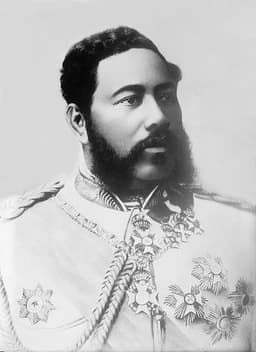
Kalakaua
Emperor · Modern
51.8Total

Napoleon Bonaparte
General · Modern
70.9Total
Basic Information
Born
1836
1769
Died
1891
1821
Era
Modern
Modern
Nationality
Hawaii
France
Occupation
Emperor
General
Civilization
Other
Western
Score Comparison
Military (10%)
13.3
94.0
Political (20%)
72.0
72.0
Influence (20%)
61.0
40.0
Legacy (20%)
49.2
80.0
Leadership (15%)
53.2
78.0
Strategy (15%)
41.6
90.0
TOTAL
51.8
70.9
Kalakaua — Complete Timeline
1874 AD
Elected King of HawaiiPolitical Action◆ Major
David Kalākaua was elected king by the Hawaiian legislature after the death of King Lunalilo. His election sparked a riot by supporters of Queen Emma, which was suppressed by American and British troops.
ElectionMonarchy
Impact: national
1875 AD
Signed the Reciprocity Treaty of 1875Political Action◆ Major
Kalākaua signed a reciprocity treaty with the United States that eliminated tariffs on Hawaiian sugar and other products. In exchange, the US gained exclusive rights to use Pearl Harbor as a naval base, increasing American influence.
TradePearl Harbor
Impact: national
1881 AD
Circumnavigated the GlobeOther◆ Major
Kalākaua became the first monarch to circumnavigate the globe, traveling to the United States, Europe, and Asia. He sought to strengthen diplomatic ties, promote Hawaiian culture, and recruit immigrants to work on sugar plantations.
DiplomacyTravel
Impact: globalconstructive
1882 AD
Built ʻIolani PalaceCultural◆ Major
Kalākaua completed the construction of ʻIolani Palace in Honolulu, the only royal palace in the United States. The palace was equipped with modern amenities like electricity and telephones, symbolizing Hawaiian modernization.
ArchitectureRoyal palace
Impact: nationalconstructive
1887 AD
Forced to Sign the Bayonet ConstitutionPolitical Action◆ Major
Kalākaua was forced by a group of American and European businessmen, backed by the Honolulu Rifles militia, to sign a new constitution. The Bayonet Constitution stripped the monarchy of power, gave voting rights only to wealthy landowners, and favored foreign interests.
ConstitutionCoup
Impact: nationaldestructive
1891 AD
Died in San FranciscoOther◆ Major
Kalākaua died in San Francisco while on a diplomatic trip to the United States. His death was attributed to Bright's disease (kidney failure). He was the last reigning king of Hawaii.
DeathDiplomacy
Impact: nationaltragic
Napoleon Bonaparte — Complete Timeline
1799 AD
Coup of 18 BrumaireOther◆ Major
Napoleon Bonaparte, with support from his brother Lucien and key political figures, overthrew the Directory in a bloodless coup. He established the Consulate with himself as First Consul, effectively becoming the ruler of France. This event ended the French Revolution's most unstable period.
French RevolutionCoupRise to Power
Impact: regional
1804 AD
Promulgation of the Napoleonic CodeOther◆ Major
Napoleon enacted the Civil Code of the French, known as the Napoleonic Code, a comprehensive set of laws that replaced the fragmented feudal legal systems. The code established legal equality, protected property rights, and secularized law. It became the basis for legal systems in many European and world countries.
Legal ReformNapoleonic CodeCivil Law
Impact: globalconstructive
1805 AD
Battle of AusterlitzWar◆ Major
Napoleon's Grande Arm
Napoleonic WarsBattleDecisive Victory
Impact: global
1812 AD
Invasion of RussiaWar◆ Major
Napoleon led the Grande Arm
Napoleonic WarsInvasionDisaster
Impact: globaldestructive
1815 AD
Battle of WaterlooWar◆ Major
Napoleon's French army was defeated by the combined forces of the Duke of Wellington's Anglo-Allied army and Gebhard Leberecht von Bl
Napoleonic WarsBattleFinal Defeat
Impact: globaldestructive
Expert Analysis
kalakaua-vs-napoleon-bonaparte
# The Emperor and the King: Two Paths Through the Modern World
On a winter morning in 1814, Napoleon Bonaparte stood in the courtyard of the Palace of Fontainebleau, bidding farewell to his Old Guard before abdicating his throne. The veterans wept. Less than eighty years later, on a January day in 1891, King David Kalākaua lay dying in a San Francisco hotel room, far from his beloved Hawaii, his kingdom slipping from his grasp. Both men fought to shape their nations' destinies in a rapidly changing world. One built an empire that shook Europe; the other fought to preserve a kingdom that the world was swallowing. Why did their fates diverge so dramatically? The answer lies not merely in their choices, but in the forces of history that placed them on such different stages.
Origins
Napoleon was born in 1769 on the Mediterranean island of Corsica, a place that had become French only months before his birth. His family was minor nobility, poor but proud. He spoke Italian before French, and throughout his life carried the outsider's hunger—the need to prove himself to a mainland that looked down on Corsicans. The French Revolution, which erupted when he was twenty, shattered the old order and opened paths that birth alone could never have granted. A young artillery officer with ambition, intelligence, and no money could rise as high as his talents could take him.
David Kalākaua was born in 1836 into a different world entirely—the Hawaiian Kingdom, a chain of volcanic islands in the Pacific where chiefs and commoners had lived for centuries under a system of kapu, or sacred law. His family was of high chiefly lineage, but by the time of his birth, foreign influences had already transformed his homeland. American missionaries had arrived in 1820, whalers and traders followed, and sugar planters were beginning to reshape the economy. Kalākaua grew up fluent in both Hawaiian and English, educated in a missionary school, watching his people's traditions erode under the pressure of Western commerce and Christianity.
Rise to Power
Napoleon's ascent was meteoric, a trajectory that still seems impossible. In 1793, at age twenty-four, he drove British forces from the port of Toulon and was promoted to brigadier general. By 1796 he commanded the Army of Italy, where his lightning campaigns forced Austria to sue for peace. He was twenty-seven. Egypt followed, then the coup of 18 Brumaire in 1799, and by 1804 he crowned himself Emperor of the French. Each step was a gamble, and each gamble paid off—until they stopped paying.
Kalākaua's path was slower, more constrained. He was elected King of Hawaii in 1874 after the death of King Lunalilo, but his election sparked a riot. American and European businessmen had already accumulated enormous economic power on the islands, and they made clear that the monarchy existed at their pleasure. Kalākaua understood this reality. He was not a conqueror but a diplomat, a man trying to maneuver within a system that was not of his making.
Leadership & Governance
Napoleon governed with the energy of a man who believed he could reshape reality. His Napoleonic Code unified French law, established merit-based advancement in government, and spread revolutionary ideals of equality before the law across Europe. He built roads, established the Bank of France, and reorganized education. His military genius is beyond dispute—the 1805 campaign at Austerlitz remains a masterpiece of deception and concentration. But his political wisdom was fatally flawed by overreach. He could not stop. Victory demanded more victory, and each new conquest created new enemies.
Kalākaua governed differently because he had to. He signed the Reciprocity Treaty of 1875 with the United States, eliminating tariffs on Hawaiian sugar in exchange for access to Pearl Harbor. It was a bargain that enriched the planters and tied Hawaii's economy to America. He built ʻIolani Palace, completed in 1882—a magnificent structure with electric lights and telephones, meant to project Hawaiian sovereignty to the world. In 1881, he became the first monarch to circumnavigate the globe, traveling to America, Europe, and Asia to seek allies and immigrants. He was trying to build a modern Hawaiian nation, but the forces arrayed against him were overwhelming.
Triumph & Tragedy
Napoleon's greatest triumph was his empire at its height in 1810—France stretched from Spain to Poland, and his family sat on thrones across Europe. His greatest tragedy was the invasion of Russia in 1812. He marched with 600,000 men; fewer than 100,000 returned. The disaster broke his aura of invincibility. Exiled to Elba, he returned for the Hundred Days, but Waterloo in 1815 ended it forever. He died in 1821 on Saint Helena, a British prisoner, at age fifty-one.
Kalākaua's tragedy was quieter but no less devastating. In 1887, a group of American and European businessmen, backed by the Honolulu Rifles militia, forced him to sign the Bayonet Constitution. It stripped the monarchy of most of its power, requiring voters to meet property and income requirements that excluded most native Hawaiians. The king signed to avoid bloodshed. He died in San Francisco in 1891, possibly poisoned, possibly of Bright's disease, at age fifty-four. Two years later, the monarchy he had fought to preserve was overthrown.
Character & Destiny
Napoleon was a man of extraordinary will, capable of working eighteen-hour days and inspiring soldiers to die for him. But his character contained the seed of his downfall: he could not delegate, could not compromise, could not accept limits. "Power is my mistress," he said, and he meant it. His personality drove him to conquer, but also to overreach.
Kalākaua was a man of charm and resilience, known as the "Merrie Monarch" for his revival of Hawaiian hula and music. He understood that survival required adaptation. But his character could not change the fundamental reality: his kingdom was small, its strategic location valuable, and its native population vulnerable to disease and dispossession. He was a skilled politician playing a losing hand.
Legacy
Napoleon's legacy is written across Europe—in legal codes, administrative systems, and the very idea of the modern state. He is remembered as both hero and tyrant, liberator and conqueror. His scores reflect this: military 94, political 75, influence 82. He changed the world, for better and worse.
Kalākaua's legacy is more fragile. He is remembered in Hawaii as the monarch who tried to preserve his people's sovereignty and culture. His scores—military 14, political 83, influence 73—reflect a different kind of greatness. He could not win on the battlefield, but he fought with diplomacy, with culture, with the sheer act of being Hawaiian in a world that wanted Hawaiians to disappear.
Conclusion
Napoleon and Kalākaua lived in the same modern era, but they faced it from opposite positions of power. One commanded armies that shook continents; the other commanded only the loyalty of a small island kingdom. Yet both understood that the modern world was a storm, and that a leader's task was to navigate it. Napoleon tried to ride the storm, to become the storm itself. Kalākaua tried to build a shelter. Both were swept away in the end. Their stories remind us that historical greatness is not measured only in conquests and codes, but in the quiet courage of a king who danced the old dances while his world crumbled around him.
Rankings
🥇
Napoleon BonaparteLeader
Mil: 94.0Pol: 72.0Inf: 40.0
70.9
🥈
Kalakaua
Mil: 13.3Pol: 72.0Inf: 61.0
51.8
+19.1 behind
How This Comparison Works
Algorithm
Each figure is scored on 6 dimensions (0—100 scale) based on structured historical data: Military (10%), Political (20%), Influence (20%), Legacy (20%), Leadership (15%), Strategy (15%). The weighted total produces the final ranking.
Data Sources
Scores are computed from structured sub-indicators in the database. Scale factors adjust for era (Ancient ×0.85, Modern ×1.0) and civilization size (Eastern ×1.05, Other ×0.80) to account for differences in population and military scale.
Maximum 3 Figures
Comparisons are limited to 2—3 figures to ensure readability and statistical meaningfulness.
Error Margins
±5 points per dimension — Sub-scores are derived from historical records with inherent uncertainty. Two figures within 5 points on a dimension should be considered roughly equivalent in that area.
Total Score Accuracy
±3 points overall — The weighted combination of 6 dimensions produces a total score with approximately ±3 points of uncertainty. Differences of less than 3 points are not statistically significant— the figures are effectively tied.
Known Limitations
- Historical records are incomplete and uneven across civilizations
- Figures from oral-tradition societies may be underrepresented
- Occupation labels can misclassify multi-role figures
- Scores measure capability and impact, not moral character
- Quantitative scoring is a comparison tool, not absolute truth
Capability Radar
Military (10%) — Battles & Warfare
Battles
8
95
Win Rate
9
90
Expansion
9
95
Political (20%) — Governance & Reform
Reform
55
95
Diplomacy
65
80
Economy
50
85
Influence (20%) — Cultural & Global Reach
Cultural
60
85
Global
45
90
Legacy (20%) — Historical Impact
Historical
55
95
Longevity
50
90
Leadership (15%) — Power & Stability
Tenure
60
85
Stability
40
70
Strategy (15%) — Tactics & Innovation
Strategy
15
95
Tactics
15
98
Reform
21
92
Similar Comparisons
Comments & Discussion
ChasseurMaudit6/17/2026
Anyone comparing Napoleon to a Hawaiian king clearly skipped 18th-century military history. Napoleon commanded 600,000 men at his peak and redrew the map of Europe from Cairo to Moscow. Kalākaua commanded... a hula troupe? Let’s be real: one man fielded the Grande Armée; the other signed a reciprocity treaty so he could sell sugar to America. The scale isn’t just different—it’s laughable. Call me when Kalākaua wins at Austerlitz.
数据御史6/17/2026
你们用拿破仑来对比卡拉卡瓦,根本就是在偷换概念。前者颠复欧洲格局,后者连自己王位都保不住,怎么比?拿破仑手下有50万法军横扫大陆,卡拉卡瓦的军队最多几千人,还大多是土著。更关键的是,拿破仑掌握的工业革命红利是19世纪最强武器,而夏威夷连蒸汽船都没几艘。这种对比只能糊弄不懂数据的人。
LegionisToga6/17/2026
As a classics scholar, I see the real parallel: both men were tragic hero-kings in the Homeric mold—brilliant, hubristic, undone by forces they barely understood. Napoleon stuck his hand into the Russian winter; Kalākaua into the jaws of American colonialism. Both chose defiance over submission, and both ended exiled from their thrones. Napoleon at St. Helena, Kalākaua in a San Francisco hotel. The enemy changed, but the story didn't.
太平洋的波6/17/2026
说卡拉卡瓦不如拿破仑的人,根本不懂什么叫“小国的无奈”。拿破仑有法国做后盾,卡拉卡瓦有什么?几把步枪和珍珠港的天然良港。他玩外交手牌已经很厉害了,与日本天皇见面、派学生留学全球、还试图建立波利尼西亚联盟来抵制欧美势力。这种多线操作放在欧洲也未必能赢,别用拿破仑的牌戏标准来嘲笑一个赌桌上只有一对二的人。
CorsicanPineapple6/17/2026
Fine, but let's not romanticize. Kalākaua died broke in a San Francisco hotel, while Napoleon at least got a dramatic farewell at Fontainebleau—weeping veterans, imperial eagles, the whole theatre. One built an empire that rattled Europe for a decade; the other built a hotel called the Iolani Palace. If we're measuring by impact on world history, this isn’t a comparison; it’s a mismatch. Kalākaua was a footnote. Napoleon was the chapter.