Loading...
Kangxi Emperor vs William of Julich-Cleves-Berg
Kangxi Emperor leads by 23.2 pts · 2 figures compared
…
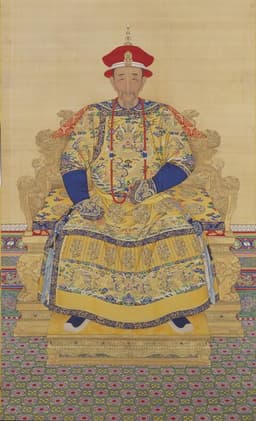
Kangxi Emperor
Emperor · Modern
73.4Total

William of Julich-Cleves-Berg
Emperor · Modern
50.2Total
Basic Information
Born
1654
1516
Died
1722
1592
Era
Modern
Modern
Nationality
China
Cleves
Occupation
Emperor
Emperor
Civilization
Eastern
Western
Score Comparison
Military (10%)
85.0
55.0
Political (20%)
78.0
54.7
Influence (20%)
69.8
50.2
Legacy (20%)
65.0
40.0
Leadership (15%)
81.3
67.0
Strategy (15%)
72.7
38.6
TOTAL
73.4
50.2
Kangxi Emperor — Complete Timeline
1673 AD
Suppression of the Revolt of the Three FeudatoriesWar
The Kangxi Emperor faced a major rebellion led by three powerful Han Chinese feudatories in southern China, including Wu Sangui. He personally directed military campaigns, and by 1681 the revolt was crushed, consolidating Qing control over the south.
RebellionFeudatoriesQing Dynasty
Impact: national
1683 AD
Conquest of TaiwanWar◆ Major
Kangxi ordered the invasion of Taiwan, then held by the Ming loyalist Zheng Keshuang. Qing naval forces defeated the Zheng fleet, and Taiwan was incorporated into the Qing Empire as a prefecture, ending the last major Ming resistance.
TaiwanConquestMing Loyalists
Impact: regional
1689 AD
Treaty of NerchinskPolitical Action◆ Major
The Kangxi Emperor negotiated the Treaty of Nerchinsk with the Russian Empire, establishing the border between Siberia and Manchuria. This was China's first treaty with a European power and secured the northern frontier, allowing trade and diplomatic relations.
TreatyRussiaBorder
Impact: globalconstructive
1691 AD
Incorporation of Outer MongoliaPolitical Action◆ Major
Kangxi personally met with Khalkha Mongol leaders at Dolon Nor, where they formally submitted to Qing authority. This brought Outer Mongolia under Qing control, ending the Dzungar threat and expanding the empire's northern borders.
MongoliaExpansionQing
Impact: regionalconstructive
1716 AD
Compilation of the Kangxi DictionaryCultural◆ Major
Kangxi commissioned the Kangxi Dictionary, a comprehensive dictionary of Chinese characters. It became the standard reference for Chinese lexicography, containing over 47,000 characters and influencing scholarship for centuries.
DictionaryLanguageScholarship
Impact: globalconstructive
William of Julich-Cleves-Berg — Complete Timeline
1539 AD
Inherited the United Duchies of Jülich-Cleves-BergPolitical Action◆ Major
William inherited the combined territories of J
SuccessionTerritorial Inheritance
Impact: regional
1543 AD
Battle of SittardWar◆ Major
William's forces were defeated by the army of Emperor Charles V at Sittard. This battle was part of the Gelderland Wars and resulted in William being forced to cede the Duchy of Gelderland to the Habsburgs, ending his expansionist ambitions.
BattleDefeatGelderland Wars
Impact: regionaldestructive
Treaty of VenloPolitical Action
Following his defeat at Sittard, William signed the Treaty of Venlo with Emperor Charles V. The treaty forced him to surrender Gelderland and Zutphen to the Habsburgs and accept the Catholic Church's authority, significantly reducing his power.
TreatyTerritorial LossHabsburg
Impact: regionaldestructive
1555 AD
Founded the University of DuisburgCultural◆ Major
William founded the University of Duisburg as a Protestant institution. The university served as a center for learning and religious education in his territories, contributing to the intellectual and cultural development of the region.
UniversityEducationCultural Development
Impact: regionalconstructive
Expert Analysis
Origins
Kangxi Emperor (Xuanye, 1654–1722) was born into the Aisin Gioro clan of the Qing dynasty. His father, the Shunzhi Emperor, died when Xuanye was seven, leaving him under regents. He received rigorous education in Confucian classics, martial arts, and Manchu traditions. His mother, Empress Xiaokangzhang, came from a prominent Manchu family.
William of Julich-Cleves-Berg (1516–1592), known as 'the Rich,' was born into the House of Mark. He inherited the United Duchies of Jülich, Cleves, and Berg from his father, John III, in 1539. William was raised in the Catholic faith but later converted to Lutheranism, reflecting the religious turmoil of the Reformation. His territories were strategically located in northwest Germany, bordering the Netherlands and the Holy Roman Empire.
Rise to Power
Kangxi assumed personal rule in 1669 at age 14 after ousting the regent Oboi, who had dominated the court. His early reign was marked by the Revolt of the Three Feudatories (1673–1681), where three Han Chinese lords—Wu Sangui, Shang Zhixin, and Geng Jingzhong—rebelled. Kangxi personally directed campaigns, and by 1681 the revolt was crushed, solidifying his authority. In 1683, he conquered Taiwan from Ming loyalists, and in 1689, he signed the Treaty of Nerchinsk with Russia, establishing borders and trade.
William inherited his duchies in 1539, immediately facing pressure from Emperor Charles V over the Gelderland succession. William claimed Gelderland and Zutphen, leading to the Gelderland Wars. In 1543, his forces were defeated at the Battle of Sittard by Charles V's army. William was forced to sign the Treaty of Venlo, surrendering Gelderland and Zutphen to Charles. This defeat defined his reign, reducing his territory and influence. He then focused on consolidating his remaining lands and promoting Protestantism.
Leadership & Governance
Kangxi centralized power, reducing the influence of the Eight Banners and Manchu nobility. He established the Grand Council to streamline decision-making and used Confucian rituals to legitimize his rule. He personally led military campaigns, including against the Dzungar Mongols in the 1690s, and oversaw the compilation of the Kangxi Dictionary (1716), which standardized Chinese characters. He also promoted science and technology, employing Jesuit missionaries for astronomy and cartography. His political score is 78.0, reflecting effective governance.
William ruled as a duke in the Holy Roman Empire, balancing Catholic and Protestant factions. He founded the University of Duisburg in 1555 as a Protestant institution, fostering education and religious identity. However, his political score is 54.7, as he failed to secure Gelderland and lost influence. He maintained neutrality in larger conflicts, but his duchy remained fragmented. His leadership score is 67.0, indicating competent but not transformative rule.
Triumph & Tragedy
Kangxi's greatest triumph was expanding Qing territory: incorporating Outer Mongolia (1691) through the Dolon Nor assembly, conquering Taiwan, and securing the northern border via the Treaty of Nerchinsk. His reign saw population growth and cultural flourishing. However, his failure to fully integrate the Eight Banners led to later corruption, and his handling of the succession—choosing the Yongzheng Emperor—caused factionalism. His military score is 85.0, but his legacy score is 65.0, as some later problems originated in his era.
William's triumph was founding the University of Duisburg, which lasted until 1818, and maintaining his duchies despite external pressures. His tragedy was the loss of Gelderland and Zutphen, and his inability to expand influence. He died in 1592, leaving a fragmented territory. His military score is 55.0 and strategy 38.6, reflecting poor strategic decisions.
Character & Destiny
Kangxi was pragmatic, curious, and disciplined. He learned multiple languages, studied mathematics, and personally led armies. His character shaped his destiny: his patience in the feudatory revolt and his diplomatic skill in the Treaty of Nerchinsk secured stability. However, his leniency toward some officials led to corruption. Historians view him as one of China's greatest emperors, with a balanced approach to reform and tradition.
William was cautious and religiously motivated, converting to Lutheranism to assert independence. His defeat at Sittard showed his limited military acumen. He focused on internal development rather than expansion. His character led to a defensive posture, resulting in a smaller legacy.
Legacy
Kangxi's legacy includes the Kangxi Dictionary, the Complete Tang Poems, and territorial expansion that shaped modern China. The Qing dynasty's stability under his rule allowed for a golden age of arts and sciences. His influence is still felt in Chinese lexicography and border policies. He scores 69.8 in influence and 65.0 in legacy.
William's legacy is primarily the University of Duisburg and his role in the Protestant Reformation in northwest Germany. However, his duchy was later divided, and his name is less known. He scores 50.2 in influence and 40.0 in legacy.
Conclusion
Kangxi Emperor had a greater impact, with a total score of 73.4 compared to William's 50.2. Kangxi ruled an empire, expanded territory, and left lasting cultural works, while William lost territory and his influence was regional. The 23.2-point gap reflects Kangxi's superior military, political, and strategic achievements. While William founded a university, Kangxi's governance shaped a civilization.
Rankings
🥇
Kangxi EmperorLeader
Mil: 85.0Pol: 78.0Inf: 69.8
73.4
🥈
William of Julich-Cleves-Berg
Mil: 55.0Pol: 54.7Inf: 50.2
50.2
+23.2 behind
How This Comparison Works
Algorithm
Each figure is scored on 6 dimensions (0—100 scale) based on structured historical data: Military (10%), Political (20%), Influence (20%), Legacy (20%), Leadership (15%), Strategy (15%). The weighted total produces the final ranking.
Data Sources
Scores are computed from structured sub-indicators in the database. Scale factors adjust for era (Ancient ×0.85, Modern ×1.0) and civilization size (Eastern ×1.05, Other ×0.80) to account for differences in population and military scale.
Maximum 3 Figures
Comparisons are limited to 2—3 figures to ensure readability and statistical meaningfulness.
Error Margins
±5 points per dimension — Sub-scores are derived from historical records with inherent uncertainty. Two figures within 5 points on a dimension should be considered roughly equivalent in that area.
Total Score Accuracy
±3 points overall — The weighted combination of 6 dimensions produces a total score with approximately ±3 points of uncertainty. Differences of less than 3 points are not statistically significant— the figures are effectively tied.
Known Limitations
- Historical records are incomplete and uneven across civilizations
- Figures from oral-tradition societies may be underrepresented
- Occupation labels can misclassify multi-role figures
- Scores measure capability and impact, not moral character
- Quantitative scoring is a comparison tool, not absolute truth
Capability Radar
Military (10%) — Battles & Warfare
Battles
85
30
Win Rate
88
25
Expansion
92
35
Political (20%) — Governance & Reform
Reform
88
30
Diplomacy
90
35
Economy
85
45
Influence (20%) — Cultural & Global Reach
Cultural
88
20
Global
80
10
Legacy (20%) — Historical Impact
Historical
90
25
Longevity
85
15
Leadership (15%) — Power & Stability
Tenure
95
40
Stability
92
30
Strategy (15%) — Tactics & Innovation
Strategy
90
25
Tactics
82
20
Reform
85
15
Similar Comparisons
Comments & Discussion
No comments yet. Be the first to share your thoughts!