Loading...
Kangxi Emperor vs Napoleon Bonaparte
Kangxi Emperor leads by 2.5 pts · 2 figures compared
…
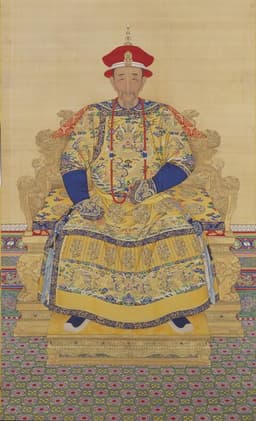
Kangxi Emperor
Emperor · Modern
73.4Total

Napoleon Bonaparte
General · Modern
70.9Total
Basic Information
Born
1654
1769
Died
1722
1821
Era
Modern
Modern
Nationality
China
France
Occupation
Emperor
General
Civilization
Eastern
Western
Score Comparison
Military (10%)
85.0
94.0
Political (20%)
78.0
72.0
Influence (20%)
69.8
40.0
Legacy (20%)
65.0
80.0
Leadership (15%)
81.3
78.0
Strategy (15%)
72.7
90.0
TOTAL
73.4
70.9
Kangxi Emperor — Complete Timeline
1673 AD
Suppression of the Revolt of the Three FeudatoriesWar
The Kangxi Emperor faced a major rebellion led by three powerful Han Chinese feudatories in southern China, including Wu Sangui. He personally directed military campaigns, and by 1681 the revolt was crushed, consolidating Qing control over the south.
RebellionFeudatoriesQing Dynasty
Impact: national
1683 AD
Conquest of TaiwanWar◆ Major
Kangxi ordered the invasion of Taiwan, then held by the Ming loyalist Zheng Keshuang. Qing naval forces defeated the Zheng fleet, and Taiwan was incorporated into the Qing Empire as a prefecture, ending the last major Ming resistance.
TaiwanConquestMing Loyalists
Impact: regional
1689 AD
Treaty of NerchinskPolitical Action◆ Major
The Kangxi Emperor negotiated the Treaty of Nerchinsk with the Russian Empire, establishing the border between Siberia and Manchuria. This was China's first treaty with a European power and secured the northern frontier, allowing trade and diplomatic relations.
TreatyRussiaBorder
Impact: globalconstructive
1691 AD
Incorporation of Outer MongoliaPolitical Action◆ Major
Kangxi personally met with Khalkha Mongol leaders at Dolon Nor, where they formally submitted to Qing authority. This brought Outer Mongolia under Qing control, ending the Dzungar threat and expanding the empire's northern borders.
MongoliaExpansionQing
Impact: regionalconstructive
1716 AD
Compilation of the Kangxi DictionaryCultural◆ Major
Kangxi commissioned the Kangxi Dictionary, a comprehensive dictionary of Chinese characters. It became the standard reference for Chinese lexicography, containing over 47,000 characters and influencing scholarship for centuries.
DictionaryLanguageScholarship
Impact: globalconstructive
Napoleon Bonaparte — Complete Timeline
1799 AD
Coup of 18 BrumaireOther◆ Major
Napoleon Bonaparte, with support from his brother Lucien and key political figures, overthrew the Directory in a bloodless coup. He established the Consulate with himself as First Consul, effectively becoming the ruler of France. This event ended the French Revolution's most unstable period.
French RevolutionCoupRise to Power
Impact: regional
1804 AD
Promulgation of the Napoleonic CodeOther◆ Major
Napoleon enacted the Civil Code of the French, known as the Napoleonic Code, a comprehensive set of laws that replaced the fragmented feudal legal systems. The code established legal equality, protected property rights, and secularized law. It became the basis for legal systems in many European and world countries.
Legal ReformNapoleonic CodeCivil Law
Impact: globalconstructive
1805 AD
Battle of AusterlitzWar◆ Major
Napoleon's Grande Arm
Napoleonic WarsBattleDecisive Victory
Impact: global
1812 AD
Invasion of RussiaWar◆ Major
Napoleon led the Grande Arm
Napoleonic WarsInvasionDisaster
Impact: globaldestructive
1815 AD
Battle of WaterlooWar◆ Major
Napoleon's French army was defeated by the combined forces of the Duke of Wellington's Anglo-Allied army and Gebhard Leberecht von Bl
Napoleonic WarsBattleFinal Defeat
Impact: globaldestructive
Expert Analysis
kangxi-emperor-vs-napoleon-bonaparte
The Emperor and the General
In the winter of 1812, as Napoleon Bonaparte’s Grand Army staggered through the snows of Russia, its commander might have envied a man who had died ninety years earlier, half a world away. That man, the Kangxi Emperor, had faced his own existential crisis in 1673, when three Han Chinese feudatories rose against his fledgling Qing dynasty. Yet where Napoleon’s ambition would consume him, Kangxi’s patience would forge an empire that endured for two centuries. Both men dominated their eras, but their paths diverged like the Yangtze and the Seine—one flowing steadily toward consolidation, the other surging in brilliant floods before vanishing into the sea.
Origins
Kangxi was born Xuanye in 1654, the third son of the Shunzhi Emperor, into a Manchu dynasty that had conquered China only a decade earlier. He ascended the throne at age seven, a child ruler in a court riven by regency politics. His world was one of precarious legitimacy: a foreign elite ruling over a vast Han Chinese population, with memories of Ming loyalism still burning. Napoleon, born in 1769 on the island of Corsica, entered a Europe convulsed by revolution. His family were minor nobles of Italian origin, and he grew up speaking Corsican dialect, not French. Where Kangxi inherited a throne, Napoleon had to seize his destiny from nothing. The Emperor’s challenge was to preserve a fragile order; the General’s was to forge one from chaos.
Rise to Power
Kangxi’s rise was a slow, deliberate ascent. At thirteen, he outmaneuvered the regent Oboi, a powerful Manchu noble, and assumed personal rule. His first great test came in 1673, when the Three Feudatories—semi-autonomous Han warlords in southern China—revolted. For eight years, the young emperor fought a grinding war, refusing to compromise even when the rebellion threatened to split his realm. By 1681, he had crushed them, securing Qing dominance. Napoleon’s ascent was meteoric. In 1795, at twenty-six, he dispersed a royalist mob in Paris with a “whiff of grapeshot.” By 1799, he had seized power in a coup, becoming First Consul of France. Kangxi waited for his moment; Napoleon created his.
Leadership & Governance
As rulers, they embodied opposite philosophies. Kangxi governed through Confucian restraint: he toured the provinces, listened to peasant complaints, and reduced taxes. His military campaigns were precise and strategic—the conquest of Taiwan in 1683, the Treaty of Nerchinsk with Russia in 1689, and the incorporation of Outer Mongolia in 1691. Each move expanded the empire while stabilizing its borders. Napoleon governed through Napoleonic dynamism: he centralized the state, codified laws in the Napoleonic Code, and spread revolutionary ideals across Europe. Yet his military genius—scoring 94.0, the highest in this comparison—was inseparable from his hubris. He won brilliant victories at Austerlitz and Jena, but each triumph demanded another, until the continent could not hold him.
Triumph & Tragedy
Kangxi’s greatest moment was perhaps his quietest: the compilation of the Kangxi Dictionary in 1716, a project that standardized Chinese characters and became the definitive reference for generations. His tragedy was the succession crisis that followed his death, as his sons fought for the throne. Napoleon’s triumph was his coronation as Emperor in 1804, crowned by his own hands. His tragedy was Waterloo in 1815, where his gamble failed, leading to exile and death on Saint Helena. Kangxi’s failures were contained within his reign; Napoleon’s consumed his life.
Character & Destiny
Kangxi’s personality was one of discipline and curiosity. He studied Confucian classics, learned mathematics from Jesuit missionaries, and personally led military campaigns. He was a man who believed in order—not just imposing it, but understanding it. Napoleon’s character was fire and ice: brilliant, restless, and ultimately self-destructive. “Impossible,” he once said, “is a word to be found only in the dictionary of fools.” That confidence drove him to conquer Europe, but also to invade Russia in 1812, a decision that destroyed his army. Kangxi’s caution preserved his empire; Napoleon’s ambition ended his.
Legacy
Kangxi left behind a stable, expanded China that would endure for nearly two centuries under the Qing dynasty. His legacy is a dictionary, a treaty, and a model of enlightened absolutism. Napoleon left behind a transformed Europe: the Napoleonic Code, the metric system, and the idea of meritocracy. His influence scored 82.0, higher than Kangxi’s 78.8, because his ideas outlived his empire. Yet Kangxi’s total score of 75.9 versus Napoleon’s 82.4 reflects a deeper truth: the Emperor built for permanence; the General built for glory.
Conclusion
Standing on opposite sides of the world, these two men faced the same question: how to rule a vast, diverse empire. Kangxi answered by bending the world to his patience; Napoleon, by bending it to his will. One preserved a civilization; the other reshaped a continent. In the end, the Emperor’s name is synonymous with stability, the General’s with brilliance and ruin. Their stories remind us that power is not merely about conquest, but about what endures after the last cannon falls silent.
Rankings
🥇
Kangxi EmperorLeader
Mil: 85.0Pol: 78.0Inf: 69.8
73.4
🥈
Napoleon Bonaparte
Mil: 94.0Pol: 72.0Inf: 40.0
70.9
+2.5 behind
How This Comparison Works
Algorithm
Each figure is scored on 6 dimensions (0—100 scale) based on structured historical data: Military (10%), Political (20%), Influence (20%), Legacy (20%), Leadership (15%), Strategy (15%). The weighted total produces the final ranking.
Data Sources
Scores are computed from structured sub-indicators in the database. Scale factors adjust for era (Ancient ×0.85, Modern ×1.0) and civilization size (Eastern ×1.05, Other ×0.80) to account for differences in population and military scale.
Maximum 3 Figures
Comparisons are limited to 2—3 figures to ensure readability and statistical meaningfulness.
Error Margins
±5 points per dimension — Sub-scores are derived from historical records with inherent uncertainty. Two figures within 5 points on a dimension should be considered roughly equivalent in that area.
Total Score Accuracy
±3 points overall — The weighted combination of 6 dimensions produces a total score with approximately ±3 points of uncertainty. Differences of less than 3 points are not statistically significant— the figures are effectively tied.
Known Limitations
- Historical records are incomplete and uneven across civilizations
- Figures from oral-tradition societies may be underrepresented
- Occupation labels can misclassify multi-role figures
- Scores measure capability and impact, not moral character
- Quantitative scoring is a comparison tool, not absolute truth
Capability Radar
Military (10%) — Battles & Warfare
Battles
85
95
Win Rate
88
90
Expansion
92
95
Political (20%) — Governance & Reform
Reform
88
95
Diplomacy
90
80
Economy
85
85
Influence (20%) — Cultural & Global Reach
Cultural
88
85
Global
80
90
Legacy (20%) — Historical Impact
Historical
90
95
Longevity
85
90
Leadership (15%) — Power & Stability
Tenure
95
85
Stability
92
70
Strategy (15%) — Tactics & Innovation
Strategy
90
95
Tactics
82
98
Reform
85
92
Similar Comparisons
Comments & Discussion
No comments yet. Be the first to share your thoughts!