Loading...
Karl Renner vs Nikita Khrushchev
Nikita Khrushchev leads by 9.3 pts · 2 figures compared
…

Karl Renner
Politician · Modern
55.3Total
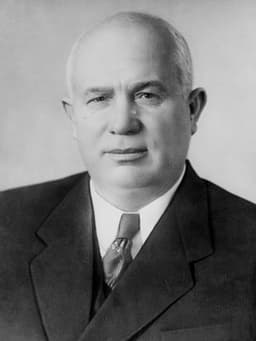
Nikita Khrushchev
Politician · Modern
64.6Total
Basic Information
Born
1870
1894
Died
1950
1971
Era
Modern
Modern
Nationality
Austria
Russia
Occupation
Politician
Politician
Civilization
Western
Western
Score Comparison
Military (10%)
13.4
43.3
Political (20%)
78.0
70.0
Influence (20%)
60.0
82.0
Legacy (20%)
52.0
52.0
Leadership (15%)
78.0
72.0
Strategy (15%)
25.2
54.8
TOTAL
55.3
64.6
Karl Renner — Complete Timeline
1918 AD
Election as first Chancellor of the Republic of German-AustriaPolitical Action◆ Major
On October 30, 1918, Renner was elected as the first chancellor of the newly proclaimed Republic of German-Austria. He led the provisional government that succeeded the Habsburg monarchy after World War I, overseeing the transition from empire to republic.
RepublicFoundingPost-WWI
Impact: nationalconstructive
1919 AD
Signing of the Treaty of Saint-Germain-en-LayePolitical Action
As chancellor, Renner signed the Treaty of Saint-Germain-en-Laye on September 10, 1919. The treaty formally ended World War I for Austria, forced the dissolution of the union with Germany, and imposed territorial losses and reparations on the new republic.
TreatyPeaceTerritorial Loss
Impact: nationaltragic
1945 AD
Election as first President of the Second Austrian RepublicPolitical Action
On April 29, 1945, Renner was elected as the first president of the re-established Republic of Austria after World War II. He formed a provisional government with Soviet approval, laying the foundation for Austria's post-war independence and democratic reconstruction.
Post-WWIIRepublicReconstruction
Impact: nationalconstructive
Nikita Khrushchev — Complete Timeline
1956 AD
Secret Speech on the Cult of PersonalityPolitical Action
Khrushchev delivered a closed-session speech to the 20th Congress of the Communist Party, denouncing Stalin's cult of personality and crimes. This speech initiated de-Stalinization, leading to political reforms and the release of political prisoners.
De-StalinizationSpeechCommunist Party
Impact: globalconstructive
1957 AD
Launch of Sputnik 1Invention◆ Major
Under Khrushchev's leadership, the Soviet Union launched Sputnik 1, the first artificial satellite to orbit Earth. This achievement sparked the Space Race and demonstrated Soviet technological superiority at the time.
Space RaceSatelliteTechnology
Impact: globalconstructive
1958 AD
Berlin UltimatumPolitical Action◆ Major
Khrushchev issued an ultimatum demanding the withdrawal of Western forces from West Berlin within six months. The ultimatum escalated Cold War tensions but was eventually dropped after negotiations, leading to the Berlin Crisis of 1961.
Cold WarBerlinUltimatum
Impact: global
1962 AD
Cuban Missile CrisisWar
Khrushchev authorized the placement of Soviet nuclear missiles in Cuba, leading to a 13-day confrontation with the United States. The crisis ended with a negotiated withdrawal of missiles from both Cuba and Turkey, averting nuclear war.
Cold WarNuclear CrisisCuba
Impact: global
1964 AD
Ouster from PowerPolitical Action◆ Major
Khrushchev was removed from his positions as First Secretary and Premier by the Communist Party leadership, led by Leonid Brezhnev. The ouster was due to his erratic policies, the Cuban Missile Crisis fallout, and agricultural failures.
CoupBrezhnevSoviet Union
Impact: nationaltragic
Expert Analysis
Origins
Karl Renner was born on December 14, 1870, in Untertannowitz, Moravia, then part of the Austrian Empire, into a peasant family. He studied law at the University of Vienna and became a librarian and a leading figure in the Social Democratic Workers' Party. His early writings on the nationality question in Austria-Hungary established him as a political theorist. Renner's background was rooted in the multicultural Habsburg Empire, shaping his views on federalism and national autonomy.
Nikita Khrushchev was born on April 15, 1894, in Kalinovka, Russia, into a poor peasant family. He had minimal formal education and worked as a metal fitter. He joined the Bolsheviks in 1918 and fought in the Russian Civil War. Khrushchev rose through the party ranks under Stalin, becoming a protégé of Lazar Kaganovich. His early career involved organizing party structures in Ukraine and Moscow, where he demonstrated loyalty and ruthlessness.
Rise to Power
Renner's rise came during the collapse of the Austro-Hungarian Empire. On October 30, 1918, he was elected first chancellor of the Republic of German-Austria, leading a provisional government. He represented Austria at the Paris Peace Conference and signed the Treaty of Saint-Germain-en-Laye in 1919, which formalized Austria's separation from Hungary and imposed war reparations. Despite the treaty's harsh terms, Renner's role cemented his status as a key statesman. He served as chancellor again in 1931, but his influence waned during the Austrofascist period and Nazi annexation. After World War II, on April 29, 1945, Renner was elected first president of the Second Austrian Republic at age 74, with Soviet support, making him the only figure to lead Austria after both world wars.
Khrushchev's ascent was more gradual and combative. He became First Secretary of the Communist Party of Ukraine in 1938, overseeing purges and industrialization. During World War II, he served as a political commissar. After Stalin's death in 1953, Khrushchev outmaneuvered rivals like Lavrentiy Beria and Georgy Malenkov to become First Secretary of the CPSU by September 1953. His turning point was the Secret Speech on February 25, 1956, at the 20th Party Congress, denouncing Stalin's cult of personality and crimes. This speech, while shocking, consolidated his power and initiated de-Stalinization.
Leadership & Governance
Renner's leadership style was pragmatic and conciliatory. As president (1945-1950), he focused on rebuilding Austria as a neutral, democratic state. He prioritized national unity, forming a grand coalition between the People's Party and Socialists. Renner's governance emphasized consensus and gradual reform, avoiding radical changes. His political score of 78.0 reflects his ability to navigate between Allied powers and domestic factions.
Khrushchev's governance was bold and erratic. He pursued de-Stalinization, releasing political prisoners and relaxing censorship, but within communist bounds. His economic policies included the Virgin Lands Campaign (1954) to boost agriculture, which initially succeeded but later faltered due to soil erosion. In foreign policy, he took risks: the Berlin Ultimatum (1958) demanding Western withdrawal from West Berlin, and the Cuban Missile Crisis (1962), where he authorized missile placement in Cuba. His leadership score of 72.0 and strategy score of 54.8 indicate a mix of innovation and miscalculation.
Triumph & Tragedy
Renner's greatest triumph was overseeing Austria's rebirth as a sovereign republic after World War II, with the State Treaty of 1955 (signed after his death) establishing permanent neutrality. His greatest tragedy was signing the Treaty of Saint-Germain, which many Austrians saw as a national humiliation, and his inability to prevent the Anschluss in 1938. He was also criticized for his early support of the Anschluss as a union with Germany, though he later opposed Nazi rule.
Khrushchev's triumphs include the launch of Sputnik 1 in 1957, signaling Soviet technological prowess, and his role in the peaceful resolution of the Cuban Missile Crisis, which averted nuclear war. His tragedies include the failure of the Berlin Ultimatum, which embarrassed the USSR, and his ouster in 1964 due to policy failures and alienating party elites. The Virgin Lands Campaign caused environmental damage and food shortages.
Character & Destiny
Renner was a methodical, scholarly figure, described as a "legalist" who believed in gradual change through institutions. His character suited Austria's need for stability after war, but also led to accusations of opportunism, especially regarding the Anschluss. His destiny was to be a founding father twice, yet his legacy is often overshadowed by more charismatic leaders.
Khrushchev was impulsive, energetic, and prone to grand gestures. His Secret Speech showed courage but also recklessness, as it destabilized communist regimes in Eastern Europe (e.g., Hungarian Revolution of 1956). His character led to bold initiatives like Sputnik, but also to crises like the Cuban Missile showdown. His ouster reflected his inability to maintain party consensus.
Legacy
Renner's legacy is most visible in Austria's political system: stable democracy, neutrality, and social partnership. He is remembered as the "Father of the Republic" and his political score of 78.0 reflects his foundational role. However, his influence is largely confined to Austria.
Khrushchev's legacy is global. He initiated de-Stalinization, which reshaped the Soviet Union and its satellites. His space achievements spurred the Space Race. However, his legacy is mixed: he is credited with thawing the Cold War but also with near-catastrophic risks. His influence score of 82.0 underscores his global impact, while his legacy score of 52.0 reflects the incomplete nature of his reforms.
Conclusion
While both men were pivotal in their nations' histories, Nikita Khrushchev had a greater overall impact. His total score of 64.6 surpasses Renner's 55.3, driven by higher influence and military scores (82.0 vs 60.0, and 43.3 vs 13.4). Khrushchev's actions—de-Stalinization, Sputnik, the Cuban Missile Crisis—altered the course of the Cold War and global politics. Renner, though crucial for Austria, operated on a smaller stage. Khrushchev's combination of political acumen and strategic gambles, despite failures, left a deeper mark on the 20th century.
Rankings
🥇
Nikita KhrushchevLeader
Mil: 43.3Pol: 70.0Inf: 82.0
64.6
🥈
Karl Renner
Mil: 13.4Pol: 78.0Inf: 60.0
55.3
+9.3 behind
How This Comparison Works
Algorithm
Each figure is scored on 6 dimensions (0—100 scale) based on structured historical data: Military (10%), Political (20%), Influence (20%), Legacy (20%), Leadership (15%), Strategy (15%). The weighted total produces the final ranking.
Data Sources
Scores are computed from structured sub-indicators in the database. Scale factors adjust for era (Ancient ×0.85, Modern ×1.0) and civilization size (Eastern ×1.05, Other ×0.80) to account for differences in population and military scale.
Maximum 3 Figures
Comparisons are limited to 2—3 figures to ensure readability and statistical meaningfulness.
Error Margins
±5 points per dimension — Sub-scores are derived from historical records with inherent uncertainty. Two figures within 5 points on a dimension should be considered roughly equivalent in that area.
Total Score Accuracy
±3 points overall — The weighted combination of 6 dimensions produces a total score with approximately ±3 points of uncertainty. Differences of less than 3 points are not statistically significant— the figures are effectively tied.
Known Limitations
- Historical records are incomplete and uneven across civilizations
- Figures from oral-tradition societies may be underrepresented
- Occupation labels can misclassify multi-role figures
- Scores measure capability and impact, not moral character
- Quantitative scoring is a comparison tool, not absolute truth
Capability Radar
Military (10%) — Battles & Warfare
Battles
13
5
Win Rate
11
10
Expansion
18
20
Political (20%) — Governance & Reform
Reform
65
80
Diplomacy
75
70
Economy
60
55
Influence (20%) — Cultural & Global Reach
Cultural
40
60
Global
50
70
Legacy (20%) — Historical Impact
Historical
60
75
Longevity
50
55
Leadership (15%) — Power & Stability
Tenure
70
75
Stability
55
50
Strategy (15%) — Tactics & Innovation
Strategy
18
15
Tactics
21
10
Reform
27
30
Similar Comparisons
Comments & Discussion
No comments yet. Be the first to share your thoughts!