Loading...
Nikita Khrushchev vs Nursultan Nazarbayev
Nikita Khrushchev leads by 7.4 pts · 2 figures compared
…
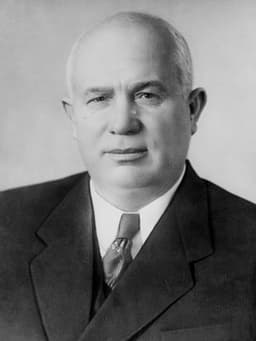
Nikita Khrushchev
Politician · Modern
64.6Total
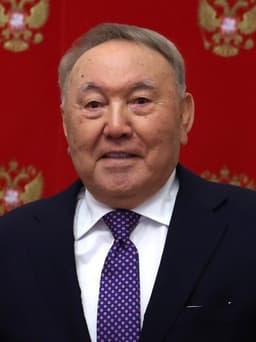
Nursultan Nazarbayev
Politician · Modern
57.2Total
Basic Information
Born
1894
1940
Died
1971
—
Era
Modern
Modern
Nationality
Russia
Kazakhstan
Occupation
Politician
Politician
Civilization
Western
Eastern
Score Comparison
Military (10%)
43.3
10.0
Political (20%)
70.0
78.0
Influence (20%)
82.0
62.0
Legacy (20%)
52.0
54.0
Leadership (15%)
72.0
78.0
Strategy (15%)
54.8
38.3
TOTAL
64.6
57.2
Nikita Khrushchev — Complete Timeline
1956 AD
Secret Speech on the Cult of PersonalityPolitical Action
Khrushchev delivered a closed-session speech to the 20th Congress of the Communist Party, denouncing Stalin's cult of personality and crimes. This speech initiated de-Stalinization, leading to political reforms and the release of political prisoners.
De-StalinizationSpeechCommunist Party
Impact: globalconstructive
1957 AD
Launch of Sputnik 1Invention◆ Major
Under Khrushchev's leadership, the Soviet Union launched Sputnik 1, the first artificial satellite to orbit Earth. This achievement sparked the Space Race and demonstrated Soviet technological superiority at the time.
Space RaceSatelliteTechnology
Impact: globalconstructive
1958 AD
Berlin UltimatumPolitical Action◆ Major
Khrushchev issued an ultimatum demanding the withdrawal of Western forces from West Berlin within six months. The ultimatum escalated Cold War tensions but was eventually dropped after negotiations, leading to the Berlin Crisis of 1961.
Cold WarBerlinUltimatum
Impact: global
1962 AD
Cuban Missile CrisisWar
Khrushchev authorized the placement of Soviet nuclear missiles in Cuba, leading to a 13-day confrontation with the United States. The crisis ended with a negotiated withdrawal of missiles from both Cuba and Turkey, averting nuclear war.
Cold WarNuclear CrisisCuba
Impact: global
1964 AD
Ouster from PowerPolitical Action◆ Major
Khrushchev was removed from his positions as First Secretary and Premier by the Communist Party leadership, led by Leonid Brezhnev. The ouster was due to his erratic policies, the Cuban Missile Crisis fallout, and agricultural failures.
CoupBrezhnevSoviet Union
Impact: nationaltragic
Nursultan Nazarbayev — Complete Timeline
1991 AD
Became First President of KazakhstanPolitical Action◆ Major
Nursultan Nazarbayev was elected as the first president of independent Kazakhstan following the dissolution of the Soviet Union. He had previously served as the head of the Kazakh Soviet Socialist Republic. His presidency focused on nation-building, economic reform, and maintaining stability.
IndependenceNation-BuildingPost-Soviet Transition
Impact: nationalconstructive
1993 AD
Introduced Market ReformsReform◆ Major
Nazarbayev implemented a series of market-oriented economic reforms, including privatization of state enterprises and price liberalization. These reforms attracted foreign investment, particularly in the oil and gas sector, and helped stabilize the economy after the Soviet collapse.
Economic ReformPrivatizationForeign Investment
Impact: nationalconstructive
1997 AD
Moved Capital to AstanaPolitical Action◆ Major
Nazarbayev ordered the relocation of the capital from Almaty to the northern city of Akmola, renamed Astana (now Nur-Sultan). The move was intended to develop the underpopulated north and assert sovereignty over the region. The new capital was built with ambitious architecture and foreign investment.
Capital RelocationUrban DevelopmentNational Identity
Impact: nationalconstructive
2019 AD
Resigned as PresidentPolitical Action◆ Major
Nazarbayev unexpectedly resigned as President of Kazakhstan after nearly 30 years in power. He was succeeded by Kassym-Jomart Tokayev, a loyalist. Nazarbayev retained significant influence as head of the Security Council and as 'Elbasy' (Leader of the Nation), a title granted by parliament.
ResignationPower TransitionPolitical Legacy
Impact: national
2022 AD
Suppressed January 2022 ProtestsPolitical Action◆ Major
Following a violent uprising in January 2022, Nazarbayev was removed from his position as head of the Security Council. The protests, initially over fuel prices, turned into a broader challenge to the regime. Tokayev ordered a crackdown with CSTO support, and Nazarbayev's influence waned.
Protest SuppressionPower StruggleCSTO Intervention
Impact: nationaldestructive
Expert Analysis
Origins
Nikita Khrushchev was born in 1894 in Kalinovka, Russia, into a peasant family. He received minimal formal education, working as a metal fitter in his youth. Joining the Bolsheviks in 1918, he fought in the Russian Civil War. His rise within the Communist Party was aided by patronage from Lazar Kaganovich, and by the 1930s he had become First Secretary of the Moscow City Committee. Khrushchev's humble origins and lack of elite education shaped his earthy, impulsive style.
Nursultan Nazarbayev was born in 1940 in Chemolgan, Kazakh SSR, to a rural family. He studied at the Karaganda Polytechnic Institute, earning a degree in metallurgy. Starting as a steelworker, he joined the Communist Party and rose through the ranks of the Kazakh SSR's government. By 1984, he became Chairman of the Council of Ministers of the Kazakh SSR. His background as a technocrat and party insider gave him a pragmatic, cautious approach.
Rise to Power
Khrushchev's ascent to the top of Soviet power began after Stalin's death in 1953. He outmaneuvered rivals like Lavrentiy Beria and Georgy Malenkov, becoming First Secretary in 1953. His crucial turning point was the 1956 Secret Speech, where he denounced Stalin's cult of personality, weakening his opponents. By 1958, he consolidated power by also becoming Premier, holding both party and state leadership.
Nazarbayev became the leader of the Kazakh SSR in 1989, during the Soviet Union's decline. When the USSR dissolved in 1991, he was elected as the first president of independent Kazakhstan. He skillfully navigated the transition, avoiding the ethnic violence seen in other republics. His rise was marked by a gradual accumulation of power, culminating in a 1995 referendum that extended his term until 2000, effectively making him president for life.
Leadership & Governance
Khrushchev's leadership was characterized by bold, often erratic initiatives. He pursued de-Stalinization, releasing political prisoners and easing censorship. Economically, he attempted reforms like the Virgin Lands campaign (1954-1960) to boost agriculture, but this led to environmental degradation and mixed results. His governance style was confrontational, famously banging his shoe at the UN in 1960. He scored 72.0 in leadership and 54.8 in strategy, reflecting his impulsiveness.
Nazarbayev's governance was authoritarian but stable. He introduced market reforms in the 1990s, privatizing state assets and attracting foreign investment, which boosted Kazakhstan's economy. He moved the capital from Almaty to Astana (now Nur-Sultan) in 1997, a strategic decision to develop the north. His political score of 78.0 reflects his ability to maintain power, but his strategy score of 38.3 indicates a lack of long-term planning, as seen in the 2022 protests.
Triumph & Tragedy
Khrushchev's greatest triumph was the launch of Sputnik 1 in 1957, which shocked the West and initiated the space age. His handling of the Cuban Missile Crisis in 1962, though perilous, ended with a negotiated withdrawal of missiles, averting nuclear war. However, his failures include the Berlin Ultimatum of 1958, which backfired, and the economic stagnation caused by his agricultural policies. His ouster in 1964 was a direct result of his unpopularity among the party elite.
Nazarbayev's triumphs include overseeing Kazakhstan's peaceful transition to independence and its economic growth, with GDP per capita rising from $1,500 in 1994 to over $9,000 by 2019. He also renounced nuclear weapons, closing the Semipalatinsk test site. His tragedies include the suppression of the January 2022 protests, which led to at least 238 deaths, and the concentration of wealth and power in his family, fostering corruption. His legacy score of 54.0 is middling, reflecting both achievements and authoritarian excesses.
Character & Destiny
Khrushchev was impulsive, emotional, and prone to grand gestures, which both helped and hindered him. His secret speech showed courage, but his bluster often alienated allies. His downfall came because his reforms threatened the party elite, and his unpredictability made him appear reckless. Historian William Taubman notes that Khrushchev was a 'paradoxical figure' – a reformer who remained a communist hardliner.
Nazarbayev was calculating, patient, and authoritarian. He cultivated a cult of personality, with streets and cities named after him. He avoided direct confrontation, preferring to co-opt or sideline opponents. His destiny was to rule for nearly three decades until resigning in 2019, but his legacy was tarnished by the violent crackdown on protests that followed. His character ensured stability but at the cost of political freedom.
Legacy
Khrushchev's legacy is mixed: he is remembered for de-Stalinization and the Cuban Missile Crisis, but his economic failures and ouster overshadow his achievements. His influence score of 82.0 reflects his role in shaping Cold War dynamics. The Soviet Union's collapse later diminished his legacy, but he remains a key figure in 20th-century history.
Nazarbayev's legacy is that of a nation-builder who transformed Kazakhstan into a regional economic power. However, his authoritarian rule and the 2022 protests have led to a reassessment. His influence score of 62.0 is lower than Khrushchev's, as his impact was largely confined to one country. The renaming of Astana back to its original name in 2022 symbolizes the partial erasure of his legacy.
Conclusion
While both leaders shaped their nations, Khrushchev had a greater global impact. His actions during the Cuban Missile Crisis directly affected the entire world, and his de-Stalinization campaign altered the course of the Soviet Union. Nazarbayev's achievements were significant but regional. With a total score of 64.6 against 57.2, Khrushchev's influence and strategic importance outweigh Nazarbayev's political longevity and economic reforms. Khrushchev, for all his flaws, changed the world; Nazarbayev changed a country.
Rankings
🥇
Nikita KhrushchevLeader
Mil: 43.3Pol: 70.0Inf: 82.0
64.6
🥈
Nursultan Nazarbayev
Mil: 10.0Pol: 78.0Inf: 62.0
57.2
+7.4 behind
How This Comparison Works
Algorithm
Each figure is scored on 6 dimensions (0—100 scale) based on structured historical data: Military (10%), Political (20%), Influence (20%), Legacy (20%), Leadership (15%), Strategy (15%). The weighted total produces the final ranking.
Data Sources
Scores are computed from structured sub-indicators in the database. Scale factors adjust for era (Ancient ×0.85, Modern ×1.0) and civilization size (Eastern ×1.05, Other ×0.80) to account for differences in population and military scale.
Maximum 3 Figures
Comparisons are limited to 2—3 figures to ensure readability and statistical meaningfulness.
Error Margins
±5 points per dimension — Sub-scores are derived from historical records with inherent uncertainty. Two figures within 5 points on a dimension should be considered roughly equivalent in that area.
Total Score Accuracy
±3 points overall — The weighted combination of 6 dimensions produces a total score with approximately ±3 points of uncertainty. Differences of less than 3 points are not statistically significant— the figures are effectively tied.
Known Limitations
- Historical records are incomplete and uneven across civilizations
- Figures from oral-tradition societies may be underrepresented
- Occupation labels can misclassify multi-role figures
- Scores measure capability and impact, not moral character
- Quantitative scoring is a comparison tool, not absolute truth
Capability Radar
Military (10%) — Battles & Warfare
Battles
5
0
Win Rate
10
0
Expansion
20
0
Political (20%) — Governance & Reform
Reform
80
75
Diplomacy
70
80
Economy
55
75
Influence (20%) — Cultural & Global Reach
Cultural
60
50
Global
70
60
Legacy (20%) — Historical Impact
Historical
75
60
Longevity
55
55
Leadership (15%) — Power & Stability
Tenure
75
90
Stability
50
70
Strategy (15%) — Tactics & Innovation
Strategy
15
0
Tactics
10
0
Reform
30
10
Similar Comparisons
Comments & Discussion
No comments yet. Be the first to share your thoughts!