Loading...
This comparison has not been analyzed yet.
One-time AI generation (~1 minute). Scores and timeline are already available below.
Kenneth MacAlpin vs King Jeongjong of Joseon
Kenneth MacAlpin leads by 13.4 pts · 2 figures compared
…
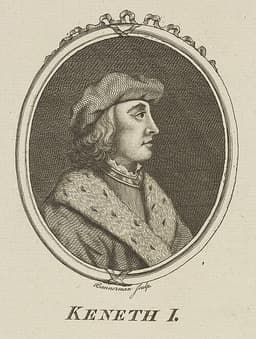
Kenneth MacAlpin
Emperor · Medieval
49.8Total
King Jeongjong of Joseon
Emperor · Medieval
36.4Total
Basic Information
Born
810
1357
Died
858
1419
Era
Medieval
Medieval
Nationality
Scotland
Korea
Occupation
Emperor
Emperor
Civilization
Western
Eastern
Score Comparison
Military (10%)
35.0
20.0
Political (20%)
42.3
26.4
Influence (20%)
54.9
46.3
Legacy (20%)
50.0
37.5
Leadership (15%)
65.7
33.6
Strategy (15%)
38.6
45.0
TOTAL
49.8
36.4
Kenneth MacAlpin — Complete Timeline
839 AD
Battle of FortriuWar◆ Major
Kenneth MacAlpin's predecessor, E
VikingsPictsSuccession
Impact: regional
843 AD
Unification of Picts and ScotsPolitical Action
Kenneth MacAlpin became king of both the Picts and the Scots, traditionally dated to 843. He united the two peoples under his rule, creating the Kingdom of Alba. This unification is considered the foundation of the medieval Scottish kingdom.
UnificationScotlandAlba
Impact: regionalconstructive
849 AD
Transfer of Relics to DunkeldCultural◆ Major
Kenneth MacAlpin transferred the relics of Saint Columba from Iona to Dunkeld for safekeeping from Viking raids. This act established Dunkeld as a major religious center and reinforced the link between the Scottish monarchy and the Columban church.
ReligionRelicsDunkeld
Impact: regionalconstructive
850 AD
Invasion of NorthumbriaWar
Kenneth MacAlpin led a raid into Northumbria, burning the monastery at Lindisfarne and attacking the region. This was part of a pattern of Scottish expansion southward, though the raid did not result in permanent territorial gains.
NorthumbriaRaidExpansion
Impact: regionaldestructive
King Jeongjong of Joseon — Complete Timeline
1398 AD
Participated in Prince's RebellionWar◆ Major
King Jeongjong (then Prince Yi Bang-gwa) supported his father Yi Seong-gye in suppressing the First Prince's Rebellion, a conflict among Yi's sons over succession. The rebellion resulted in the deaths of several princes and weakened the early Joseon court.
RebellionSuccession ConflictJoseon
Impact: nationaldestructive
Ascended Throne as Second Joseon KingPolitical Action◆ Major
King Jeongjong became the second king of Joseon after his father Yi Seong-gye abdicated following the First Prince's Rebellion. His reign was marked by instability and ongoing power struggles among the royal princes.
SuccessionJoseon DynastyAbdication
Impact: national
1399 AD
Moved Capital to GaegyeongPolitical Action
King Jeongjong moved the Joseon capital from Hanyang (Seoul) back to Gaegyeong (Kaesong), the former Goryeo capital, in an attempt to reduce factional tensions. This move was unpopular and was reversed by his successor.
Capital MovePolitical StrategyJoseon
Impact: national
1400 AD
Abdicated in Favor of Yi Bang-wonPolitical Action◆ Major
King Jeongjong abdicated after only two years on the throne, following the Second Prince's Rebellion. He ceded power to his younger brother Yi Bang-won (later King Taejong), who had emerged victorious in the succession struggle.
AbdicationSuccessionPower Struggle
Impact: national
This comparison has not been analyzed yet.
One-time AI generation (~1 minute). Scores and timeline are already available below.
Rankings
🥇
Kenneth MacAlpinLeader
Mil: 35.0Pol: 42.3Inf: 54.9
49.8
🥈
King Jeongjong of Joseon
Mil: 20.0Pol: 26.4Inf: 46.3
36.4
+13.4 behind
How This Comparison Works
Algorithm
Each figure is scored on 6 dimensions (0—100 scale) based on structured historical data: Military (10%), Political (20%), Influence (20%), Legacy (20%), Leadership (15%), Strategy (15%). The weighted total produces the final ranking.
Data Sources
Scores are computed from structured sub-indicators in the database. Scale factors adjust for era (Ancient ×0.85, Modern ×1.0) and civilization size (Eastern ×1.05, Other ×0.80) to account for differences in population and military scale.
Maximum 3 Figures
Comparisons are limited to 2—3 figures to ensure readability and statistical meaningfulness.
Error Margins
±5 points per dimension — Sub-scores are derived from historical records with inherent uncertainty. Two figures within 5 points on a dimension should be considered roughly equivalent in that area.
Total Score Accuracy
±3 points overall — The weighted combination of 6 dimensions produces a total score with approximately ±3 points of uncertainty. Differences of less than 3 points are not statistically significant— the figures are effectively tied.
Known Limitations
- Historical records are incomplete and uneven across civilizations
- Figures from oral-tradition societies may be underrepresented
- Occupation labels can misclassify multi-role figures
- Scores measure capability and impact, not moral character
- Quantitative scoring is a comparison tool, not absolute truth
Capability Radar
Military (10%) — Battles & Warfare
Battles
20
5
Win Rate
25
5
Expansion
35
5
Political (20%) — Governance & Reform
Reform
40
15
Diplomacy
45
20
Economy
30
15
Influence (20%) — Cultural & Global Reach
Cultural
40
10
Global
30
5
Legacy (20%) — Historical Impact
Historical
55
15
Longevity
50
10
Leadership (15%) — Power & Stability
Tenure
50
20
Stability
35
10
Strategy (15%) — Tactics & Innovation
Strategy
25
5
Tactics
20
5
Reform
15
5
Similar Comparisons
Comments & Discussion
No comments yet. Be the first to share your thoughts!