Loading...
Kenneth MacAlpin vs Napoleon Bonaparte
Napoleon Bonaparte leads by 21.1 pts · 2 figures compared
…
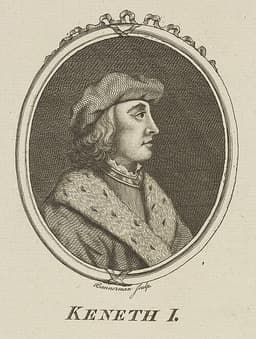
Kenneth MacAlpin
Emperor · Medieval
49.8Total

Napoleon Bonaparte
General · Modern
70.9Total
Basic Information
Born
810
1769
Died
858
1821
Era
Medieval
Modern
Nationality
Scotland
France
Occupation
Emperor
General
Civilization
Western
Western
Score Comparison
Military (10%)
35.0
94.0
Political (20%)
42.3
72.0
Influence (20%)
54.9
40.0
Legacy (20%)
50.0
80.0
Leadership (15%)
65.7
78.0
Strategy (15%)
38.6
90.0
TOTAL
49.8
70.9
Kenneth MacAlpin — Complete Timeline
839 AD
Battle of FortriuWar◆ Major
Kenneth MacAlpin's predecessor, E
VikingsPictsSuccession
Impact: regional
843 AD
Unification of Picts and ScotsPolitical Action
Kenneth MacAlpin became king of both the Picts and the Scots, traditionally dated to 843. He united the two peoples under his rule, creating the Kingdom of Alba. This unification is considered the foundation of the medieval Scottish kingdom.
UnificationScotlandAlba
Impact: regionalconstructive
849 AD
Transfer of Relics to DunkeldCultural◆ Major
Kenneth MacAlpin transferred the relics of Saint Columba from Iona to Dunkeld for safekeeping from Viking raids. This act established Dunkeld as a major religious center and reinforced the link between the Scottish monarchy and the Columban church.
ReligionRelicsDunkeld
Impact: regionalconstructive
850 AD
Invasion of NorthumbriaWar
Kenneth MacAlpin led a raid into Northumbria, burning the monastery at Lindisfarne and attacking the region. This was part of a pattern of Scottish expansion southward, though the raid did not result in permanent territorial gains.
NorthumbriaRaidExpansion
Impact: regionaldestructive
Napoleon Bonaparte — Complete Timeline
1799 AD
Coup of 18 BrumaireOther◆ Major
Napoleon Bonaparte, with support from his brother Lucien and key political figures, overthrew the Directory in a bloodless coup. He established the Consulate with himself as First Consul, effectively becoming the ruler of France. This event ended the French Revolution's most unstable period.
French RevolutionCoupRise to Power
Impact: regional
1804 AD
Promulgation of the Napoleonic CodeOther◆ Major
Napoleon enacted the Civil Code of the French, known as the Napoleonic Code, a comprehensive set of laws that replaced the fragmented feudal legal systems. The code established legal equality, protected property rights, and secularized law. It became the basis for legal systems in many European and world countries.
Legal ReformNapoleonic CodeCivil Law
Impact: globalconstructive
1805 AD
Battle of AusterlitzWar◆ Major
Napoleon's Grande Arm
Napoleonic WarsBattleDecisive Victory
Impact: global
1812 AD
Invasion of RussiaWar◆ Major
Napoleon led the Grande Arm
Napoleonic WarsInvasionDisaster
Impact: globaldestructive
1815 AD
Battle of WaterlooWar◆ Major
Napoleon's French army was defeated by the combined forces of the Duke of Wellington's Anglo-Allied army and Gebhard Leberecht von Bl
Napoleonic WarsBattleFinal Defeat
Impact: globaldestructive
Expert Analysis
kenneth-macalpin-vs-napoleon-bonaparte
# The Emperor and the King: Napoleon Bonaparte and Kenneth MacAlpin
On a June evening in 1815, a man in a grey overcoat watched his empire crumble near a small Belgian village called Waterloo. Two thousand miles and a thousand years away, another ruler had faced a different kind of crisis—not a single disastrous battle, but the slow erosion of a people’s identity under the shadow of Viking longships. Napoleon Bonaparte and Kenneth MacAlpin both forged nations, but one built an empire that collapsed in his lifetime, while the other created a kingdom that endures to this day. Why did one man’s ambition end in exile and the other’s in legacy? The answer lies not in their similarities, but in their profound differences.
Origins
Napoleon Bonaparte was born in 1769 on the island of Corsica, a place recently annexed by France. His family belonged to the minor nobility, but they were outsiders in a nation that looked down on Corsicans as provincial and rough. This shaped Napoleon’s driving hunger for acceptance and glory. He attended French military schools, where he was mocked for his accent and small stature, and emerged with a burning will to prove himself. The French Revolution had shattered the old order, and for a man of talent rather than birth, the path to power lay open.
Kenneth MacAlpin, born around 810, came from a very different world. He was a king’s son in a land of mist and stone—Dalriada, a Gaelic kingdom on the western coast of what is now Scotland. The 9th century was a brutal age of shifting alliances and constant Viking raids. Kenneth’s people, the Scots, were locked in a struggle for survival against Norse invaders and their Pictish neighbors to the east. Where Napoleon’s world was one of revolutionary upheaval and grand ideas, Kenneth’s was one of tribal loyalty, sacred relics, and the cold edge of a sword.
Rise to Power
Napoleon’s ascent was meteoric. At just 24, he captured the port of Toulon from British forces, and by 1796 he was commanding the French army in Italy. His victories were dazzling: he crossed the Alps, crushed Austrian armies, and returned to Paris a hero. In 1799, he seized power in a coup, becoming First Consul, and by 1804 he crowned himself Emperor. Every step was a gamble, a calculated risk that paid off because of his genius for war and his understanding of the public mood.
Kenneth MacAlpin’s rise was slower and more precarious. In 839, the Battle of Fortriu shattered the Pictish leadership when King Eóganán was killed fighting Vikings. This disaster created a power vacuum. Kenneth, already king of the Scots in Dalriada, saw his opportunity. By 843, tradition holds, he had become king of both the Picts and the Scots, uniting them under his rule. There was no grand coronation in a cathedral—only the quiet, ruthless work of diplomacy, marriage alliances, and the occasional raid. His power came not from conquest alone, but from being the right man at the right moment of crisis.
Leadership & Governance
Napoleon governed with a pen as sharp as his sword. He reformed French law with the Napoleonic Code, a system of clear, rational rules that replaced the tangled web of feudal privileges. He centralized the state, built roads and schools, and restored the Catholic Church’s role in France—all while keeping a tight grip on power. His military strategy was revolutionary: he used speed, surprise, and massed artillery to shatter his enemies. At Austerlitz in 1805, he destroyed a combined Russian and Austrian army, cementing his reputation as a master of war.
Kenneth MacAlpin ruled differently. His kingdom was not a centralized empire but a patchwork of clans and tribes. His power rested on personal loyalty and the sacred authority of the Church. In 849, he transferred the relics of Saint Columba from the vulnerable island of Iona to Dunkeld, deep inland. This was not just a practical move against Viking raiders—it was a political masterstroke. By protecting the saint’s bones, Kenneth claimed the spiritual heritage of all the Gaelic peoples, binding them to his kingship. He also raided Northumbria in 850, burning the monastery at Lindisfarne, a brutal act that reminded his neighbors that the new kingdom of Alba was not to be trifled with.
Triumph & Tragedy
Napoleon’s greatest triumph was also the seed of his tragedy. By 1812, he ruled an empire stretching from Spain to Poland. But he could not stop. He invaded Russia with 600,000 men, and the winter destroyed them. Only 100,000 returned. The disaster emboldened his enemies, and in 1814 Paris fell. He was exiled to Elba, escaped, and rallied France once more—only to meet final defeat at Waterloo in 1815. He died in 1821 on the remote island of Saint Helena, a prisoner.
Kenneth MacAlpin’s triumph was quieter but more lasting. He did not conquer a continent; he united two peoples into one. The Picts and Scots, once rivals, became the foundation of a kingdom that would grow into Scotland. His tragedy was that he could not see what he had built. He died in 858, probably in his bed, leaving a kingdom still fragile, still threatened by Vikings and internal strife. But the union held.
Character & Destiny
Napoleon was a man of boundless ambition and restless energy. He once said, “Impossible is a word to be found only in the dictionary of fools.” That belief drove him to conquer Europe, but it also blinded him to the limits of power. He could not stop, could not compromise, could not build a stable peace. His personality—proud, impatient, brilliant—shaped his destiny as surely as his armies.
Kenneth MacAlpin was more pragmatic. He understood that survival mattered more than glory. He did not seek to conquer the world; he sought to preserve his people. His decisions—moving relics, raiding cautiously, forming alliances—were those of a man who thought in generations, not in campaigns. He left no grand sayings, only a kingdom.
Legacy
Napoleon’s legacy is immense. The Napoleonic Code influenced legal systems across Europe and the world. His military tactics are still studied. But his empire vanished with him. He is remembered as a titan, but a tragic one—a man who rose higher than anyone and fell further.
Kenneth MacAlpin’s legacy is more subtle. He is not a household name, but Scotland exists because of him. The union he forged in 843 became the Kingdom of Alba, then Scotland, a nation that survived centuries of war and pressure from England. He is remembered as a founder, not a conqueror.
Conclusion
Napoleon and Kenneth MacAlpin both answered the call of their times, but they heard different questions. Napoleon’s age demanded a man who could ride the storm of revolution and reshape the world. He did—and the storm consumed him. Kenneth’s age demanded a man who could shelter a people from the storm. He did—and the people survived. One built a monument to himself that crumbled; the other built a nation that endures. In the end, perhaps the greatest legacy is not how high you climb, but how deep your roots grow.
Rankings
🥇
Napoleon BonaparteLeader
Mil: 94.0Pol: 72.0Inf: 40.0
70.9
🥈
Kenneth MacAlpin
Mil: 35.0Pol: 42.3Inf: 54.9
49.8
+21.1 behind
How This Comparison Works
Algorithm
Each figure is scored on 6 dimensions (0—100 scale) based on structured historical data: Military (10%), Political (20%), Influence (20%), Legacy (20%), Leadership (15%), Strategy (15%). The weighted total produces the final ranking.
Data Sources
Scores are computed from structured sub-indicators in the database. Scale factors adjust for era (Ancient ×0.85, Modern ×1.0) and civilization size (Eastern ×1.05, Other ×0.80) to account for differences in population and military scale.
Maximum 3 Figures
Comparisons are limited to 2—3 figures to ensure readability and statistical meaningfulness.
Error Margins
±5 points per dimension — Sub-scores are derived from historical records with inherent uncertainty. Two figures within 5 points on a dimension should be considered roughly equivalent in that area.
Total Score Accuracy
±3 points overall — The weighted combination of 6 dimensions produces a total score with approximately ±3 points of uncertainty. Differences of less than 3 points are not statistically significant— the figures are effectively tied.
Known Limitations
- Historical records are incomplete and uneven across civilizations
- Figures from oral-tradition societies may be underrepresented
- Occupation labels can misclassify multi-role figures
- Scores measure capability and impact, not moral character
- Quantitative scoring is a comparison tool, not absolute truth
Capability Radar
Military (10%) — Battles & Warfare
Battles
20
95
Win Rate
25
90
Expansion
35
95
Political (20%) — Governance & Reform
Reform
40
95
Diplomacy
45
80
Economy
30
85
Influence (20%) — Cultural & Global Reach
Cultural
40
85
Global
30
90
Legacy (20%) — Historical Impact
Historical
55
95
Longevity
50
90
Leadership (15%) — Power & Stability
Tenure
50
85
Stability
35
70
Strategy (15%) — Tactics & Innovation
Strategy
25
95
Tactics
20
98
Reform
15
92
Similar Comparisons
Comments & Discussion
FLAWED GOLIATH6/17/2026
Of course Napoleon was more dramatic — he had an actual empire to lose. But Kenneth MacAlpin’s victory was far harder. He didn’t conquer with big battalions; he fused two warring peoples — Gaels and Picts — through marriage, myth, and political genius. Napoleon united France by force of charisma and conquest. MacAlpin created Scotland by sheer persistence. Which legacy would you rather have: one that crumbled at Waterloo, or one that still votes on your future?|
时间线叛徒6/17/2026
把肯尼思和拿破仑放在一起比较,就像拿匕首和大炮比谁更适合造房子。拿破仑的历史意义建立在欧洲大陆的权力重构上,他修订法典、改革教育、重塑行政体系,这些成就至今影响法国。肯尼思做的是在黑暗时代艰难整合部落,这是两种完全不同的历史贡献。拿水量比火势,除了制造混乱还能得到什么?
DRIED INK ANALYST6/17/2026
Let’s be honest: we barely have contemporary sources for Kenneth MacAlpin. The ‘conquest’ of the Picts might be 12th-century propaganda, and his iconic status relies heavily on the Declaration of Arbroath’s mythmaking. Napoleon’s battles are documented down to the hour, his reforms and laws still cited in courts. Comparing the two isn’t history — it’s comparing a foggy legend to a photograph. Let’s not pretend ‘notability’ works the same way across 1,000 years.|
战术砖家6/17/2026
军事上根本不是一个量级。拿破仑指挥过六十多场会战,意大利战役、奥斯特里茨、耶拿,战术创新至今被军校研究。肯尼思·麦卡尔平留下的所谓军事成就不过是一些含糊的部落冲突记载。把一位改变欧洲战争艺术的大师和一位几乎没有可靠战役记录的早期国王放在一起比较,是对军事史的侮辱。这不是量级的差异,这是根本不同维度。