Loading...
King Saul vs Ptolemy I Soter
Ptolemy I Soter leads by 16.4 pts · 2 figures compared
…

King Saul
Emperor · Ancient
49.8Total
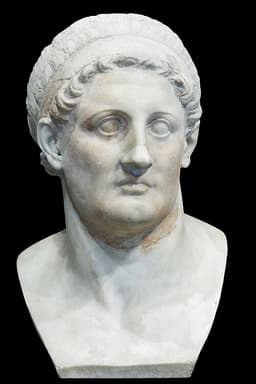
Ptolemy I Soter
Emperor · Ancient
66.2Total
Basic Information
Born
-1050
-367
Died
-1010
-283
Era
Ancient
Ancient
Nationality
Israel
Egypt
Occupation
Emperor
Emperor
Civilization
Middle Eastern
Middle Eastern
Score Comparison
Military (10%)
45.0
76.0
Political (20%)
35.1
75.0
Influence (20%)
57.2
40.0
Legacy (20%)
50.0
80.0
Leadership (15%)
48.4
75.0
Strategy (15%)
60.0
61.2
TOTAL
49.8
66.2
King Saul — Complete Timeline
1050 BC
Anointed as First King of IsraelPolitical Action
The prophet Samuel anointed Saul as the first king of the United Monarchy of Israel at Mizpah. This established the monarchy as a political institution, uniting the twelve tribes under a single ruler in response to Philistine threats.
MonarchyIsraelSamuel
Impact: nationalconstructive
1040 BC
Battle of MichmashWar◆ Major
Saul's son Jonathan initiated a surprise attack on a Philistine garrison at Michmash, leading to a full Israelite victory. Saul then rallied the army and routed the Philistines, temporarily securing Israel's central highlands from Philistine control.
PhilistinesBattleIsrael
Impact: national
1025 BC
Rejection by SamuelPolitical Action◆ Major
Samuel declared that God had rejected Saul as king after Saul failed to completely destroy the Amalekites and their livestock as commanded. This marked the beginning of Saul's decline and the rise of David as his successor.
ProphecyKingshipSamuel
Impact: nationaltragic
1010 BC
Battle of Mount GilboaWar
Saul and his sons, including Jonathan, were killed in battle against the Philistines at Mount Gilboa. The Philistines displayed Saul's armor in the temple of Ashtaroth and hung his body on the wall of Beth-shan, ending his reign.
DeathPhilistinesBattle
Impact: nationaltragic
Ptolemy I Soter — Complete Timeline
321 BC
Capture of Alexander's BodyPolitical Action◆ Major
Ptolemy I intercepted the funeral cortege of Alexander the Great and brought his body to Memphis, later to Alexandria. This act legitimized his rule over Egypt and made Alexandria a pilgrimage site, enhancing his prestige among the Diadochi.
DiadochiAlexanderEgypt
Impact: regionalconstructive
312 BC
Battle of GazaWar
Ptolemy I defeated Demetrius Poliorcetes, son of Antigonus I, at Gaza. This victory secured Ptolemy's control over Syria and Palestine temporarily, though he later lost these territories. The battle was part of the ongoing Wars of the Diadochi.
DiadochiBattleEgypt
Impact: regional
305 BC
Foundation of the Ptolemaic DynastyPolitical Action
Ptolemy I Soter declared himself king of Egypt, founding the Ptolemaic dynasty. He established a Greek-speaking monarchy that ruled Egypt for nearly 300 years, blending Greek and Egyptian cultures. His reign began the Hellenistic period in Egypt.
DiadochiEgyptHellenistic
Impact: regionalconstructive
295 BC
Founding of the Library of AlexandriaCultural◆ Major
Ptolemy I established the Library of Alexandria as part of the Musaeum, a center of learning. The library aimed to collect all known Greek works and became the largest and most famous library of the ancient world, fostering scholarship.
EgyptLibraryHellenistic
Impact: globalconstructive
Expert Analysis
Origins
King Saul, born around 1079 BCE, was the son of Kish, a wealthy Benjamite. Little is known of his early life before his anointing. He was a tall, physically imposing figure, described as head and shoulders above others. His background was agricultural, with no prior experience in governance. The prophet Samuel anointed him as Israel's first king around 1020 BCE, responding to the people's demand for a monarch to lead them against the Philistines.
Ptolemy I Soter was born around 367 BCE as the son of Lagus, a Macedonian nobleman, and Arsinoe, possibly related to the Macedonian royal family. He was a childhood friend and trusted general of Alexander the Great. Ptolemy grew up in the Macedonian court and received a Greek education. He participated in Alexander's campaigns from the outset, distinguishing himself in battles such as the Battle of Issus (333 BCE) and the Siege of Tyre (332 BCE).
Rise to Power
Saul's rise began when Samuel anointed him privately, followed by a public selection at Mizpah. After a victory over the Ammonites at Jabesh-Gilead (around 1020 BCE), Saul's kingship was confirmed by the people. His early reign saw military successes against the Philistines, notably his son Jonathan's initiative at Michmash (around 1010 BCE), which rallied the Israelite army. However, Saul's relationship with Samuel deteriorated after he failed to destroy the Amalekites completely, leading to Samuel's declaration that God had rejected Saul as king. This marked a turning point, as Samuel secretly anointed David as Saul's successor.
Ptolemy's rise was intertwined with Alexander's conquests. After Alexander's death in 323 BCE, Ptolemy seized Egypt as his satrapy. He cleverly intercepted Alexander's funeral cortege in 322 BCE, bringing his body to Egypt, which legitimized his rule. In 305 BCE, he declared himself king, founding the Ptolemaic dynasty. He consolidated power by defending Egypt against invasions, notably defeating Perdiccas in 321 BCE and later Demetrius Poliorcetes at the Battle of Gaza in 312 BCE. Ptolemy's political acumen (score 75.0) allowed him to navigate the Wars of the Diadochi successfully.
Leadership & Governance
Saul's leadership style was charismatic but impulsive. He ruled as a military chieftain, often leading armies personally. His governance was tribal and lacked institutional structure. He made decisions based on emotional reactions, such as when he swore a rash oath that nearly cost his son Jonathan's life after the Michmash victory. Saul's inability to delegate and his growing paranoia toward David undermined his reign. He spent his later years pursuing David rather than defending Israel.
Ptolemy I Soter was a pragmatic and visionary leader. He established a centralized bureaucracy blending Greek and Egyptian elements. He founded Alexandria as a cultural capital, creating the Library of Alexandria and the Musaeum, attracting scholars from across the Mediterranean. His political score of 75.0 reflects his ability to maintain stability through diplomacy and strategic marriages. He codified laws, promoted trade, and issued coinage that boosted the economy. Unlike other Diadochi, he avoided overextension, focusing on consolidating Egypt's borders.
Triumph & Tragedy
Saul's greatest triumph was unifying the Israelite tribes against external threats. He achieved significant victories, such as defeating the Philistines at Michmash and rescuing Jabesh-Gilead. However, his failures were profound: his disobedience regarding the Amalekites led to divine rejection; his jealousy toward David fractured the kingdom; and his final battle at Mount Gilboa (around 1010 BCE) ended in defeat, with Saul committing suicide to avoid capture. His legacy score of 50.0 reflects a mixed record.
Ptolemy's greatest success was founding a dynasty that ruled Egypt for nearly 300 years. He established a stable government, fostered culture, and expanded Egyptian influence. His military score of 76.0 includes victories that secured his realm. However, his failure to fully integrate Greek and Egyptian populations led to later tensions. His control over Syria and Palestine was temporary, lost after his death. Despite this, his legacy score of 80.0 is high for his lasting impact.
Character & Destiny
Saul was a tragic figure: courageous but insecure, obedient initially but prone to disobedience. His character—marked by impulsiveness, paranoia, and an inability to accept criticism—led to his downfall. Historical assessments, such as in 1 Samuel, portray him as a king who failed because he did not fully submit to divine will. His leadership score of 48.4 reflects these flaws.
Ptolemy was shrewd, patient, and intellectually curious. He was a capable general but preferred diplomacy and consolidation. His decision to write a history of Alexander's campaigns (now lost) shows his interest in legacy. He avoided the hubris of other Diadochi like Antigonus or Seleucus. His political score of 75.0 and leadership score of 75.0 reflect his balanced approach. He died peacefully in 283 BCE, passing the throne to his son.
Legacy
Saul's legacy is limited: he was the first king of Israel, but his reign ended in disaster. He is remembered as a cautionary tale of a leader who lost divine favor. The monarchy he founded was taken over by David, who established a lasting dynasty. Saul's influence score of 57.2 is modest; his story influenced later biblical narratives but had little direct impact beyond Israel.
Ptolemy's legacy is immense. He founded the Ptolemaic dynasty, which ruled Egypt until Cleopatra VII. The Library of Alexandria became a center of learning for centuries. His policies of Hellenization shaped the Mediterranean world. The Rosetta Stone, from later in his dynasty, enabled the decipherment of Egyptian hieroglyphs. His influence score of 40.0 is lower than expected due to his focus on Egypt rather than global conquest, but his legacy score of 80.0 underscores his enduring impact.
Conclusion
Ptolemy I Soter had a greater impact than King Saul. With a total score of 66.2 versus Saul's 49.8, Ptolemy outperformed in military (76.0 vs 45.0), political (75.0 vs 35.1), legacy (80.0 vs 50.0), and leadership (75.0 vs 48.4). While Saul's role as Israel's first king was significant, his reign was brief and ended in failure. Ptolemy built a dynasty that lasted centuries, founded a cultural capital, and shaped the course of Hellenistic history. The score gap of 16.4 points reflects a clear difference in long-term influence and governance success.
Rankings
🥇
Ptolemy I SoterLeader
Mil: 76.0Pol: 75.0Inf: 40.0
66.2
🥈
King Saul
Mil: 45.0Pol: 35.1Inf: 57.2
49.8
+16.4 behind
How This Comparison Works
Algorithm
Each figure is scored on 6 dimensions (0—100 scale) based on structured historical data: Military (10%), Political (20%), Influence (20%), Legacy (20%), Leadership (15%), Strategy (15%). The weighted total produces the final ranking.
Data Sources
Scores are computed from structured sub-indicators in the database. Scale factors adjust for era (Ancient ×0.85, Modern ×1.0) and civilization size (Eastern ×1.05, Other ×0.80) to account for differences in population and military scale.
Maximum 3 Figures
Comparisons are limited to 2—3 figures to ensure readability and statistical meaningfulness.
Error Margins
±5 points per dimension — Sub-scores are derived from historical records with inherent uncertainty. Two figures within 5 points on a dimension should be considered roughly equivalent in that area.
Total Score Accuracy
±3 points overall — The weighted combination of 6 dimensions produces a total score with approximately ±3 points of uncertainty. Differences of less than 3 points are not statistically significant— the figures are effectively tied.
Known Limitations
- Historical records are incomplete and uneven across civilizations
- Figures from oral-tradition societies may be underrepresented
- Occupation labels can misclassify multi-role figures
- Scores measure capability and impact, not moral character
- Quantitative scoring is a comparison tool, not absolute truth
Capability Radar
Military (10%) — Battles & Warfare
Battles
55
75
Win Rate
45
70
Expansion
40
85
Political (20%) — Governance & Reform
Reform
25
80
Diplomacy
35
85
Economy
30
90
Influence (20%) — Cultural & Global Reach
Cultural
55
85
Global
50
80
Legacy (20%) — Historical Impact
Historical
60
90
Longevity
65
85
Leadership (15%) — Power & Stability
Tenure
40
85
Stability
20
80
Strategy (15%) — Tactics & Innovation
Strategy
45
80
Tactics
50
65
Reform
30
60
Similar Comparisons
Comments & Discussion
No comments yet. Be the first to share your thoughts!