Loading...
Maximinus Thrax vs Ptolemy XII Auletes
Ptolemy XII Auletes leads by 4.4 pts · 2 figures compared
…
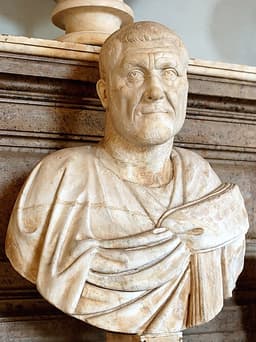
Maximinus Thrax
Emperor · Ancient
41.0Total

Ptolemy XII Auletes
Emperor · Ancient
45.4Total
Basic Information
Born
173
-117
Died
238
-51
Era
Ancient
Ancient
Nationality
Roman Empire
Egypt
Occupation
Emperor
Emperor
Civilization
Western
Middle Eastern
Score Comparison
Military (10%)
45.0
22.6
Political (20%)
26.4
37.9
Influence (20%)
47.9
53.3
Legacy (20%)
38.3
43.3
Leadership (15%)
33.6
62.2
Strategy (15%)
60.0
39.6
TOTAL
41.0
45.4
Maximinus Thrax — Complete Timeline
235 AD
Campaign against the AlemanniWar◆ Major
Maximinus led a campaign against the Alemanni tribe in Germania. He defeated them in battle and drove them back across the Rhine. He then devastated their territory, earning the title 'Germanicus Maximus' from the Senate.
Germanic WarsRhine FrontierMilitary Victory
Impact: regional
Accession as EmperorPolitical Action
Maximinus was proclaimed emperor by the Pannonian legions after the assassination of Severus Alexander. He was the first emperor to rise from the ranks of the army without any senatorial background, marking a shift in imperial power dynamics.
Imperial AccessionBarracks EmperorMilitary Coup
Impact: global
238 AD
Siege of AquileiaWar◆ Major
Maximinus marched on Italy to suppress a rebellion led by the Senate and the Gordians. He besieged the city of Aquileia, which resisted his army. The siege dragged on, and Maximinus's troops grew discontented with the lack of supplies and progress.
Civil WarSiegeItaly
Impact: regionaldestructive
Assassination by His Own TroopsPolitical Action◆ Major
Maximinus was assassinated in his tent by soldiers of the Legio II Parthica during the siege of Aquileia. His death ended his three-year reign. The Praetorian Guard and the Senate then recognized the new emperors Pupienus and Balbinus.
AssassinationMilitary MutinyEnd of Reign
Impact: nationaltragic
Ptolemy XII Auletes — Complete Timeline
80 BC
Accession as Pharaoh of EgyptPolitical Action◆ Major
Ptolemy XII Auletes became pharaoh of Egypt after the death of Ptolemy XI Alexander II. His reign was marked by political instability, economic decline, and increasing Roman influence. He was known for his pro-Roman policies and lavish spending.
AccessionPtolemaic DynastyRoman Influence
Impact: regional
58 BC
Exile from EgyptPolitical Action◆ Major
Ptolemy XII was driven from Egypt by a popular revolt, likely due to his heavy taxation and pro-Roman stance. He fled to Rome, where he sought support for his restoration. His daughter Berenice IV took the throne in his absence.
ExileRevoltRoman Support
Impact: regionaltragic
55 BC
Restoration to the ThronePolitical Action◆ Major
Ptolemy XII was restored to the Egyptian throne with military support from the Roman governor of Syria, Aulus Gabinius. The Roman army helped him defeat the forces of Berenice IV. He executed his daughter and resumed his pro-Roman policies.
RestorationRoman InterventionExecution
Impact: regionaldestructive
Will Naming Rome as GuardianPolitical Action◆ Major
Ptolemy XII made a will naming the Roman Republic as the guardian of his children and the Egyptian kingdom. This will later be used by Julius Caesar to justify Roman intervention in Egypt after Ptolemy's death, leading to the Alexandrian War.
WillRoman GuardianshipSuccession
Impact: regional
Expert Analysis
Origins
Maximinus Thrax was born around 173 AD in Thrace (modern Bulgaria) to a Gothic father and an Alanic mother. He grew up in a provincial village, likely of humble origins. His physical stature—reported as over 8 feet tall—and strength led him to join the Roman auxiliary forces, where he rose through the ranks due to his martial prowess. He served under emperors Septimius Severus and Alexander Severus, eventually commanding the Legio IV Italica.
Ptolemy XII Auletes was born around 117 BC into the Ptolemaic dynasty, the ruling family of Egypt. His father was Ptolemy IX Soter II, and his mother was likely Cleopatra IV. He was raised in the royal court of Alexandria, receiving a Greek education. He became pharaoh in 80 BC after the murder of Ptolemy XI Alexander II, but his reign was immediately contested due to his illegitimate birth (his mother was a concubine).
Rise to Power
Maximinus rose to prominence through military service. In 235 AD, during a campaign against the Germanic tribes, Emperor Severus Alexander was assassinated by his own troops. The Pannonian legions, impressed by Maximinus's leadership and physical strength, proclaimed him emperor. The Senate reluctantly confirmed him. His accession marked the first time a man of non-senatorial, barbarian background became Roman emperor, earning him the label 'first barracks emperor'.
Ptolemy XII's rise was more dynastic but equally fraught. He became pharaoh after the childless Ptolemy XI was killed by an Alexandrian mob. To secure his position, he married his cousin Cleopatra V Tryphaena. However, his reign was plagued by instability as he struggled to assert authority against the powerful priesthood and the Roman Republic, which increasingly dominated the eastern Mediterranean.
Leadership & Governance
Maximinus ruled as a military autocrat. He focused on military campaigns against Germanic tribes, achieving victories against the Alemanni and driving them across the Rhine. He financed his wars by confiscating senatorial property and imposing heavy taxes on cities, which alienated the elite. He never set foot in Rome, governing from military camps. His leadership scored 33.6, reflecting a style that prioritized army loyalty over civil administration.
Ptolemy XII was a shrewd but unpopular ruler. He secured his throne by paying massive bribes to Roman senators, including Julius Caesar and Pompey, to gain recognition. He imposed heavy taxes to finance these payments, leading to a revolt that forced him into exile in 58 BC. He was restored by Roman military force under Aulus Gabinius in 55 BC. His political score of 37.9 indicates his reliance on external support rather than domestic strength.
Triumph & Tragedy
Maximinus's greatest triumph was his successful campaign against the Alemanni, which secured the Rhine frontier. He also suppressed a revolt in Moesia. His tragedy came when he marched on Italy to crush a senatorial rebellion. He besieged Aquileia but faced supply shortages and disloyalty. In 238 AD, his own soldiers assassinated him in his tent, ending a three-year reign. His military score of 45.0 reflects mixed effectiveness.
Ptolemy XII's triumph was his restoration to the throne with Roman help, which allowed him to rule for another four years. He also fathered Cleopatra VII, who would become one of history's most famous queens. His tragedy was his subservience to Rome, which drained Egypt's wealth and set the stage for its eventual annexation. He died in 51 BC, leaving his children under Roman guardianship. His political score of 37.9 underscores his inability to maintain independence.
Character & Destiny
Maximinus was known for his immense size and strength, but also for his cruelty and suspicion. He executed many senators and officials, fearing conspiracies. His character led to isolation and ultimately betrayal by the troops he prioritized. Historical assessments note that his reign demonstrated the power of the army to make and unmake emperors.
Ptolemy XII was cunning and pragmatic, but also corrupt and weak. He prioritized personal survival over national interests, which earned him the nickname 'Auletes' (flute player) for his fondness for music and revelry. His character made him a pawn of Rome, and his decisions shaped Egypt's decline.
Legacy
Maximinus's legacy is as the archetypal barracks emperor, setting a precedent for military usurpation that plagued Rome for decades. His brief reign contributed to the Crisis of the Third Century. His legacy score of 38.3 reflects limited long-term impact.
Ptolemy XII's legacy is overshadowed by his daughter Cleopatra, but his actions directly enabled Roman intervention in Egypt. His will naming Rome as guardian of his children was used by Julius Caesar to justify intervention. His legacy score of 43.3 is higher because of his dynastic influence.
Conclusion
Ptolemy XII Auletes had a greater overall impact (total score 45.4 vs. 41.0). While Maximinus Thrax's military actions were immediate, Ptolemy's political maneuvers shaped the fate of Egypt and the rise of Cleopatra, affecting the course of Roman history. His leadership score (62.2) significantly exceeds Maximinus's (33.6), indicating more effective governance within his context. Therefore, Ptolemy XII is the more significant historical figure.
Rankings
🥇
Ptolemy XII AuletesLeader
Mil: 22.6Pol: 37.9Inf: 53.3
45.4
🥈
Maximinus Thrax
Mil: 45.0Pol: 26.4Inf: 47.9
41.0
+4.4 behind
How This Comparison Works
Algorithm
Each figure is scored on 6 dimensions (0—100 scale) based on structured historical data: Military (10%), Political (20%), Influence (20%), Legacy (20%), Leadership (15%), Strategy (15%). The weighted total produces the final ranking.
Data Sources
Scores are computed from structured sub-indicators in the database. Scale factors adjust for era (Ancient ×0.85, Modern ×1.0) and civilization size (Eastern ×1.05, Other ×0.80) to account for differences in population and military scale.
Maximum 3 Figures
Comparisons are limited to 2—3 figures to ensure readability and statistical meaningfulness.
Error Margins
±5 points per dimension — Sub-scores are derived from historical records with inherent uncertainty. Two figures within 5 points on a dimension should be considered roughly equivalent in that area.
Total Score Accuracy
±3 points overall — The weighted combination of 6 dimensions produces a total score with approximately ±3 points of uncertainty. Differences of less than 3 points are not statistically significant— the figures are effectively tied.
Known Limitations
- Historical records are incomplete and uneven across civilizations
- Figures from oral-tradition societies may be underrepresented
- Occupation labels can misclassify multi-role figures
- Scores measure capability and impact, not moral character
- Quantitative scoring is a comparison tool, not absolute truth
Capability Radar
Military (10%) — Battles & Warfare
Battles
55
10
Win Rate
50
10
Expansion
35
5
Political (20%) — Governance & Reform
Reform
15
20
Diplomacy
20
50
Economy
15
30
Influence (20%) — Cultural & Global Reach
Cultural
20
30
Global
25
30
Legacy (20%) — Historical Impact
Historical
30
40
Longevity
20
30
Leadership (15%) — Power & Stability
Tenure
20
60
Stability
10
20
Strategy (15%) — Tactics & Innovation
Strategy
40
10
Tactics
45
10
Reform
30
5
Similar Comparisons
Comments & Discussion
No comments yet. Be the first to share your thoughts!