Loading...
This comparison has not been analyzed yet.
One-time AI generation (~1 minute). Scores and timeline are already available below.
King Wu of Zhou vs Tiglath-Pileser I
King Wu of Zhou leads by 6.7 pts · 2 figures compared
…
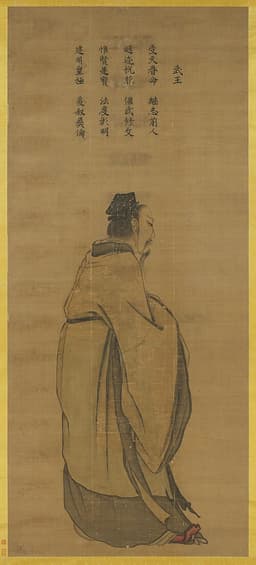
King Wu of Zhou
Emperor · Ancient
67.0Total

Tiglath-Pileser I
Emperor · Ancient
60.3Total
Basic Information
Born
-1076
-1114
Died
-1043
-1076
Era
Ancient
Ancient
Nationality
China
Assyria
Occupation
Emperor
Emperor
Civilization
Eastern
Middle Eastern
Score Comparison
Military (10%)
82.0
74.0
Political (20%)
55.0
68.0
Influence (20%)
65.0
55.7
Legacy (20%)
80.0
45.8
Leadership (15%)
51.9
72.0
Strategy (15%)
65.4
65.4
TOTAL
67.0
60.3
King Wu of Zhou — Complete Timeline
1046 BC
Battle of MuyeWar
King Wu of Zhou led a coalition of tribes and states to defeat the Shang army at Muye, near the Shang capital. The Shang king Zhou committed suicide, ending the Shang dynasty and establishing the Zhou dynasty as the ruling power in China.
Zhou DynastyBattleDynastic Change
Impact: regional
Founding of the Zhou DynastyPolitical Action◆ Major
King Wu established the Zhou dynasty, with its capital at Haojing (near modern Xi'an). He implemented the feudal system, granting land to relatives and allies, which became the basis for Zhou governance for centuries.
Zhou DynastyFoundingFeudal System
Impact: regionalconstructive
Distribution of FiefsPolitical Action◆ Major
King Wu divided the conquered Shang territories into fiefs granted to his brothers, allies, and descendants of earlier sage-kings. This system of enfeoffment created a network of semi-autonomous states loyal to the Zhou king.
Zhou DynastyFeudal SystemGovernance
Impact: regionalconstructive
Tiglath-Pileser I — Complete Timeline
1110 BC
Defeat of the MushkiWar◆ Major
Tiglath-Pileser I defeated the Mushki (Phrygians) who had invaded Assyrian territory from Anatolia. He claimed to have killed 20,000 of their warriors and driven them back, securing the northern frontier.
Military CampaignMushkiDefense
Impact: regional
1105 BC
Restoration of the Temple of AshurCultural◆ Major
Tiglath-Pileser I undertook the restoration and enlargement of the Temple of Ashur in the city of Ashur. He decorated it with precious materials and dedicated it to the god Ashur, reinforcing the religious center of the empire.
Temple RestorationReligious PatronageAssyrian Empire
Impact: nationalconstructive
1100 BC
Campaign to the MediterraneanWar◆ Major
Tiglath-Pileser I led a military campaign westward, reaching the Mediterranean Sea. He received tribute from Phoenician city-states such as Byblos, Sidon, and Arvad, extending Assyrian influence to the coast.
Military CampaignMediterraneanExpansion
Impact: regional
Hunting of Wild BullsCultural
Tiglath-Pileser I recorded hunting wild bulls in the region of the Euphrates River. He claimed to have killed four bulls and brought their hides and horns to the city of Ashur, demonstrating his prowess as a hunter.
HuntingRoyal ProwessAssyrian Annals
This comparison has not been analyzed yet.
One-time AI generation (~1 minute). Scores and timeline are already available below.
Rankings
🥇
King Wu of ZhouLeader
Mil: 82.0Pol: 55.0Inf: 65.0
67.0
🥈
Tiglath-Pileser I
Mil: 74.0Pol: 68.0Inf: 55.7
60.3
+6.7 behind
How This Comparison Works
Algorithm
Each figure is scored on 6 dimensions (0—100 scale) based on structured historical data: Military (10%), Political (20%), Influence (20%), Legacy (20%), Leadership (15%), Strategy (15%). The weighted total produces the final ranking.
Data Sources
Scores are computed from structured sub-indicators in the database. Scale factors adjust for era (Ancient ×0.85, Modern ×1.0) and civilization size (Eastern ×1.05, Other ×0.80) to account for differences in population and military scale.
Maximum 3 Figures
Comparisons are limited to 2—3 figures to ensure readability and statistical meaningfulness.
Error Margins
±5 points per dimension — Sub-scores are derived from historical records with inherent uncertainty. Two figures within 5 points on a dimension should be considered roughly equivalent in that area.
Total Score Accuracy
±3 points overall — The weighted combination of 6 dimensions produces a total score with approximately ±3 points of uncertainty. Differences of less than 3 points are not statistically significant— the figures are effectively tied.
Known Limitations
- Historical records are incomplete and uneven across civilizations
- Figures from oral-tradition societies may be underrepresented
- Occupation labels can misclassify multi-role figures
- Scores measure capability and impact, not moral character
- Quantitative scoring is a comparison tool, not absolute truth
Capability Radar
Military (10%) — Battles & Warfare
Battles
60
75
Win Rate
85
80
Expansion
70
80
Political (20%) — Governance & Reform
Reform
80
60
Diplomacy
75
65
Economy
60
55
Influence (20%) — Cultural & Global Reach
Cultural
85
50
Global
70
45
Legacy (20%) — Historical Impact
Historical
90
55
Longevity
95
40
Leadership (15%) — Power & Stability
Tenure
15
70
Stability
50
60
Strategy (15%) — Tactics & Innovation
Strategy
75
75
Tactics
70
70
Reform
65
65
Similar Comparisons
Comments & Discussion
No comments yet. Be the first to share your thoughts!