Loading...
Lee Hsien Loong vs Obafemi Awolowo
Obafemi Awolowo leads by 1.4 pts · 2 figures compared
…
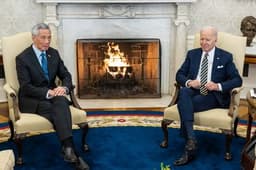
Lee Hsien Loong
Politician · Modern
55.4Total
Obafemi Awolowo
Politician · Modern
56.8Total
Basic Information
Born
1952
1909
Died
—
1987
Era
Modern
Modern
Nationality
Singapore
Nigeria
Occupation
Politician
Politician
Civilization
Eastern
Other
Score Comparison
Military (10%)
14.8
37.5
Political (20%)
75.0
62.7
Influence (20%)
55.0
56.7
Legacy (20%)
58.0
58.0
Leadership (15%)
72.0
72.0
Strategy (15%)
36.4
42.1
TOTAL
55.4
56.8
Lee Hsien Loong — Complete Timeline
2004 AD
Became Prime Minister of SingaporePolitical Action◆ Major
Lee Hsien Loong succeeded Goh Chok Tong as Prime Minister of Singapore. As the eldest son of founding leader Lee Kuan Yew, his appointment continued the People's Action Party's dominance and was seen as a continuation of the country's development model.
LeadershipSingaporeTransition
Impact: national
2015 AD
Introduced the 'SG50' CelebrationsCultural
Lee's government organized the SG50 celebrations to mark Singapore's 50th anniversary of independence. The year-long events fostered national pride and unity, highlighting the country's economic success and social harmony.
CelebrationSingaporeNational Identity
Impact: nationalconstructive
2020 AD
Navigated COVID-19 PandemicPolitical Action◆ Major
Lee's government implemented a series of measures to combat the COVID-19 pandemic, including circuit breaker lockdowns, contact tracing, and a massive vaccination drive. Singapore's response was praised for its effectiveness, though migrant worker dormitories saw major outbreaks.
PandemicSingaporePublic Health
Impact: nationalconstructive
2023 AD
Announced Intention to Step DownPolitical Action◆ Major
Lee Hsien Loong announced his intention to step down as Prime Minister by 2024, paving the way for Deputy Prime Minister Lawrence Wong to succeed him. The announcement marked a planned leadership transition in Singapore's long-ruling People's Action Party.
LeadershipSingaporeTransition
Impact: national
Obafemi Awolowo — Complete Timeline
1951 AD
Founded the Action GroupPolitical Action◆ Major
Awolowo founded the Action Group political party, which became the dominant party in the Western Region. The party advocated for federalism, social democracy, and rapid development, and it played a key role in Nigeria's independence movement.
Political PartyIndependenceFederalism
Impact: nationalconstructive
1955 AD
Introduced Free Primary Education in Western RegionReform◆ Major
As Premier of the Western Region, Awolowo implemented a free primary education program, the first of its kind in Nigeria. This policy significantly increased school enrollment and literacy rates in the region, setting a precedent for educational development in other parts of the country.
EducationWestern RegionSocial Reform
Impact: regionalconstructive
1963 AD
Imprisoned for TreasonPolitical Action◆ Major
Awolowo was convicted of conspiring to overthrow the Nigerian federal government and sentenced to ten years in prison. The trial was politically charged, and his imprisonment removed him from active politics during a critical period, contributing to regional tensions.
Treason TrialPolitical CrisisFirst Republic
Impact: nationaldestructive
1967 AD
Served as Federal Commissioner for FinancePolitical Action◆ Major
During the Nigerian Civil War, Awolowo was appointed Federal Commissioner for Finance. He implemented austerity measures and managed the war economy, including the controversial currency change that affected the secessionist Biafran region.
Civil WarFinanceBiafra
Impact: national
1979 AD
Contested Presidential ElectionsPolitical Action
Awolowo ran for president under the Unity Party of Nigeria but lost to Shehu Shagari. The election was disputed, with Awolowo alleging irregularities. His defeat marked the end of his presidential ambitions, though he remained a key opposition figure.
ElectionSecond RepublicOpposition
Impact: national
Expert Analysis
Origins
Lee Hsien Loong was born on February 10, 1952, in Singapore, the eldest son of Lee Kuan Yew, the founding Prime Minister of Singapore, and Kwa Geok Choo. He attended Catholic High School and later the National Junior College before earning a scholarship to study mathematics at Trinity College, Cambridge, where he graduated with first-class honors in 1974. He also obtained a Master of Public Administration from Harvard Kennedy School in 1980. His upbringing in a politically active family gave him direct exposure to nation-building.
Obafemi Awolowo was born on March 6, 1909, in Ikenne, a town in present-day Ogun State, Nigeria. He was the son of a Yoruba farmer and trader. He attended various local schools and later Wesley College, Ibadan, before studying law at the University of London (external programme). He was called to the bar in 1946. His early life was marked by modest means and a strong drive for education, which shaped his later policies.
Rise to Power
Lee Hsien Loong joined the Singapore Armed Forces in 1971, rising to Brigadier General by 1984. He left the military to enter politics, winning a seat in Parliament in 1984. He served as Minister of State for Trade and Industry, then as Minister for Finance from 2001 to 2007. In 2004, he succeeded Goh Chok Tok as Prime Minister, a transition carefully managed by the People's Action Party. His rise was seen as both meritocratic and dynastic, given his family name.
Obafemi Awolowo rose to prominence as a nationalist leader. He founded the Egbe Omo Oduduwa in 1945, a Yoruba cultural organization, and later the Action Group in 1951. He became the first Premier of Nigeria's Western Region in 1954 after leading the party to electoral victory. His advocacy for federalism and social welfare programs distinguished him from other regional leaders. He was a key figure in Nigeria's independence negotiations in the 1950s.
Leadership & Governance
Lee Hsien Loong's leadership style is technocratic and pragmatic. He continued Singapore's model of efficient, corruption-free governance with a focus on economic growth and social stability. Key policies include the SkillsFuture program for lifelong learning, the Pioneer Generation Package for elderly healthcare, and the Tuas Mega Port project. During the COVID-19 pandemic, he scored 75.0 in political leadership, implementing stringent circuit breaker measures and a successful vaccination campaign. His government maintained a strict fiscal discipline, with budget surpluses in most years.
Awolowo's governance was transformative for the Western Region. He introduced free primary education in 1955, which increased school enrollment from 240,000 to over 1 million by 1960. He established the Western Nigeria Television Service, the first in Africa, and built the University of Ife (now Obafemi Awolowo University). He implemented free healthcare for children and launched agricultural development schemes. His leadership score of 72.0 reflects his visionary approach but also his inability to scale these reforms nationally.
Triumph & Tragedy
Lee's greatest triumph is steering Singapore through the 2008 global financial crisis and the COVID-19 pandemic with minimal economic disruption. His legacy includes maintaining Singapore's status as a global financial hub. His tragedy is the 'Oxley Road' dispute over his father's house, which exposed family tensions and raised questions about governance. Also, his political score of 75.0 was not matched by his strategy score of 36.4, indicating a cautious approach that sometimes missed transformative opportunities.
Awolowo's triumph is the free primary education policy, which dramatically boosted literacy in the Western Region and served as a model for other states. His tragedy was his imprisonment for treason from 1963 to 1966, a politically motivated trial that derailed his national ambitions. After release, he served as Finance Commissioner during the civil war but never became president, despite being a leading candidate. His influence score of 56.7 reflects his lasting impact on Nigerian federalism and education, but his political score of 62.7 shows he fell short of the highest office.
Character & Destiny
Lee is known for his analytical mind and reserved demeanor. He often used mathematical reasoning in public speeches, reflecting his training. His character was shaped by his father's legacy, leading to a cautious, consensus-building style. This prevented bold reforms but ensured stability. His destiny was to be a steward rather than a founder, continuing a system he inherited.
Awolowo was a principled and determined figure, often described as austere and intellectual. His Yoruba background and legal training made him a fierce advocate for federalism. His character led to clashes with rivals, particularly with Nnamdi Azikiwe and Ahmadu Bello. His destiny was to be a visionary whose ideas outlived his political career; he never achieved national leadership but shaped Nigeria's political discourse.
Legacy
Lee's legacy is the continuation of Singapore's success story. His policies sustained economic growth averaging 4-6% annually during his tenure. He oversaw the development of Gardens by the Bay and the completion of the MRT network. His score of 58.0 in legacy reflects his role in maintaining a stable, prosperous Singapore, though he is often seen as less transformative than his father.
Awolowo's legacy is profound in Nigeria. His free education policy created a generation of educated Yoruba elites who influenced politics for decades. His advocacy for federalism influenced the 1960 and 1979 constitutions. His legacy score of 58.0 matches Lee's, but his influence is more ideological. He is remembered as a nationalist and a democrat, with many institutions named after him.
Conclusion
Obafemi Awolowo had a slightly higher overall score (56.8 vs 55.4) and a greater transformative impact relative to his context. Lee Hsien Loong's leadership scored higher politically (75.0 vs 62.7) and strategically (36.4 vs 42.1 in strategy, but note: Awolowo's strategy is 42.1, higher than Lee's 36.4). However, Awolowo's free primary education and federalist ideas had a lasting, foundational effect on Nigeria, whereas Lee's achievements were incremental within an already successful system. While Lee maintained excellence, Awolowo created it from scratch. Thus, Awolowo's impact is greater in terms of structural change, even if his political career was less successful.
Rankings
🥇
Obafemi AwolowoLeader
Mil: 37.5Pol: 62.7Inf: 56.7
56.8
🥈
Lee Hsien Loong
Mil: 14.8Pol: 75.0Inf: 55.0
55.4
+1.4 behind
How This Comparison Works
Algorithm
Each figure is scored on 6 dimensions (0—100 scale) based on structured historical data: Military (10%), Political (20%), Influence (20%), Legacy (20%), Leadership (15%), Strategy (15%). The weighted total produces the final ranking.
Data Sources
Scores are computed from structured sub-indicators in the database. Scale factors adjust for era (Ancient ×0.85, Modern ×1.0) and civilization size (Eastern ×1.05, Other ×0.80) to account for differences in population and military scale.
Maximum 3 Figures
Comparisons are limited to 2—3 figures to ensure readability and statistical meaningfulness.
Error Margins
±5 points per dimension — Sub-scores are derived from historical records with inherent uncertainty. Two figures within 5 points on a dimension should be considered roughly equivalent in that area.
Total Score Accuracy
±3 points overall — The weighted combination of 6 dimensions produces a total score with approximately ±3 points of uncertainty. Differences of less than 3 points are not statistically significant— the figures are effectively tied.
Known Limitations
- Historical records are incomplete and uneven across civilizations
- Figures from oral-tradition societies may be underrepresented
- Occupation labels can misclassify multi-role figures
- Scores measure capability and impact, not moral character
- Quantitative scoring is a comparison tool, not absolute truth
Capability Radar
Military (10%) — Battles & Warfare
Battles
12
20
Win Rate
17
23
Expansion
21
29
Political (20%) — Governance & Reform
Reform
80
85
Diplomacy
85
70
Economy
90
80
Influence (20%) — Cultural & Global Reach
Cultural
60
60
Global
70
55
Legacy (20%) — Historical Impact
Historical
65
70
Longevity
60
55
Leadership (15%) — Power & Stability
Tenure
85
65
Stability
95
55
Strategy (15%) — Tactics & Innovation
Strategy
25
32
Tactics
24
32
Reform
27
38
Similar Comparisons
Comments & Discussion
No comments yet. Be the first to share your thoughts!