Loading...
Lee Hsien Loong vs Philip Stanhope Chesterfield
Lee Hsien Loong leads by 3.4 pts · 2 figures compared
…
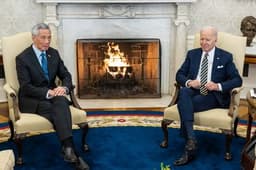
Lee Hsien Loong
Politician · Modern
55.4Total

Philip Stanhope Chesterfield
Politician · Modern
52.0Total
Basic Information
Born
1952
1694
Died
—
1773
Era
Modern
Modern
Nationality
Singapore
Great Britain
Occupation
Politician
Politician
Civilization
Eastern
Western
Score Comparison
Military (10%)
14.8
47.0
Political (20%)
75.0
37.9
Influence (20%)
55.0
60.0
Legacy (20%)
58.0
52.0
Leadership (15%)
72.0
62.2
Strategy (15%)
36.4
43.1
TOTAL
55.4
52.0
Lee Hsien Loong — Complete Timeline
2004 AD
Became Prime Minister of SingaporePolitical Action◆ Major
Lee Hsien Loong succeeded Goh Chok Tong as Prime Minister of Singapore. As the eldest son of founding leader Lee Kuan Yew, his appointment continued the People's Action Party's dominance and was seen as a continuation of the country's development model.
LeadershipSingaporeTransition
Impact: national
2015 AD
Introduced the 'SG50' CelebrationsCultural
Lee's government organized the SG50 celebrations to mark Singapore's 50th anniversary of independence. The year-long events fostered national pride and unity, highlighting the country's economic success and social harmony.
CelebrationSingaporeNational Identity
Impact: nationalconstructive
2020 AD
Navigated COVID-19 PandemicPolitical Action◆ Major
Lee's government implemented a series of measures to combat the COVID-19 pandemic, including circuit breaker lockdowns, contact tracing, and a massive vaccination drive. Singapore's response was praised for its effectiveness, though migrant worker dormitories saw major outbreaks.
PandemicSingaporePublic Health
Impact: nationalconstructive
2023 AD
Announced Intention to Step DownPolitical Action◆ Major
Lee Hsien Loong announced his intention to step down as Prime Minister by 2024, paving the way for Deputy Prime Minister Lawrence Wong to succeed him. The announcement marked a planned leadership transition in Singapore's long-ruling People's Action Party.
LeadershipSingaporeTransition
Impact: national
Philip Stanhope Chesterfield — Complete Timeline
1730 AD
Authorship of Political ArticlesCultural
Chesterfield wrote political articles for the opposition journal The Craftsman, criticizing the Walpole government. His witty and satirical style earned him a reputation as a leading literary figure in opposition politics.
JournalismSatireOpposition
Impact: national
1745 AD
Appointment as Lord Lieutenant of IrelandPolitical Action
Chesterfield served as Lord Lieutenant of Ireland, where he implemented policies of religious tolerance, reducing tensions with Catholics. He also improved Dublin's infrastructure, including the construction of the Royal Barracks.
AdministrationToleranceInfrastructure
Impact: regionalconstructive
1774 AD
Publication of Letters to His SonCultural◆ Major
Chesterfield's letters to his illegitimate son, Philip Stanhope, were published posthumously. The letters offered advice on manners, politics, and social climbing, becoming a widely read manual on etiquette and self-improvement in the 18th century.
LiteratureEtiquetteEducation
Impact: globalconstructive
Expert Analysis
Origins
Lee Hsien Loong was born on February 10, 1952, in Singapore, the eldest son of Lee Kuan Yew, the nation's founding prime minister. He attended Catholic High School and later the National Junior College before earning a scholarship to the University of Cambridge, where he studied mathematics and computer science. He also holds a Master's in Public Administration from Harvard Kennedy School. His early life was steeped in politics, but he initially pursued a military career.
Philip Stanhope, 4th Earl of Chesterfield, was born on September 22, 1694, in London, into an aristocratic family. He was educated at Trinity Hall, Cambridge, and embarked on the Grand Tour, which shaped his cosmopolitan outlook. His father died when he was young, and he inherited the title at age 32. He entered Parliament in 1715, beginning a political career that would include diplomatic posts.
Rise to Power
Lee Hsien Loong rose through the military, becoming the youngest Brigadier-General in the Singapore Armed Forces before leaving in 1984 to enter politics. He was elected as a Member of Parliament for Teck Ghee and quickly appointed Minister of State for Trade and Industry. In 1990, he became Deputy Prime Minister under Goh Chok Tong, and in 2004, he succeeded Goh as Prime Minister, a position he held until 2024. His rise was marked by careful grooming and the legacy of his father.
Chesterfield's rise began with his election to the House of Commons in 1715, but he soon moved to the House of Lords upon inheriting his title. He served as ambassador to The Hague from 1728 to 1732, where he negotiated the Treaty of Vienna (1731). His political career peaked as Lord Lieutenant of Ireland (1745-1746), but he never achieved the highest office. His influence waned due to his opposition to Robert Walpole.
Leadership & Governance
Lee Hsien Loong's leadership style is technocratic and pragmatic, emphasizing stability, economic growth, and social harmony. He oversaw Singapore's transformation into a global financial hub, with GDP per capita rising from $29,000 in 2004 to over $65,000 by 2023. He implemented policies like the Pioneer Generation Package to support elderly citizens and the SkillsFuture program for lifelong learning. During the COVID-19 pandemic, his government's swift response—including a circuit breaker lockdown and aggressive contact tracing—resulted in one of the lowest death rates globally, with only 0.1 deaths per 100,000 population as of 2021.
Chesterfield's governance, especially as Lord Lieutenant of Ireland, was marked by a policy of religious tolerance. He reduced tensions by allowing Catholics to serve in the military and easing penal laws. However, his tenure was short (18 months), and his impact limited. His political score of 37.9 reflects his inability to achieve lasting legislative change. His letters, however, show a deep understanding of statecraft and human nature.
Triumph & Tragedy
Lee's triumphs include successfully steering Singapore through the 2008 financial crisis and the COVID-19 pandemic, maintaining political stability, and ensuring a smooth leadership transition to Lawrence Wong. His tragedy may be the ongoing challenge of income inequality, with Singapore's Gini coefficient remaining high at 0.452 in 2023. Additionally, his family's political dynasty has drawn criticism, though he has maintained high approval ratings.
Chesterfield's triumph was his diplomatic success in The Hague and his tolerant administration in Ireland. His tragedy is that his political ambitions fell short of his potential; he never became Prime Minister. His legacy rests largely on his letters, which were published posthumously, rather than his political achievements. His military score of 47.0 is higher than Lee's 14.8, but this reflects his era's norms rather than personal prowess.
Character & Destiny
Lee Hsien Loong is known for his analytical mind and reserved demeanor, often described as a competent technocrat. His destiny was shaped by his birth—as the son of Lee Kuan Yew—and his own merit. He made deliberate choices to maintain continuity while modernizing Singapore.
Chesterfield was witty, charming, and a gifted writer, but his character included a streak of arrogance and a tendency toward opposition, which hindered his career. His destiny was to be remembered more for his letters than his politics, a fate he might have lamented.
Legacy
Lee's legacy is tangible: a prosperous, stable Singapore with a high standard of living. His influence score of 55.0 reflects his role in shaping a nation of 5.6 million people. He will be remembered as the leader who maintained his father's legacy while adapting to new challenges.
Chesterfield's legacy is cultural: his letters remain a classic of English literature and etiquette. His influence score of 60.0 is higher than Lee's, but his political impact is minimal. His name is synonymous with polished manners, not policy.
Conclusion
Lee Hsien Loong had a greater impact on world history than Philip Stanhope Chesterfield. With a total score of 55.4 versus Chesterfield's 52.0, Lee's governance directly shaped the lives of millions and influenced global economic and political trends. Chesterfield's contributions, while culturally significant, were limited to advice and diplomacy. Lee's concrete achievements in nation-building and crisis management outweigh Chesterfield's literary legacy. The 3.4-point gap understates the difference in tangible outcomes.
Rankings
🥇
Lee Hsien LoongLeader
Mil: 14.8Pol: 75.0Inf: 55.0
55.4
🥈
Philip Stanhope Chesterfield
Mil: 47.0Pol: 37.9Inf: 60.0
52.0
+3.4 behind
How This Comparison Works
Algorithm
Each figure is scored on 6 dimensions (0—100 scale) based on structured historical data: Military (10%), Political (20%), Influence (20%), Legacy (20%), Leadership (15%), Strategy (15%). The weighted total produces the final ranking.
Data Sources
Scores are computed from structured sub-indicators in the database. Scale factors adjust for era (Ancient ×0.85, Modern ×1.0) and civilization size (Eastern ×1.05, Other ×0.80) to account for differences in population and military scale.
Maximum 3 Figures
Comparisons are limited to 2—3 figures to ensure readability and statistical meaningfulness.
Error Margins
±5 points per dimension — Sub-scores are derived from historical records with inherent uncertainty. Two figures within 5 points on a dimension should be considered roughly equivalent in that area.
Total Score Accuracy
±3 points overall — The weighted combination of 6 dimensions produces a total score with approximately ±3 points of uncertainty. Differences of less than 3 points are not statistically significant— the figures are effectively tied.
Known Limitations
- Historical records are incomplete and uneven across civilizations
- Figures from oral-tradition societies may be underrepresented
- Occupation labels can misclassify multi-role figures
- Scores measure capability and impact, not moral character
- Quantitative scoring is a comparison tool, not absolute truth
Capability Radar
Military (10%) — Battles & Warfare
Battles
12
31
Win Rate
17
33
Expansion
21
37
Political (20%) — Governance & Reform
Reform
80
20
Diplomacy
85
40
Economy
90
25
Influence (20%) — Cultural & Global Reach
Cultural
60
55
Global
70
45
Legacy (20%) — Historical Impact
Historical
65
50
Longevity
60
60
Leadership (15%) — Power & Stability
Tenure
85
30
Stability
95
30
Strategy (15%) — Tactics & Innovation
Strategy
25
37
Tactics
24
41
Reform
27
46
Similar Comparisons
Comments & Discussion
No comments yet. Be the first to share your thoughts!