Loading...
Li Bian vs Ulugh Beg
Li Bian leads by 3.4 pts · 2 figures compared
…
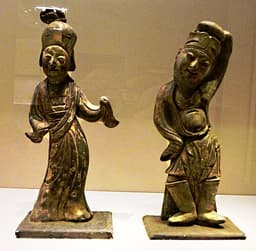
Li Bian
Emperor · Medieval
54.1Total

Ulugh Beg
Emperor · Medieval
50.7Total
Basic Information
Born
889
1394
Died
943
1449
Era
Medieval
Medieval
Nationality
China
Timurid Empire
Occupation
Emperor
Emperor
Civilization
Eastern
Middle Eastern
Score Comparison
Military (10%)
55.0
50.0
Political (20%)
68.0
37.9
Influence (20%)
58.0
68.0
Legacy (20%)
47.5
55.0
Leadership (15%)
40.0
41.5
Strategy (15%)
60.0
30.3
TOTAL
54.1
50.7
Li Bian — Complete Timeline
937 AD
Founded the Southern Tang DynastyPolitical Action
Li Bian, originally Xu Zhigao, usurped the throne from the Yang family of the Wu kingdom and proclaimed himself emperor of the Southern Tang dynasty. He established his capital at Jinling (Nanjing) and initiated a period of cultural and economic prosperity.
Dynasty FoundingSouthern TangUsurpation
Impact: regional
938 AD
Implemented Peaceful and Prosperous PoliciesReform◆ Major
Li Bian reduced taxes, promoted agriculture, and encouraged trade. He also patronized literature and the arts, attracting scholars to his court. His reign brought stability and relative peace to the Yangtze River region during the turbulent Five Dynasties period.
ReformsProsperityCultural Patronage
Impact: regionalconstructive
Ulugh Beg — Complete Timeline
1420 AD
Patronage of Mathematics and AstronomyCultural
Ulugh Beg gathered scholars like Al-Kashi and Qadi Zada al-Rumi at his court in Samarkand. He funded the study of mathematics, trigonometry, and astronomy, making Samarkand a leading scientific center of the 15th century.
SciencePatronageSamarkand
Impact: regionalconstructive
1424 AD
Construction of the Ulugh Beg ObservatoryInvention◆ Major
Ulugh Beg built a large observatory in Samarkand, equipped with a 40-meter sextant. He used it to compile the Zij-i Sultani, a star catalog of over 1,000 stars, which was the most accurate in the world for 250 years.
AstronomyScienceSamarkand
Impact: globalconstructive
1437 AD
Publication of the Zij-i SultaniCultural◆ Major
Ulugh Beg published the Zij-i Sultani, a star catalog and astronomical tables. It corrected errors in Ptolemy's Almagest and provided accurate positions of stars and planets, influencing later astronomers like Copernicus and Tycho Brahe.
AstronomyScienceStar Catalog
Impact: globalconstructive
1447 AD
Accession as Timurid SultanPolitical Action◆ Major
Upon the death of his father Shah Rukh, Ulugh Beg became the ruler of the Timurid Empire, based in Samarkand. His reign was short and marked by conflict with his nephew Abd al-Latif and other rivals.
SuccessionTimurid EmpireSamarkand
Impact: regional
1449 AD
Defeat and Execution by Abd al-LatifPolitical Action
Ulugh Beg was defeated in battle by his son Abd al-Latif, who had rebelled against him. He was captured and executed on Abd al-Latif's orders, ending his reign. His death marked the decline of the Timurid Empire.
DeathCivil WarTimurid Decline
Impact: regionaltragic
Expert Analysis
Origins
Li Bian (born 888) was an orphan who rose from obscurity. He was adopted by the Wu kingdom's regent, Xu Wen, and took the name Xu Zhigao. His humble beginnings shaped his pragmatic and cautious approach to governance. Ulugh Beg (born 1394) was the grandson of Timur (Tamerlane) and son of Shah Rukh. Raised in the Timurid court, he received a privileged education in science and the arts, which fostered his lifelong passion for astronomy.
Rise to Power
Li Bian's rise was gradual and strategic. After Xu Wen's death, he consolidated power within the Wu court, outmaneuvering rivals. In 937, he forced the last Wu emperor to abdicate and proclaimed himself emperor of the Southern Tang dynasty, adopting the name Li Bian. Ulugh Beg became governor of Samarkand in 1409 under his father Shah Rukh. Upon Shah Rukh's death in 1447, he ascended as Timurid sultan, but his rule was immediately challenged by his son Abd al-Latif.
Leadership & Governance
Li Bian focused on internal stability and prosperity. He reduced taxes, promoted agriculture, and encouraged trade, earning him a reputation as a benevolent ruler. He also patronized literature and the arts, attracting scholars to his court. His leadership score of 40.0 reflects his cautious, non-expansionist style. Ulugh Beg was a less effective political leader, scoring 37.9. He prioritized scientific patronage over military and administrative duties, leading to unrest. He built the Samarkand observatory and gathered scholars like Al-Kashi, but his governance suffered from neglect.
Triumph & Tragedy
Li Bian's greatest triumph was founding the Southern Tang dynasty and creating a peaceful, prosperous state. His tragedy was that his successors failed to maintain his policies, leading to the dynasty's collapse. Ulugh Beg's triumph was the Zij-i Sultani, a star catalog of over 1,000 stars with unprecedented accuracy. His tragedy was his defeat and execution by his son Abd al-Latif in 1449, ending his reign and scientific work.
Character & Destiny
Li Bian was cautious, patient, and focused on long-term stability. His character suited his era of fragmented kingdoms. Ulugh Beg was intellectually driven but politically naive. His passion for science alienated him from his court and family, leading to his downfall. Historians note that his assassination was a direct result of his neglect of power dynamics.
Legacy
Li Bian's Southern Tang dynasty endured only three decades, but his administrative reforms influenced later Chinese states. He is remembered as a wise founder. Ulugh Beg's astronomical work had a lasting impact. The Zij-i Sultani was used by later astronomers, including Copernicus. The observatory's ruins remain a UNESCO World Heritage site. His legacy in science far outshines his political achievements.
Conclusion
While Li Bian scored higher overall (54.1 vs 50.7), Ulugh Beg's contributions to astronomy have had a more enduring global impact. Li Bian's political stability was limited to his region and time, whereas Ulugh Beg's star catalog influenced the Scientific Revolution. Therefore, Ulugh Beg had greater long-term impact.
Rankings
🥇
Li BianLeader
Mil: 55.0Pol: 68.0Inf: 58.0
54.1
🥈
Ulugh Beg
Mil: 50.0Pol: 37.9Inf: 68.0
50.7
+3.4 behind
How This Comparison Works
Algorithm
Each figure is scored on 6 dimensions (0—100 scale) based on structured historical data: Military (10%), Political (20%), Influence (20%), Legacy (20%), Leadership (15%), Strategy (15%). The weighted total produces the final ranking.
Data Sources
Scores are computed from structured sub-indicators in the database. Scale factors adjust for era (Ancient ×0.85, Modern ×1.0) and civilization size (Eastern ×1.05, Other ×0.80) to account for differences in population and military scale.
Maximum 3 Figures
Comparisons are limited to 2—3 figures to ensure readability and statistical meaningfulness.
Error Margins
±5 points per dimension — Sub-scores are derived from historical records with inherent uncertainty. Two figures within 5 points on a dimension should be considered roughly equivalent in that area.
Total Score Accuracy
±3 points overall — The weighted combination of 6 dimensions produces a total score with approximately ±3 points of uncertainty. Differences of less than 3 points are not statistically significant— the figures are effectively tied.
Known Limitations
- Historical records are incomplete and uneven across civilizations
- Figures from oral-tradition societies may be underrepresented
- Occupation labels can misclassify multi-role figures
- Scores measure capability and impact, not moral character
- Quantitative scoring is a comparison tool, not absolute truth
Capability Radar
Military (10%) — Battles & Warfare
Battles
30
20
Win Rate
35
20
Expansion
40
10
Political (20%) — Governance & Reform
Reform
65
40
Diplomacy
55
25
Economy
60
35
Influence (20%) — Cultural & Global Reach
Cultural
50
70
Global
30
65
Legacy (20%) — Historical Impact
Historical
45
75
Longevity
40
70
Leadership (15%) — Power & Stability
Tenure
60
30
Stability
55
20
Strategy (15%) — Tactics & Innovation
Strategy
45
15
Tactics
40
15
Reform
50
10
Similar Comparisons
Comments & Discussion
No comments yet. Be the first to share your thoughts!