Loading...
Louis XV vs Philip IV of Spain
Philip IV of Spain leads by 8.8 pts · 2 figures compared
…
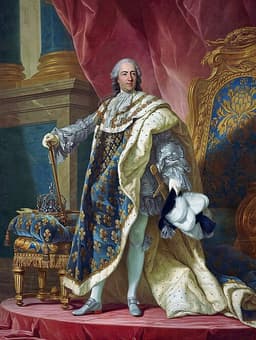
Louis XV
Emperor · Modern
48.2Total

Philip IV of Spain
Emperor · Modern
57.0Total
Basic Information
Born
1710
1605
Died
1774
1665
Era
Modern
Modern
Nationality
France
Spain
Occupation
Emperor
Emperor
Civilization
Western
Western
Score Comparison
Military (10%)
55.0
25.9
Political (20%)
39.4
30.8
Influence (20%)
54.9
82.0
Legacy (20%)
42.5
56.0
Leadership (15%)
53.2
65.7
Strategy (15%)
45.0
54.8
TOTAL
48.2
57.0
Louis XV — Complete Timeline
1740 AD
War of the Austrian SuccessionWar◆ Major
Louis XV involved France in the War of the Austrian Succession, supporting Prussia against Austria. French forces achieved victories at Fontenoy (1745) but failed to secure lasting gains. The war drained French finances and ended with the inconclusive Treaty of Aix-la-Chapelle.
WarEuropean ConflictDynastic Struggle
Impact: global
1748 AD
Treaty of Aix-la-Chapelle (1748)Political Action◆ Major
Louis XV signed the Treaty of Aix-la-Chapelle, ending the War of the Austrian Succession. France gained little from the war despite military successes, returning conquered territories including the Austrian Netherlands. The treaty was seen as a diplomatic failure and contributed to the decline of royal prestige.
TreatyWar of the Austrian SuccessionDiplomacy
Impact: global
1756 AD
Seven Years' War (French and Indian War)War
Louis XV led France into the Seven Years' War against Great Britain and Prussia. The war resulted in France losing most of its North American colonies (New France) and its influence in India. The Treaty of Paris (1763) confirmed these losses, severely weakening French colonial power.
Colonial WarLoss of TerritorySeven Years' War
Impact: globaldestructive
1771 AD
Suppression of the ParlementsPolitical Action◆ Major
Louis XV, advised by Chancellor Maupeou, abolished the Parlements (high courts) that had opposed royal tax reforms. This authoritarian move centralized power but alienated the nobility and legal classes, creating long-term opposition to the monarchy.
Judicial ReformAbsolutismParlements
Impact: nationaldestructive
Philip IV of Spain — Complete Timeline
1618 AD
Outbreak of the Thirty Years' War involvementWar◆ Major
Spain under Philip IV continued its involvement in the Thirty Years' War, fighting to maintain Habsburg hegemony in Europe. The war drained Spanish resources and led to military defeats, contributing to the decline of Spanish power.
WarHabsburgDecline
Impact: globaldestructive
1621 AD
Appointment of Gaspar de Guzmán as chief ministerPolitical Action◆ Major
Upon ascending the throne, Philip IV appointed the Count-Duke of Olivares as his chief minister. This decision placed the direction of Spanish policy in Olivares's hands for over two decades, shaping the kingdom's domestic and foreign affairs.
GovernmentAppointmentOlivares
Impact: national
1623 AD
Patronage of Diego VelázquezCultural◆ Major
Philip IV appointed Diego Vel
ArtPatronageGolden Age
Impact: globalconstructive
1640 AD
Revolt of CataloniaWar◆ Major
Catalonia rebelled against Philip IV's rule, triggered by centralizing policies and the burden of war. The revolt lasted until 1652, weakening the Spanish monarchy and leading to a prolonged conflict that further strained the kingdom's finances.
RevoltCataloniaCentralization
Impact: regionaldestructive
Loss of PortugalWar
Portugal declared independence from Spain, ending the Iberian Union that had existed since 1580. Philip IV's forces failed to suppress the rebellion, and the loss of Portugal marked a significant territorial and prestige blow to the Spanish Empire.
IndependencePortugalIberian Union
Impact: regionaltragic
1648 AD
Peace of WestphaliaPolitical Action
Spain under Philip IV signed the Peace of Westphalia, ending the Eighty Years' War with the Dutch Republic. Spain recognized Dutch independence, marking the end of Spanish dominance in Europe and the beginning of its decline as a great power.
TreatyDutch IndependenceDecline
Impact: global
1665 AD
Death of Philip IVOther◆ Major
Philip IV died, leaving a weakened Spanish Empire to his young son Charles II. His reign had seen the peak and decline of Spanish power, with economic troubles, military defeats, and territorial losses marking the end of the Spanish Golden Age.
DeathSuccessionDecline
Impact: national
Expert Analysis
Origins
Louis XV (1710–1774) was the great-grandson of Louis XIV, born at Versailles into a family devastated by smallpox. His father, the Dauphin Louis, died in 1711, and his mother, Marie Adélaïde of Savoy, in 1712, leaving the orphan prince to be raised by tutors under the regency of Philippe d'Orléans. His education emphasized piety and divine-right rule, but he lacked the discipline of his predecessor. Philip IV of Spain (1605–1665) was born in Valladolid, son of Philip III and Margaret of Austria. Raised in the rigid Habsburg court, he received a Jesuit education focused on piety, hunting, and the arts. Unlike Louis, Philip was groomed for kingship from birth, yet he inherited a sprawling empire already strained by war and economic decline.
Rise to Power
Louis XV became king at age five in 1715, with Philippe d'Orléans ruling as regent until 1723. The young king's early years were marked by the collapse of John Law's Mississippi Company (1720) and the War of the Quadruple Alliance (1718–1720). He assumed personal rule in 1723, guided by his tutor Cardinal Fleury until Fleury's death in 1743. Louis's involvement in the War of the Austrian Succession (1740–1748) brought French victories at Fontenoy (1745) but little territorial gain, as the Treaty of Aix-la-Chapelle (1748) returned conquered lands. Philip IV ascended the throne in 1621 at age sixteen, immediately dismissing the Duke of Lerma's faction and appointing Gaspar de Guzmán, Count-Duke of Olivares, as his chief minister. Olivares centralized power and pursued aggressive Habsburg policies, plunging Spain into the Thirty Years' War (1618–1648) and the war with the Dutch Republic. Philip's reign began with hopes of restoring Spanish prestige, but his reliance on Olivares set the stage for overextension.
Leadership & Governance
Louis XV's governance style was one of personal indolence and delegation to favorites. He allowed ministers like Cardinal Fleury and later the Duke of Choiseul to manage affairs, but interfered unpredictably. His attempt to centralize tax collection by suppressing the Parlements in 1771 (the Maupeou reform) backfired, alienating the nobility and judiciary. Louis scored 39.4 in political acumen, reflecting his failure to build consensus. Philip IV, by contrast, delegated to Olivares until 1643, when he dismissed the count-duke and attempted to rule personally. However, Philip lacked administrative talent; his military score of 25.9 reflects the disastrous outcomes of his wars. Both rulers presided over declining empires, but Philip's Spain lost Portugal (1640) and recognized Dutch independence (1648), while Louis's France lost Canada and India (1763).
Triumph & Tragedy
Louis XV's greatest triumph was the expansion of French influence in Europe through the War of the Austrian Succession, where French arms achieved a decisive victory at Fontenoy (1745). However, the Seven Years' War (1756–1763) was a catastrophe: France lost Canada, the Ohio Valley, and its Indian possessions to Britain, and its navy was destroyed. The Diamond Necklace Affair, though posthumous, tarnished the monarchy. Philip IV's triumphs include the patronage of Diego Velázquez, whose paintings such as Las Meninas (1656) defined the Spanish Golden Age. Militarily, Spanish forces held the Spanish Road and suppressed revolts in Italy. Yet the loss of Portugal in 1640 and the Peace of Westphalia (1648) marked the end of Spanish hegemony. The Thirty Years' War drained Spanish treasure, leading to repeated bankruptcies (1627, 1647, 1652).
Character & Destiny
Louis XV was intelligent but lazy, preferring hunting and mistresses to statecraft. His secret diplomacy (the Secret du Roi) undermined his own ministers. His indecisiveness and lack of discipline allowed factions to paralyze government. Philip IV was melancholic and devout, deeply influenced by Olivares. After Olivares's fall, he struggled to govern, relying on a junta of nobles. Both kings inherited overextended empires and failed to adapt. Louis's character led to a decline in royal prestige, while Philip's piety and patronage of the arts could not halt Spain's economic collapse.
Legacy
Louis XV's reign is remembered as the nadir of the French monarchy, setting the stage for the French Revolution. His political score of 39.4 and leadership of 53.2 reflect a king who failed to modernize. Philip IV's legacy is more mixed: his cultural patronage (Velázquez, Calderón) earned him an influence score of 82.0, but his military and political failures (25.9 and 30.8) left Spain a second-rate power. The loss of Portugal and the Dutch Republic's independence reshaped Europe. Philip's total score of 57.0 exceeds Louis's 48.2.
Conclusion
Philip IV of Spain had greater impact than Louis XV, despite his lower military and political scores. Philip's reign witnessed the formal end of Spanish dominance in Europe through the Peace of Westphalia and the loss of Portugal, events that redefined the balance of power. Louis XV's France, though militarily stronger, failed to capitalize on its potential and squandered opportunities. Philip's influence on art and culture endures, while Louis's legacy is one of decay. Thus, Philip's total score of 57.0 versus Louis's 48.2 reflects a more consequential, if tragic, reign.
Rankings
🥇
Philip IV of SpainLeader
Mil: 25.9Pol: 30.8Inf: 82.0
57.0
🥈
Louis XV
Mil: 55.0Pol: 39.4Inf: 54.9
48.2
+8.8 behind
How This Comparison Works
Algorithm
Each figure is scored on 6 dimensions (0—100 scale) based on structured historical data: Military (10%), Political (20%), Influence (20%), Legacy (20%), Leadership (15%), Strategy (15%). The weighted total produces the final ranking.
Data Sources
Scores are computed from structured sub-indicators in the database. Scale factors adjust for era (Ancient ×0.85, Modern ×1.0) and civilization size (Eastern ×1.05, Other ×0.80) to account for differences in population and military scale.
Maximum 3 Figures
Comparisons are limited to 2—3 figures to ensure readability and statistical meaningfulness.
Error Margins
±5 points per dimension — Sub-scores are derived from historical records with inherent uncertainty. Two figures within 5 points on a dimension should be considered roughly equivalent in that area.
Total Score Accuracy
±3 points overall — The weighted combination of 6 dimensions produces a total score with approximately ±3 points of uncertainty. Differences of less than 3 points are not statistically significant— the figures are effectively tied.
Known Limitations
- Historical records are incomplete and uneven across civilizations
- Figures from oral-tradition societies may be underrepresented
- Occupation labels can misclassify multi-role figures
- Scores measure capability and impact, not moral character
- Quantitative scoring is a comparison tool, not absolute truth
Capability Radar
Military (10%) — Battles & Warfare
Battles
45
20
Win Rate
40
15
Expansion
20
5
Political (20%) — Governance & Reform
Reform
20
10
Diplomacy
30
20
Economy
25
15
Influence (20%) — Cultural & Global Reach
Cultural
40
75
Global
30
55
Legacy (20%) — Historical Impact
Historical
35
60
Longevity
30
60
Leadership (15%) — Power & Stability
Tenure
80
55
Stability
20
10
Strategy (15%) — Tactics & Innovation
Strategy
30
10
Tactics
35
10
Reform
25
5
Similar Comparisons
Comments & Discussion
No comments yet. Be the first to share your thoughts!