Loading...
Luis Alberto Lacalle vs Manmohan Singh
Manmohan Singh leads by 10.5 pts · 2 figures compared
…
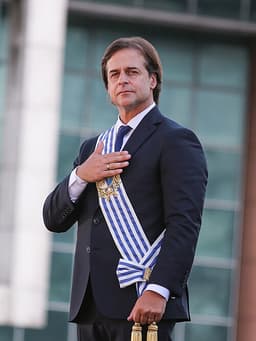
Luis Alberto Lacalle
Politician · Modern
50.7Total

Manmohan Singh
Politician · Modern
61.2Total
Basic Information
Born
1941
1932
Died
—
—
Era
Modern
Modern
Nationality
Uruguay
India
Occupation
Politician
Politician
Civilization
Western
Indian
Score Comparison
Military (10%)
50.0
27.4
Political (20%)
68.0
72.0
Influence (20%)
55.7
62.0
Legacy (20%)
45.0
58.0
Leadership (15%)
40.0
78.0
Strategy (15%)
42.9
60.0
TOTAL
50.7
61.2
Luis Alberto Lacalle — Complete Timeline
1989 AD
Elected President of UruguayPolitical Action◆ Major
Luis Alberto Lacalle was elected president of Uruguay in the 1989 general election as the National Party candidate, defeating the Colorado Party. His victory ended 122 years of Colorado Party dominance in the presidency.
ElectionNational PartyEnd of Colorado Dominance
Impact: nationalconstructive
1990 AD
Implemented Neoliberal Economic ReformsReform◆ Major
Lacalle implemented a series of neoliberal reforms, including trade liberalization, deregulation, and privatization of state-owned enterprises. The reforms aimed to modernize the economy but faced opposition from labor unions and led to increased unemployment.
Economic ReformNeoliberalismPrivatization
Impact: nationalconstructive
1991 AD
Signed the Treaty of AsunciónPolitical Action◆ Major
Lacalle signed the Treaty of Asunci
Regional IntegrationTrade BlocMercosur
Impact: regionalconstructive
1992 AD
Faced Referendum on State ReformsPolitical Action
Lacalle's government faced a referendum in December 1992 on several state reform laws, including privatization of state enterprises. Voters rejected the reforms, dealing a political setback to Lacalle's agenda.
ReferendumPrivatizationPolitical Setback
Impact: nationaldestructive
Manmohan Singh — Complete Timeline
2004 AD
Appointed Prime Minister of IndiaPolitical Action◆ Major
Manmohan Singh became the 13th Prime Minister of India, leading the United Progressive Alliance (UPA) coalition. He was the first Sikh to hold the office and served two full terms until 2014.
Indian PoliticsUPASikh Prime Minister
Impact: nationalconstructive
Presided Over High Economic Growth PeriodOther◆ Major
During Singh's tenure, India experienced an average GDP growth rate of over 8% per year, lifting millions out of poverty. The growth was driven by economic reforms initiated in the 1990s and global demand.
Economic GrowthDevelopmentGDP
Impact: nationalconstructive
2005 AD
Implemented National Rural Employment Guarantee Act (NREGA)Reform◆ Major
Singh's government enacted NREGA, guaranteeing 100 days of wage employment per year to rural households. The program became one of India's largest social welfare schemes, reducing rural poverty but facing implementation challenges.
Social WelfareRural EmploymentNREGA
Impact: nationalconstructive
2008 AD
Signed US-India Civil Nuclear AgreementPolitical Action
Singh's government finalized the US-India Civil Nuclear Agreement, ending India's nuclear isolation and allowing civilian nuclear trade. The deal faced political opposition but was passed after a confidence vote.
Nuclear DealUS-India RelationsEnergy Policy
Impact: globalconstructive
2010 AD
Faced 2G Spectrum Scandal AllegationsPolitical Action◆ Major
Singh's government was embroiled in the 2G spectrum allocation scandal, with allegations of underpricing leading to revenue loss. The Supreme Court later cancelled 122 licenses, and the scandal damaged the government's reputation.
Corruption2G ScandalTelecom
Impact: nationaldestructive
Expert Analysis
Origins
Luis Alberto Lacalle de Herrera was born on July 13, 1941, in Montevideo, Uruguay, into a politically prominent family. His great-uncle was former president Luis Alberto de Herrera. Lacalle studied law at the University of the Republic and entered politics early, becoming a deputy in 1972. During the 1973-1985 dictatorship, he was briefly imprisoned but later resumed his political career, serving as a senator and then as president.
Manmohan Singh was born on September 26, 1932, in Gah, Punjab (now in Pakistan), into a Sikh family. He studied at Punjab University, then at Cambridge (BA in Economics) and Oxford (DPhil). He was an academic and civil servant, serving as chief economic adviser, governor of the Reserve Bank of India, and finance minister before becoming prime minister.
Rise to Power
Lacalle rose within the National Party, winning the presidency in the 1989 general election with 37% of the vote, defeating the Colorado Party after 22 years of Colorado rule. His campaign focused on economic reform and anti-corruption. He took office on March 1, 1990.
Singh's rise was unconventional. As finance minister in 1991, he initiated economic liberalization, dismantling the License Raj and opening India to foreign investment. His success led to his appointment as prime minister in 2004 after the Congress-led coalition won the election. He served two terms from 2004 to 2014.
Leadership & Governance
Lacalle pursued neoliberal reforms: trade liberalization, deregulation, and privatization of state enterprises. He signed the Treaty of Asunción in 1991, creating Mercosur with Argentina, Brazil, and Paraguay. His governance was technocratic but faced strong opposition. A 1992 referendum rejected key privatization laws, reflecting public discontent. His political score of 68.0 reflects modest success amid constraints.
Singh, an economist, presided over India's high-growth period (average 8% GDP annually). He implemented the National Rural Employment Guarantee Act (NREGA), providing 100 days of work to rural households, and the Right to Information Act. He also signed the US-India Civil Nuclear Agreement in 2008, ending India's nuclear isolation. His leadership score of 78.0 reflects steady governance, though coalition pressures limited his autonomy.
Triumph & Tragedy
Lacalle's triumph was Mercosur, which boosted regional trade and integration. His tragedy was the 1992 referendum defeat, which stalled his reform agenda and weakened his political capital. His legacy score of 45.0 indicates limited long-term impact.
Singh's triumph was economic transformation: lifting millions from poverty and integrating India globally. His tragedy was the 2G spectrum scandal, where his government faced allegations of underpricing, leading to Supreme Court intervention. Singh's personal integrity remained untarnished, but the scandal damaged his administration's reputation. His influence score of 62.0 reflects his role as a respected technocrat.
Character & Destiny
Lacalle was pragmatic and reform-oriented, but his policies faced public resistance. His character—determined yet politically isolated—led to mixed results. He scored 42.9 in strategy, reflecting a focused but contested approach.
Singh was introverted and intellectual, often seen as a prime minister guided by coalition dynamics. His calm demeanor and consensus-building allowed long-term reforms, but he was criticized for being passive on corruption. His strategy score of 60.0 indicates effective but cautious leadership.
Legacy
Lacalle's legacy is tied to Mercosur, which remains a key regional bloc. However, his domestic reforms were largely reversed. He is remembered as a transitional figure in Uruguay's return to democracy.
Singh's legacy is more profound: he is credited with India's economic rise, the nuclear deal, and social welfare programs. His tenure set India on a path of sustained growth. He scored 58.0 in legacy, reflecting his transformative impact.
Conclusion
Manmohan Singh had greater impact. His economic reforms reshaped India's trajectory, lifting over 200 million people out of poverty and integrating India into the global economy. Lacalle's Mercosur was significant but regional, and his domestic reforms stalled. Singh's total score of 61.2 versus Lacalle's 50.7 reflects his broader influence and lasting legacy.
Rankings
🥇
Manmohan SinghLeader
Mil: 27.4Pol: 72.0Inf: 62.0
61.2
🥈
Luis Alberto Lacalle
Mil: 50.0Pol: 68.0Inf: 55.7
50.7
+10.5 behind
How This Comparison Works
Algorithm
Each figure is scored on 6 dimensions (0—100 scale) based on structured historical data: Military (10%), Political (20%), Influence (20%), Legacy (20%), Leadership (15%), Strategy (15%). The weighted total produces the final ranking.
Data Sources
Scores are computed from structured sub-indicators in the database. Scale factors adjust for era (Ancient ×0.85, Modern ×1.0) and civilization size (Eastern ×1.05, Other ×0.80) to account for differences in population and military scale.
Maximum 3 Figures
Comparisons are limited to 2—3 figures to ensure readability and statistical meaningfulness.
Error Margins
±5 points per dimension — Sub-scores are derived from historical records with inherent uncertainty. Two figures within 5 points on a dimension should be considered roughly equivalent in that area.
Total Score Accuracy
±3 points overall — The weighted combination of 6 dimensions produces a total score with approximately ±3 points of uncertainty. Differences of less than 3 points are not statistically significant— the figures are effectively tied.
Known Limitations
- Historical records are incomplete and uneven across civilizations
- Figures from oral-tradition societies may be underrepresented
- Occupation labels can misclassify multi-role figures
- Scores measure capability and impact, not moral character
- Quantitative scoring is a comparison tool, not absolute truth
Capability Radar
Military (10%) — Battles & Warfare
Battles
26
46
Win Rate
32
49
Expansion
34
49
Political (20%) — Governance & Reform
Reform
45
85
Diplomacy
60
70
Economy
50
90
Influence (20%) — Cultural & Global Reach
Cultural
30
40
Global
45
60
Legacy (20%) — Historical Impact
Historical
40
65
Longevity
30
50
Leadership (15%) — Power & Stability
Tenure
55
75
Stability
40
65
Strategy (15%) — Tactics & Innovation
Strategy
40
50
Tactics
40
55
Reform
43
60
Similar Comparisons
Comments & Discussion
No comments yet. Be the first to share your thoughts!